MINERAL OF THE MONTH: September 2014 – Black Corundum

Corundum is a crystalline form of aluminum oxide (Al2O3) with traces of iron, titanium and chromium. It can be found as a component in rocks as well as in pure crystal form. It is one of the naturally transparent materials, but can have different colors when impurities are present. Transparent specimens are used as gems — Ruby and Sapphire. which are scientifically the same mineral but just different colors. Ruby is red and Sapphire is the variety that encompasses all other colors, although the most popular and valued color of Sapphire is blue.

Because of corundum’s hardness (pure corundum is has a hardness of 9.0 Mohs), it can scratch almost every other mineral. It is commonly used as an abrasive on everything from sandpaper to large machines. Corundum is the third hardest natural mineral known to science. The hardest mineral, diamond is four times harder than corundum. The second hardest is Moissanite (Silicon Carbide) at 9.25. The hardness of corundum can be partially attributed to the strong and short oxygen-aluminum bonds. These bonds pull the oxygen and aluminum atoms close together, making the crystal not only hard but also quite dense for a mineral made up of two relatively light elements.

Corundum can be found in stream and beach sands because of its hardness and resistance to weathering. The largest documented single natural crystal of corundum ever found measures about 65×40×40 cm (26×16×16 in), and weighs 152 kg (335 lb).

Corundum can not only be artificially synthesized, but even natural gem stones are often heat treated to enhance their color.

The specimen featured in the picture above was acquired from Pierre Trudel, who recently visited the Gitche Gumee Museum from Quebec, Canada. The smaller specimen shown in close up detail below was donated by Pierre.

Below are a couple of close up photos that I took of this specimen of black corundum.

Metaphysical Properties

According to the web page http://www.mineralminers.com/html/corminfo.htm#metaphysical-corundum-information , “Corundum is said to enhance one’s creativity, self-confidence, awareness, intuition and ambition. It is also said to help release negative emotions in constructive ways while giving give inner peace.”

CITES:

History’s Gem of the Month: Michigan Beach Stones By Robert W. Kelley

September 2014

NOTE: Last May I purchased a small rock collection from a woman in Gwinn, MI. The collection belonged to her husband, who passed away a decade ago. This information sheet was included in the collection. The source is unknown.

OUR GREAT LAKES SHORELINES ARE TREASURE-LADEN WITH A HOST OF TRULY fascinating gem materials—not only hard-to-find agates, but also easy-to-find chert, jasper, granite, quartz, arid basalt. Though more plentiful around Lake Superior, the common varieties may be found most anywhere. No special training is needed for rock collecting. Just look for colors and patterns that please you. You’re the judge. It’s as simple as that. The variety of stones is infinite. Seldom are two precisely alike, so giving them names is also difficult. Unlike plants and animals, classes of stone grade one into another. Divisions are purely arbitrary based upon subtle differences in chemistry and texture. Sometimes, identity is difficult to establish, even in the laboratory!

One note about beach combing along Michigan’s Great Lakes: To walk on the exposed strip of dry beach, you should obtain the consent of the property owner. His rights extend to the edge of the water regardless of water level fluctuations. Permission is not required, however, if you wade in the water, just off the beach. The submerged bottom lands of the Great Lakes are public, owned by all of us together. Now, turn the page and see some of the beautiful stones awaiting you on our beaches. The specimens are reproduced at one-half their true size. Photography is by John R. Byerlay and Robert W. Kelley of the Geological Survey Division, Illustration is by Jim Campbell, and the specimens are shown through the courtesy of Warren and Dorothy Kelley, Calumet, Michigan.

Description of Stones Shown In This Folder

  1. AMYGDALOID (Greek: “almond”)—Pebbles of basalt, or lava, with almond-shaped cavities created by gas bubbles trapped beneath the crust of a once molten rock flow. Green “amygdules” are chrysocolla: red, analcite. Note copper amygdules in pebble nearest upper left corner.
  2. NATIVE COPPER — Michigan’s “honor mineral.” Specimens found in old mine waste piles usually have a green patina coating; when polished the bright copper color emerges.
  3. NATIVE SILVER— Lake Superior copper is noted for its silver content that imparts “superior” qualities for many uses. Hammered nuggets of inter-mixed copper and silver are called half-breeds.
  4. LAKE SUPERIOR AGATES—Typical beach specimens. Besides their inherent hardness and fine lustre, concentric banding is a definite clue to the identity of two of these specimens. The specimen on the right, however, might easily go unnoticed.
  5. LAKE SUPERIOR AGATES—A string of tumbled round agates of the size most commonly found.
  6. LAKE SUPERIOR AGATES—cut and polished gem stones collected at various beaches from Ontonagon to Sault Ste. Marie.
  7. HONEYCOMB CORAL—the original limey skeleton of this fossil has been replaced by silica (quartz).
  8. JACOBSVILLE SANDSTONE — not considered a lapidary material, but sometimes weathering processes cement the grains into a compact mass that takes a fairly good polish.
  9. PREHNITE—a member of the zeolite mineral group, which also includes thomsonite, chlorastrolite, and an alcite, common to the Copper Country. See the minute flecks of copper?
  10. BRECCIA (Italian: stone fragments)—Angular pieces of basalt fragmented in a zone of violent rock breakage and re cemented with other minerals, often quartz or calcite.
  11. JASPILITE—a specimen of iron formation in which the usual red iron oxide coloring has been weathered to ochre-colored limonite.
  12. CONGLOMERATE — an aggregation or “conglomeration” of rounded pebbles cemented together by other mineral matter.
  13. RHYOLITE — red to brown fine-grained type of igneous rock.
  14. QUARTZ—with green epidote and red jasper.
  15. QUARTZ—with red jasper.
  16. EPIDOTE—in basalt.
  17. BRECCIA— Fragments of basalt cemented by milky quartz with traces of red jasper.
  18. EPIDOTE—in basalt.
  19. BRECCIA—Fragments of basalt cemented by milky quartz with traces of green epidote.
  20. FINE-GRAINED GRANITE — contains small interlocked grains of clear quartz and flesh-colored feldspar.
  21. JASPILITE—Interbanded red jasper and grey hematite. The ever-increasing production of iron from occurrences of this ore is a vital factor in Michigan’s economy.
  22. PETOSKEY STONE — fossil colony coral.
  23. RAW BEACH STONES — a collection of various hard unpolished pebbles, typical of Lake Superior shores, but also found elsewhere to a lesser extent. True cherts are usually white, pale brown, brownish yellow, red grey, sometimes black, and occasionally green. In all cases, however, they consist of a dense, non-crystalline water-deposited form of silica that takes an exceedingly high polish. Colors are the result of other mineral impurities: iron oxide imparts the red color; green pebbles (basalts) are colored by epidote; glassy white to grey stones with frosted surfaces are usually vein quartz, a crystal line variety of silica.
  24. THOMSONITE—Exquisite shades of pink and green with a radiant fibrous structure.
  25. CHLORASTROLITE—the famous Lake Superior gem, “greenstone”.
  26. TUMBLED BEACH STONES—Same as in group No. 23, except the inherent beauty of their colors and textures has been enhanced by tumbling.
  27. RHYOLITE — A fine-grained igneous rock shaped into a convex gem form known as a cabochon. The group of four banded reddish brown pebbles immediately beneath are also rhyolite.
  28. CHERT—with small orbs of red jasper.
  29. CHERT—just chert, but most unusual and pleasing gem specimens.
  30. DATOLITE — often very colorful, and though not as hard as either agate or chert, takes a superb polish because of its very dense texture. Unusual, too, because it contains the element boron. Rarely occurs on beaches, but the two yellow pebbles were picked up on a Keweenaw beach fifty paces apart—and they’re mates!

CURRENT GRAND MARAIS SCENES: September 2014

I would like to thank everyone again for the positive comments about the pictures I post on the blog at www.agatelady.blogspot.com, as well as those I put on my personal Facebook page at https://www.facebook.com/karen.brzys?ref=tn_tnmn Sometimes, but not always, I duplicate a few of the photos between the two pages. This helps save time, plus there are different people who visit the two web pages.

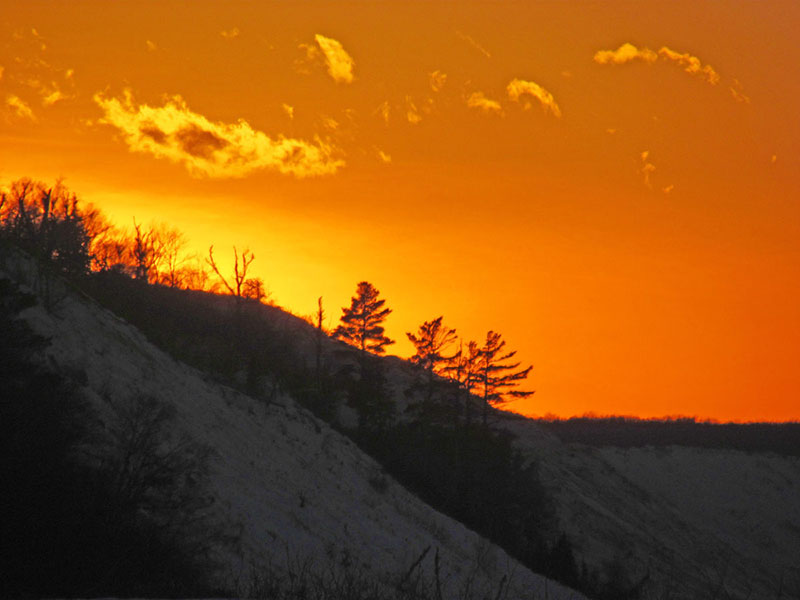
For this web page update, I have selected some of my favorite sunset pictures. Beginning early spring, the sun sets far enough to the northwest that we finally get to see it peek out from behind Au Sable Point. We can seemingly see the sun dip to the horizon until the sun again sets behind Au Sable Point in the fall. This year there was floating ice on the lake into June, so I was able to get some interesting sunset photos.

The photo below shows some of the floating ice. This picture was taken on May 28th.

Many of you know that I am passionate about the Grand Sable Dunes. The picture below was taken from the middle of the dunes.

Of course, I have to include a beach photo. The picture below was taken around six miles east of Grand Marais.


CUSTOMER AGATE FINDS: April 2014

Since winter has hit the Grand Marais area with a vengeance, there has been little to no agate hunting these past few months. Once in a while there is a minute patch of gravel drudged up by moving ice, especially during the early winter and early spring. Sure enough, when I was trekking down the beach with friends, Jamey and Lois Fite, Jamey found a small little agate chipper on December 1st.

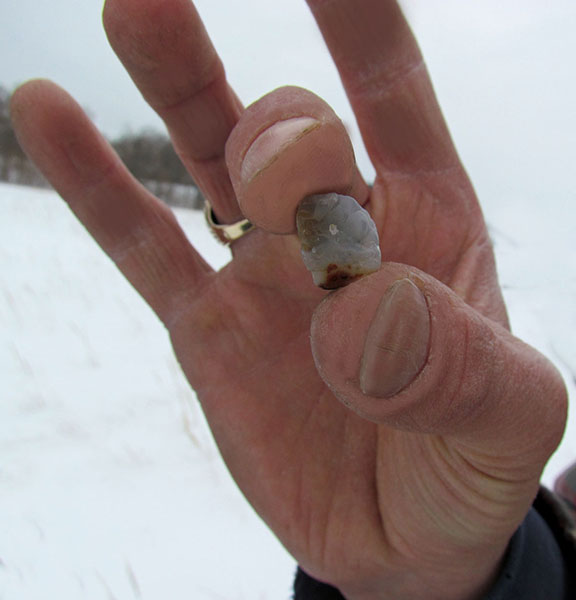
In March I received an email from Cheryl Haessig. The text in the email: “Hi, came across this agate in a display that came from Grand Marais Michigan. Believe he bought it from your shop a couple of years ago. Cheryl Haessig (frequent summer visitor to Grand Marais)”

This was one of the museum founder’s agates that I decided to sell.

For the rest of the photos included in this web page update, I am including some of the close up pictures I took using my USB microscope camera. The detail is amazing.

Let’s start with a couple close ups of Lake Superior agates.

Next: Argentina Condor agate.

Equally magnificent are these photos of a Montana Dry Head agate.

Finally last, but certainly not least, a couple pictures of an Australian Queensland shadow agate.


ROCKHOUNDING AND ADVENTURE TRIPS: Arizona – 2014

Last year I did not drive out west because I was working on the online rockhounding classes. So this year I decided that I had to make the drive – all 6,285 miles of it.

Thanks to friend, Helen Riley, for flying out to Arizona to share the adventure, which included hiking the Grand Canyon and Sedona. I also visited the Petrified Forest and the Painted Desert.

First, a few Grand Canyon photos.

A couple of Painted Desert photos…..

I really enjoyed the Petrified Forest.

We went on eight different hikes in the Sedona area. They were all different, but all awesome.

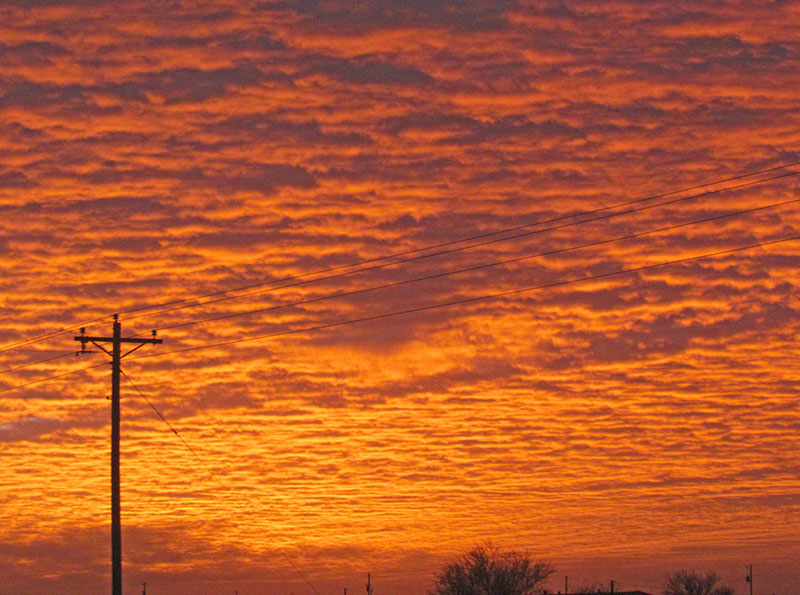
On my way back east, I stopped in Albuquerque for a few days. Thanks to the Hannishs for their hospitality. When I left early one morning, I caught this sunrise glow as I drove over the mountains east of Albuquerque.

MINERAL OF THE MONTH: April 2014 – Tiger’s Eye

Tiger’s eye (also called Tigers eye or Tiger eye) is an unusual quartz rock that forms when silica replaces a fibrous form of blue asbestos (crocidolite). Rocks that form under this replacement process are called pseudomorphs. It comes in various colors, but is naturally golden in color. Red tigers eye stones are manipulated with heat treatment. Darker tigers eye has been altered using nitric acid.

Here is a picture of natural, untreated, unpolished tigers eye.

Tigers eye is especially known for its chatoyancy. Chatoyant minerals are comprised of tubes or fibers that form in a perpendicular arrangement. When light hits these rocks, a luminous streak of light is reflected perpendicular to the direction of the fibers, imitating the look of a feline’s eye.

Notable sources of tiger’s eye include Australia, Burma, India, Namibia, South Africa, United States, Brazil, Canada, China, Korea, and Spain.

Tigers eye is thought to be one of the most protective stones. It can also promote balance, clear emotions, promote a positive attitude, and encourage calmness and peaceful disposition.

CITES:

History’s Gem of the Month: Souvenir View Book of Sault Ste. Marie

April 2014

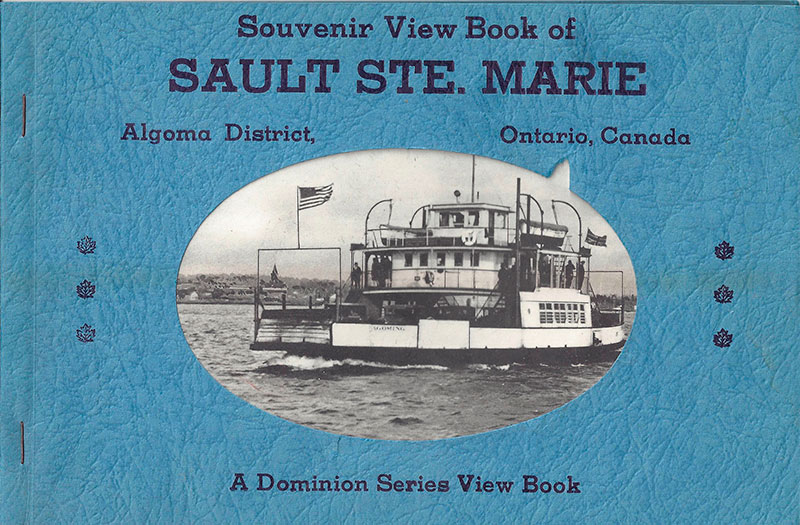
Thanks to my friend, Jill Phillips, I was able to borrow a souvenir book published during the 1930s by Photogeletins Engraving Co., Toronto, Canada. It is one of the Dominion Series books that this company published.

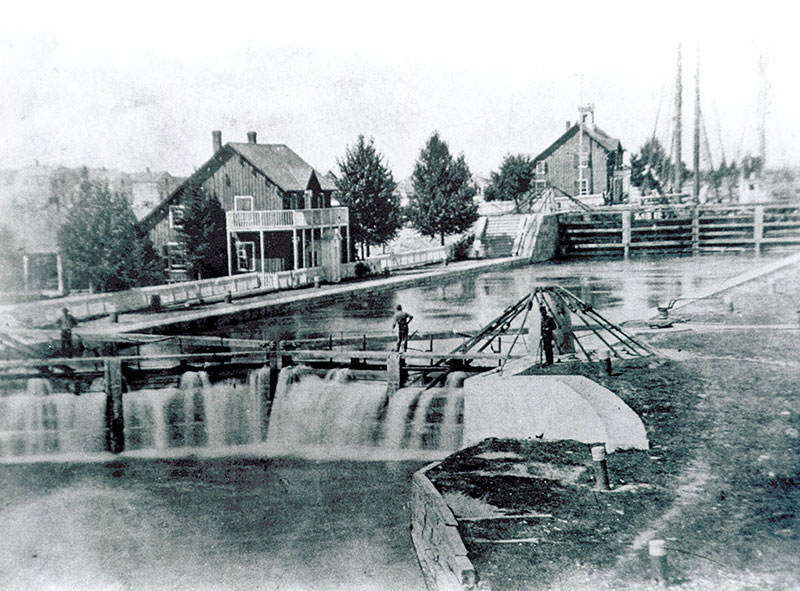
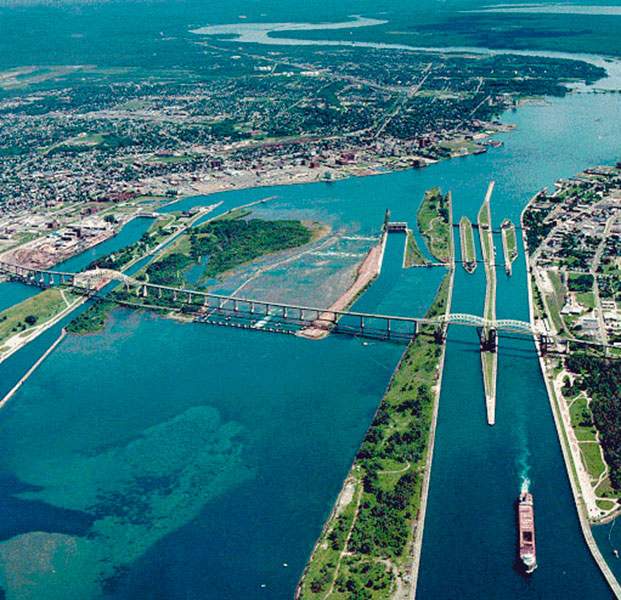
The Soo Locks (pronounced “soo”) are a set of shipping locks arranged parallel to each other. These locks enable ships, sailboats, and other vessels to travel through the St. Marys River between Lake Superior and Lake Huron, traversing between the United States and Canada. The locks allow boats and ships to bypass the rapids of the river, where the water falls 21 feet (7 m).

According to the web page http://www.guideoftravels.com “Sault Ste. Marie’s … the oldest city in Michigan. It’s where Ojibwa settled to fish the productive rapids, and where the French established a busy fur-trading post, and it’s also why the Soo Locks were built—the first one completed in 1855—to finally tame those rapids and open Lake Superior’s vast mineral riches to shipping.”

The locks pass an average of 10,000 ships per year, despite being closed during the winter from January through March, when ice shuts down shipping on the Great Lakes. The winter closure period is used to inspect and maintain the locks. According to the Army Corps of Engineers, the freight transported through the Soo Locks exceeds that of the Panama and Suez canals put together, making it the busiest waterway in the world.

A couple of the photos of the locks from the souvenir booklet are below.

The locks share a name with the two cities named Sault Ste. Marie, situated in Ontario and in Michigan, located on either side of the St. Marys River. The Sault Ste. Marie International Bridge permits vehicular traffic to pass over the locks.

The U.S. locks form part of a 1.6-mile (2.6-km) canal, which is owned and maintained by the United States Army Corps of Engineers. Although these locks are not inexpensive to operate, the locks, provides free passage.

The current configuration consists of four parallel lock chambers, each running east to west; starting at the Michigan shoreline and moving north toward Ontario, these are:

  • The MacArthur Lock, built in 1943. It is 800 feet (244 m) long, 80 feet (24 m) wide, and 29.5 feet (9 m) deep.
  • The Poe Lock, originally completed on August 3, 1895. The first ship to pass through was the passenger ship Majestic in September 1895. It was re-built in 1968, after the Saint Lawrence Seaway opened. It is 1,200 feet (366 m) long, 110 feet (34 m) wide, and 32 feet (10 m) deep.
  • The Davis Lock, built in 1914. It is 1,350 feet (411 m) long, 80 feet (24 m) wide, and 23.1 feet (7 m) deep.
  • The Sabin Lock, built in 1919. It is 1,350 feet (411 m) long, 80 feet (24 m) wide, and 23.1 feet (7 m) deep.

The Davis and Sabin locks have been slated for replacement since 1986 with a new ‘Super-Lock’, which would provide a second lock capable of accommodating the “lakers”. Groundbreaking for the new lock project was held on June 30, 2009, but no work has continued since funding has not been appropriated.

A single small lock is currently operated on the Canadian side of the Soo. Opened in 1998, it was built within a damaged older lock, and is 77 meters (253 ft) long, 15.4 meters (51 ft) wide and 13.5 meters (44 ft) deep. The Canadian lock is used for recreational and tour boats;

CITES:

CURRENT GRAND MARAIS SCENES: April 2014

I would like to thank everyone again for the positive comments about the pictures I post on the blog at www.agatelady.blogspot.com, as well as those I put on my personal Facebook page at https://www.facebook.com/karen.brzys?ref=tn_tnmn Sometimes, but not always, I duplicate a few of the photos between the two pages. This helps save time, plus there are different people who visit the two web pages.

For this web page update, I have selected some of my favorite pictures taken during the winter months. This has been quite a winter. It has been many years since Lake Superior has been as frozen as it was this year. I am hearing conflicting information about just how much snow we received, but it is close to 300 inches, if not more. Since we never had a thaw this winter, the snow just kept piling up. We are hoping that the initial formation of shore ice, followed by early winter movement of the ice around Lake Superior, and hopefully ending up with significant ice movement on the lake during the spring breakup – will bring new agates to the south shore. Time will tell.

The winter season started early. As the surface of the lake starts to freeze, pancake ice forms. The channel connecting Grand Marais Bay with Lake Superior is the best place to see pancake ice formations.


Next are a series of photos of Grand Marais lighthouses taken over the course of the winter.

I think the Grand Sable Dunes are more beautiful in the winter when you get the contrasting colors of various shades of white and brown.


As the wind shifts during the winter, it blows the ice back and forth around Lake Superior. Occasionally the ice breaks under the load and piles up. These ice sections are up to 20 feet in diameter.


Here are a couple of winter shoreline photos. The first was taken east of town; the second west of town.

Snow, snow, and more snow.

During the depth of the winter, the sun sets to the southwest. We always know spring is coming when the position of the setting sun starts to move toward and beyond Au Sable Point.


CUSTOMER AGATE FINDS: November 2013

This has been a really weird year for agate hunting in Grand Marais. Since there was moving ice on Lake Superior last winter that brought new rock to our shore and dredged up other rock that was laying just off shore – rock hunting in the early spring was terrific. Since then we have had periodic storms on Lake Superior that have not been cooperative. These November-like gales now happen any month of the year and serve to undertow rocks back out into the lake or cover those at the high water mark with sand. There have been days when beaches that historically have been covered with rock have had none. In early August, even the beach in front of Woodland Park right in Grand Marais basically had no rock.

The chaotic condition of the shoreline has continuously moved rock up and down the beach as well as down shore. Successful agate hunters have had to be patient and spread their search sites out to find the beaches that do have rock. This has not been easy since the location of beaches with rock seems to change on a daily basis. But thankfully, many great agates have been found this year including at least two that are over four pounds. One of these I did not get a chance to see. The other one I did not see originally when it was found in September by a beginning agate hunter, but I did get to see it the other night. It was found by Alesia Joki from Appleton, WI. She was up with Gary Darling, who has been giving her agate hunting tips. This 4.5 beauty shown below does not have many intricate bands, but does have awesome white floater bands as well as extremely complex agate formation transition zones and cool botryoidal formations in the center fill. It was found just off shore in two feet of water in front of Woodland Park. It was sitting by itself on “smiling” up at Alesia.

Allison from Charlevoix, MI found this intricate beauty and brought it into the museum the end of August.

Regular agate hunters Brian and Regina stopped by my booth at the Muskellunge Lake State Park show in September. I did not get close up photos of the agates.

Char Kramer from Zeeland, MI also stopped by my booth at the Muskellunge show. She showed off this Lake Superior eye agate that she found in the Grand Marais area and then tumbled.

But then Char asked me to identify the specimen shown below that she found in the Keweenaw Peninsula. Apparently she showed this specimen to several dealers. Half of us said it is thomsonite. The other half said it is prehnite. I guess in some ways we were all right. Most of the prehnite found in the Keweenaw has a characteristic pale-green to white color, but some specimens are mottled in pink and green. The pink prehnite superficially resembles thomsonite with a radiating fibrous habit that appears to have occasional “eyes.” The pink color of the prehnite is due to internal reflections from finely disseminated native copper inclusions, and the color intensity is related to the distribution, abundance, and grain size of the inclusions. In some cases this pink prehnite is referred to as “U.P. thomsonite.”

Although Claudia lives in southeast Michigan during the winter, she and her husband spend most of the summer camping in Woodland Park. Most days Claudia can be seen scouring the beach in front of Woodland Park. Here are some of her agates…..

Debra Spatrisan from St. Johns, MI, found this intricate shadow agate in Grand Marais in August.

Eric from Grand Haven, MI found this agate in Grand Marais in September. The center fill of this agate has some amethyst.

Several people either sent me photos or came into the museum with agates that they found down state. Greg found the agates shown below in Osceola County. The red one certainly looks like a Lake Superior agate that perhaps was dragged south by the glaciers. The other specimen looks more like an agate that formed in sedimentary matrix rock.

Oftentimes I hear about agates before they are brought into the museum. That is the case for this nice 12 ounce beach-worn agate found by Dirk and Heidi Hughes from Holland, MI. They found it near the mouth of the Two Hearted river.

Now that my friend, Jill, and her husband have bought property in Grand Marais, she gets to spend a lot more time agate hunting. Here are a few of her treasures…..

John Buffone from Sault Ste. Marie, Ontario spends time agate hunting all along the Lake Superior shoreline, both in Canada and in the U.S. He has found some whole nodules and rescued them from their basaltic matrix. He also acquired some old stock specimens that were taken out of the matrix basalt on Michipocoten Island (located in the northeastern part of Lake Superior) many decades ago.

Katrina Smalley found this lacey paintstone agate in early September. She is from Columbiaville, MI.

Marilynn comes to Grand Marais agate hunting multiple times during the year. Here is an interesting tube agate that she found toward the end of the summer.

Sally in Claudia’s sister-in-law. Believe it or not, they are married to identical twin brothers. Sally and Claudia are quite the pair and enjoy agate hunting together. Here is “mother-child” pair of agates that Sally found east of Grand Marais.

Unfortunately the photo I took of the eye agate shown below is not quite in focus. But I do not want to slight Sue Hoholik from Manistique, who found this agate in Grand Marais during the middle of August.


MINERAL OF THE MONTH: November 2013 – Skip-an-Atom Agate

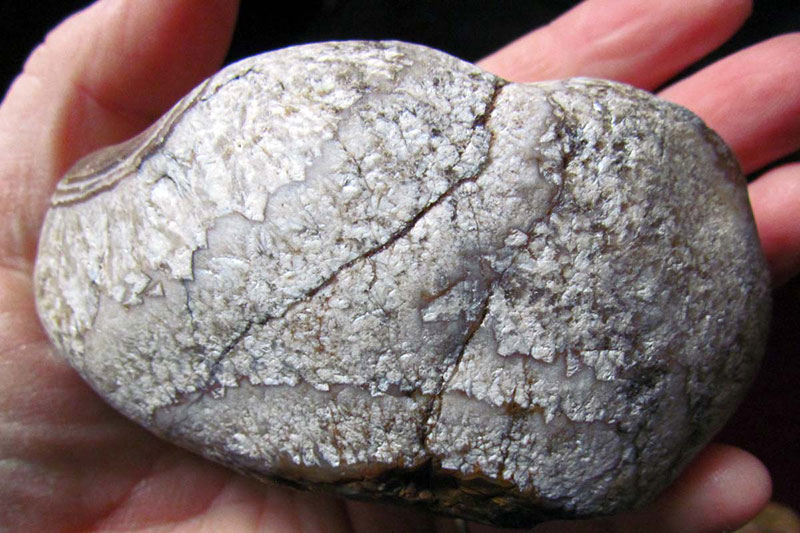
Although controversial, some people classify Skip-an-Atom Agates as s a sub-variety of Lake Superior Agate. These rocks are usually opaque with patterns of large quartz crystals with evenly distributed tiny air spaces that sometimes manifest with a lilac color cast.

These Lake Superior nodules are usually found in and around Duluth, MN – and are quite rare. In cases when these nodules were moved by glaciers or icebergs, they can also be found elsewhere including on the beaches of Grand Marais.

During the last few years rockhounds around the Mid-west have discussed these silica nodules. It seems that there is not agreement on several fronts. People do not agree on whether these specimens are in fact agate. They do not agree on exactly what constitutes a Skip-an-Atom Agate or how you can determine whether you have found one. Most agree that these specimens have a quartz ball center with a weird macro-quartz pattern. It does seem that the crystalline structure within these specimens was chemically or thermally altered causing the silica to recrystallize.

Apparently these agates were named by an elderly rockhound who thought the quartz looked so unusual that it must have “skipped an atom” in its formation. Thus, this is a descriptive term and does not have any scientific validity.

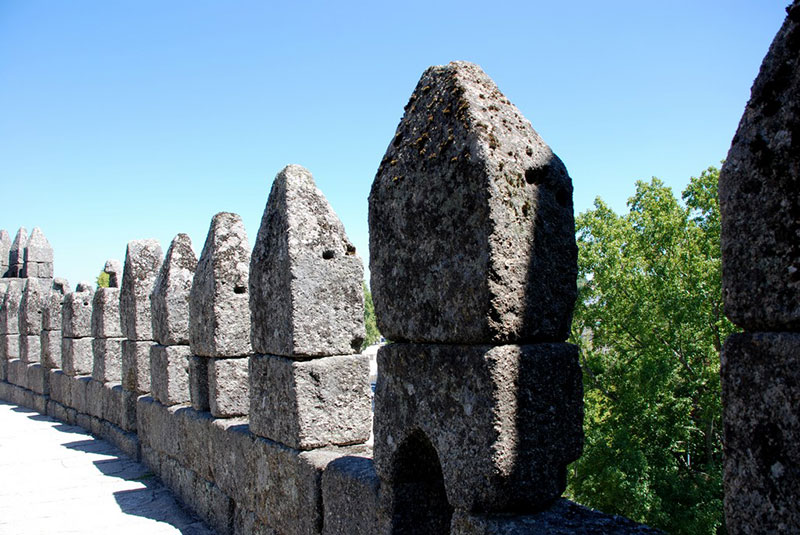
Many Skip-an-Atom agates are characterized by their notched and indented quartz crystals. The pattern of quartz crystals in Skip-an-Atom agates have been described as crenelated – like the indented/notched battlement top of the walls on an old fort (as shown below).

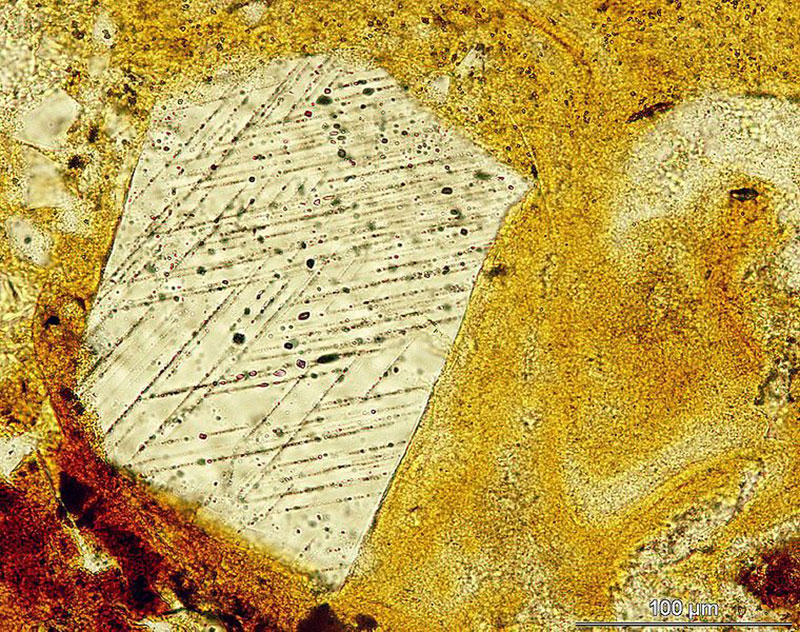
There are many theories about how these specimens formed. Some feel that these rocks formed due to the heat and pressure of a meteoric impact since the crystalline pattern resembles the shocked quartz found at impact sites (sample shown below).

Another hypothesis is that these “agates” are metamorphosed silica-rich schist called sericite. Schist is a type of metamorphic rock that is chiefly comprised of flaky minerals and exhibits a plated structure. A quartz sericite is shown below.

Typically schists contain significantly lower levels of quartz, but quartz-sericite schist is a variety that does contain more silica. As its name implies, this type of schist also contains significant amounts of sericite, which is a fine-grained type of either muscovite or paragonite, both of which are relatively abundant silicate minerals. Found in various locations, one of the best known examples of quartz-sericite schist occurs in Canada, where it is a source of economically important gold deposits.

A more plausible explanation is that contact metamorphism formed these rocks when hot molten lava intruded preexisting agate bearing rock causing the transformation of the silica in the agate nodules that were still resident in the vesicle pockets.

Here are some more photos of a Skip-an-Agate found by local resident, Kim, in Grand Marais, Michigan.

CITES: