CUSTOMER AGATE FINDS: June 2007

I don’t know if it is the low Lake Superior water level, or the tremendous weather we have been having, but people have been finding some terrific agates this spring.

Bryce Kucharek from Shingleton found 4 “keepers.” The top two are both shadow agates. The bottom right agate is a ¾ pound “fister.”

The next agate is one of the strangest I have ever seen.It was found by Jacie Hunnicutt from Lansing. It appears to have formed as a concretion, inside of a partly-hollow pocket with a chalcedony outer layer. A second picture of the bottom has a distinctive fortification pattern as well as two six-sided, inch and a half hollow cavities, which appear to have had macrocrystals that have since popped out.If anyone has seen a Lake Superior agate like this one before, or if you have any ideas about the genesis of this rare find, please send me an email to .

The next agate was found by Mike Miller from Muskegon, who is pictured below with his wife. This is a beautifully delicate Lake Superior agate with white banding, as well as some carnelian sections. This specimen was found east of Grand Marais.

The last specimen featured this month was found in the Grand Marais bay. The finder wishes to remain anonymous, but has agreed to let us feature the agate in this update. Some surface fractures caused its “owner” to decide to have it face polished. This specimen is one of the finest carnelian agates I have ever seen, which also features some nice shadow bands.

ROCKHOUNDING AND ADVENTURE TRIPS: Minnesota Agate Hunting Trip – June 2007

I have not had the chance to go on a summer vacation since 1993. Between owning the brewpub (1994-2001), and being busy with the museum after that, I just have not been able to get away in June, July, or August. Even though I probably should have stayed home to make more agate products, I decided to take a few days off. Since my friend, Renee, also wanted to get away after a busy year as school secretary, and with her husband down state, we decided to head west.

We spent three days hunting in gravel pits and rivers, along railroad tracks, in farm fields, and on gravel roads. We even spotted a few chippers in parking lots. In one of the gravel pits, we were greeted by an American Bald Eagle. All in all, this was the most successful agate trip we have ever taken. With our mascot paint pot “George,” we drove 1,270 miles to and from Grand Marais, as well as all over northern Minnesota. We decided to be frugal on this trip, so we camped with Renee in the tent and me on a mattress in the back of my Blazer. It was good to get away, even though it was just for a few days.

History’s Gem of the Month: The Story of the Grand Marais “Meteor”

June 2007

This new section, History’s Gems, replaces two sections from the original web site, including Gems from the Past, and Story Corner. It also evolves and expands to include new items. After updating the original web page each month during the first couple of years, it became more and more difficult to separate the two sections, as many of the entries could have been included in either section. Thus, in the effort to streamline the new web page, one section has emerged from the previous two. Also, as I was sorting some of my history reference materials, I realized that they have never been fully utilized. I have several books and other documents about natural history, the history of Grand Marais, surrounding communities, Michigan, and the United States. Most of these materials tell the story of what life was like in the 1890s and early 1900s.

As the web page monthly updates now continue into the future, there will be a wide array of possibilities for what will be included in the monthly History’s Gem. I may include a story written by or about Axel. An interesting recount of a Grand Marais event may be incorporated. Perhaps an intriguing tidbit about the natural world will be the selected Gem. Or I may look through the reference materials and describe a characteristic of what life was like a century ago.

June 2007

NOTE: This article, which was posted on the web site several years ago, is being reprinted due to the fact that I have decided to sell the property on which the “meteor” sits. If you are interested in looking at or purchasing this 10-acre parcel, please refer to the information at the end of the article.

The Story of the Grand Marais “Meteor”

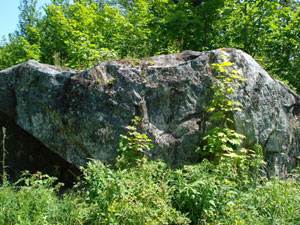
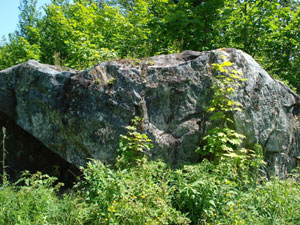
One of the memories I have from my childhood summers in Grand Marais is traipsing through the woods over by Sable Lake to visit the “meteor.” Of course, back then most of us believed that the rock really was a meteor. It never occurred to us that a bolder that is 27’ x 12’ x 8’ in dimension (including the broken off slab) maybe would have dug at least a little crater when it hit.

One of the reasons for our belief in the “meteor,” is that in the agate book published in 1973 by the museum founder, Axel Niemi, had s story titled “Observing a Falling Meteor.” Another contributing factor to our belief was that Axel created a brochure for the town pointing out various tourist attractions. A sign post was erected downtown as well as on the road near the “meteor.” Axel’s purpose in developing tourism resources was to increase the number of campers at Woodland Park, where he worked at his “day job.” It seems that Axel negotiated with the township to receive a percentage of any revenue increase realized at the camping park as a result of his marketing activities.

The chapter in his book about the “meteor” appears near the end, and is sandwiched between two factual chapters about agate hunting in the Upper Peninsula, thus, further influencing people’s tendency to believe that the story was true. This story is reproduced below:

OBSERVING A FALLING METEOR

Approximate day of occurrence 10 January 1920, Mid-day

Since a meteor is composed mostly of iron, the only manner of occurrence as iron in the natural state, the mineral or metal tends to oxidize and disappear after a few years. Nevertheless from the description given by the observer, this meteorite could very well be still in its original area of fall.

While walking across Au Sable Lake in Alger County in the winter, Otto N. Niemi observed the object. At first a sound, such as a strong wind would make, was heard. Mr. Niemi, on the open ice, had nowhere to go for shelter. Suddenly he observed a streak in the sky just above treetop level to the south. The object was coming closer and closer, leaving a trail of smoke or vapor. The angle of travel was such as to avoid the lake and traveled to his right hitting a treetop at the south end of the lake. The meteor (while still in air, it’s a meteor, on ground it’s a meteorite) finally crashed through the tops of some birch trees and into the ground.

Since the time was already beyond half-past the day, with traps and furs in sack, Otto Niemi never did visit the area of the fall, although he insists that it was not far from the edge of the lake. A real attempt to locate this object has never been made. The high-pitched sound indicated a meteor flying and producing a rapid spinning motion. This type of meteor disintegrates after striking an object. However, the fact that a large limb was taken down from the birch tree, may indicate simply a fast moving object which produced the sound due to the friction against the atmosphere, and not due to spinning motion. If such is the case, then the meteorite may well be buried nearby.

Many of those who read Axel’s book and followed his subsequent directions to go and look at the meteorite, which had since been “discovered,” never noticed the short paragraph located near the beginning of his book:

METEOR NOT A METEOR AT ALL

The author knows of an area where a meteor had fallen years ago not so far from the rock that is now marked as a “meteor.” The large stone marked “meteor” is not a meteorite at all. Rather, it is a piece of metamorphic iron sediment (note the layers of formation).

Soon after moving to Grand Marais, a good friend of mine, Jan Carol Ogden, dragged me back to the “meteor” one day. I had not been back to the site for many years, so it was great to see this incredible rock again. She announced to me that since I was the biggest rockhound she knew, that I had to purchase and own the biggest rock in town. That I did.

I’ve since studied the “meteor,” and agree with Axel that it is a metamorphic iron sediment. I also think that it is a glacial erratic, having been moved and deposited to its current location when the glaciers retreated north almost 10,000 years ago. Given that the glaciers were many thousands of feet thick, they would not have had any trouble transporting this rock.

The story of the meteor lives on to this day. It is a difficult decision for me to “burst the bubble” when I am faced with telling museum visitors that the rock is in fact not a meteor.

“METEOR” PROPERTY IS FOR SALE

Although it is a difficult decision, I have decided to sell the 10 acres on which the “meteor” sits. The property is located on a corner lot (William Hill and Lowder Roads) with 12-month road access. The area accessing and surrounding the “meteor” has been cleared and pert tested. The property is located southwest of Grand Marais a few miles, within a quarter mile of the Pictured Rocks National Lakeshore, between the Sable Lake Boat Ramp and Grand Sable Dunes. It is a mostly wooded parcel offering a peaceful setting. The selling price is $80,000. If you are interested, send an email to Karen@agatelady.com or give me a call at 906-494-2590.

MINERAL OF THE MONTH: June 2007: Lake Superior Michipicoten Agate

The mineral of the month is a Lake Superior Michipicoten agate. When a newspaper article was published in 1958 featuring the museum founder, Axel Niemi, and his 5.5-pound agate, Axel received a letter from Mrs. J. Oldenkomp. She had seen the article and asked Axel if he was interested in buying an agate that she inherited from her grandfather. Apparently, he had found the agate on Michipicoten Island, located in the northeast part of Lake Superior. As was common practice back then, he had the agate cut and polished. The lapidariest received half the agate in payment, and the Oldenkomp family kept the other half. Before cutting, the agate weighed over 8 pounds!
Axel and Mrs. Oldenkomp haggled over the price of the agate for 7 years before Axel finally purchased the specimen in 1965. The letters documenting this purchase are posted in the museum. Unfortunately, Axel cut out the price in the letter so we’ll never know how much he paid for this beauty.

CURRENT SCENES OF GRAND MARAIS: June 2007 Scenes

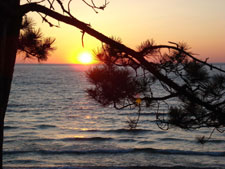
My friends have learned that in July and August, I am busy with the museum, thus, not allowing time to go camping and hiking. Also, the best time to “do Grand Marais,” as we locals call it, is in the spring and the fall. The visit from my friends Marsha and Denise provided an opportunity for me to camp at 12-mile beach for a night, as well as to hike the Lakeshore.

CUSTOMER AGATE FINDS: May 2007

It has been difficult to decide what to include in this revamped web page from the original. I’ve gone back and forth on deciding whether to include all previous customer agate finds. In the end, I’ve decided to start anew. I would like to thank all of those who have been featured in previous years for sharing their agate treasures. In the future, we will retain one to two year’s worth of customer agate finds. We will also be a little more descriptive of the featured rockhounds and/or their agates.

Renee (Beaver) Stocking

Renee has lived in Grand Marais on and off since she was a child. After living down state for more than a dozen years, she returned to Grand Marais last September to work at Burt Township School. Last fall and this spring, she has spent a considerable amount of time on the beaches. These are just a few of her recent finds.

NOTE: Renee’s father, Neal Beaver, wrote the introduction to Understanding and Finding Agates. Neal, who recently passed away, was a major influence on my life. Renee also is my oldest friend.


History’s Gem of the Month: The Telescope Story

May 2007

This first entry in the new section has been requested by several museum visitors. It recounts one of the many reasons why Axel was a major influence in my life. This is the story about Axel’s telescope, which is now safely stored at my house.

THE TELESCOPE


My eyesight was extremely poor until I was around 10 years old, due to an excess amount of oxygen in the incubator when I was born. One day, soon after my eyesight improved, Axel said to me: “Karen, meet me tonight in the street in front of the museum at 11:30.” When I asked him why, he just told me to show up. I was so nervous all day that I could barely eat or contain myself. Why would Axel want a ten-year-old kid to stay up past her bedtime to meet him in front of the museum? Both my mother and grandmother, who were as interested as I, encouraged the rendezvous.

At twenty-five minutes after 11:00, I ran the four blocks down the sidewalk from my grandmother’s house, where we were spending the summer.  I especially ran fast past the scary dip in the sidewalk east of the Lutheran Church, fueled by hours of curiosity about what Mr. Niemi was up to.

As I approached the museum, I was astonished to find Axel aiming the biggest telescope I had ever seen up toward the glittering stars. I was not aware that Axel had ordered the telescope kit and hired other kids to walk in circles to grind the lens. When they were almost finished with the grinding, the mirror fractured and, after he muttered a few select words, Axel ordered another one and started the grinding over. You can still see the mark on the floor of the museum where he fastened the grinding station.

As I ran up just before the requested time, Axel said, “You are a little early; I’m not quite ready yet — just hold your pants on for a minute.” Finally, he told me to stand up on the chair, without touching the telescope, and to look through the eyepiece. As I carefully looked through the eyepiece and saw the rings of Saturn, Axel said to me: “Karen, given your eyesight problems, if you can see the rings of Saturn, you can do anything.”

That was one of the first moments in my life that I believed I really could accomplish something. Thanks to Axel, I not only enjoyed success in several different career paths, but I also was able to acquire the museum to carry on his legacy.


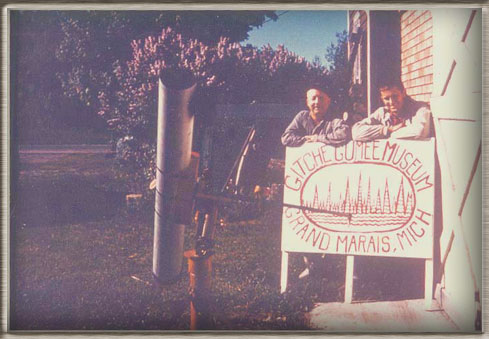
In the photograph, if anyone recognizes the person standing with Axel in front of the sign next to the telescope, please email me at karen @ agatelady.com. I know that Axel also shared the telescope with many other people throughout the years. Please send me an email if you have a story to tell about Axel’s telescope, or if you were one of the Grand Marais kids that helped to grind the telescope’s mirrors.


When I searched the Internet for a picture of Saturn, the very first web page that I looked at had the following quote at the top of the page. Coincidence? I will always thank Axel for giving me hope.

“It is difficult to say what is impossible, for the dream of yesterday is the hope of today and reality of tomorrow.” – Robert Goddard

Information about Saturn

Saturn is the sixth planet from the Sun and the second largest

Orbit: 887 million miles from the Sun (10 times that of the earth)
Diameter: 74,100 miles in diameter at the equator (9 times that of the earth)
Sunlight: Reaches in 1 hour, 19 minutes (compared to 8 minutes for the earth)
Year: Takes 29.46 earth years to rotate around the sun

In Roman mythology, Saturn was the god of agriculture. Saturn has been known since prehistoric times. Galileo was the first to observe it with a telescope in 1610; he noted its odd appearance but was confused by it. It was not until 1659 that Christian Huygens correctly inferred the geometry of the rings. Saturn’s rings remained unique in the known solar system until 1977 when very faint rings were discovered around Uranus (and shortly thereafter around Jupiter and Neptune).

Saturn was first visited by NASA’s Pioneer 11 in 1979 and later by Voyager 1 and Voyager 2. Cassini (a joint NASA / ESA project) arrived on July 1, 2004.

Saturn is the least dense of the planets; its specific gravity (0.7) is less than that of water. Like Jupiter, Saturn is about 75% hydrogen and 25% helium with traces of water, methane, ammonia and “rock”, similar to the composition of the primordial Solar Nebula from which the solar system was formed.

Though Saturn’s rings look continuous from the Earth, the rings are actually composed of innumerable small particles each in an independent orbit. The ring particles seem to be composed primarily of ice, but they may also include rocky particles with icy coatings. They range in size from a half inch to several yards in diameter, with some even larger. Despite their impressive appearance, there’s really very little material in the rings — if the rings were compressed into a single body they would be no more than 60 miles across.

The origin of the rings of Saturn is unknown. Though they may have had rings since their formation, the ring systems are not stable and must be regenerated by ongoing processes, perhaps the breakup of larger satellites. The current set of rings may be only a few hundred million years old.

When it is in the nighttime sky, Saturn is easily visible to the unaided eye. Though it is not nearly as bright as Jupiter, it is easy to identify as a planet because it doesn’t “twinkle” like the stars do. The rings and the larger Saturn moons are visible with a small astronomical telescope.

MINERAL OF THE MONTH: May 2007: Rainbow Fluorite

This month the featured mineral is Rainbow Fluorite. Fluorite is a derivative of the Latin word “fluere” which means to flow. Because of its easy melting properties, fluorite can be used during the manufacturing of steel; although its most popular use is in making jewelry. This is because fluorite is the most colorful mineral of the world and often displays distinct banded color, such as in this month’s featured mineral specimen. Fluorite can be purple, green, yellow, brown, pink, reddish-orange, and even colorless. It is a soft stone with a glassy luster and translucent. It is second only to quartz minerals in popularity. Fluorite is found worldwide, but especially in Brazil, Canada, China, England, Germany, Italy, Mexico, Norway, Russia, Argentina, Switzerland, and the USA.

At the Tucson show in February, I purchased a flat of Rainbow Fluorite slabs. A few pieces were used in the agate window pictured on this page. This particular window was sold at the Escanaba show. More will be used to make a lamp and other products. The slabs are considerably more expensive than agate, but well worth the price.

Some say that fluorite improves self-esteem, reduces stress, stimulates the imagination, and protects against illness. Others claim it has a calming energy that facilitates order and improves balance.

CURRENT SCENES OF GRAND MARAIS: May 2007 Scenes

Each monthly update will include recent photos. Usually, these are photos from the Grand Marais area. In most cases, the photos will be those taken from the previous month. For example, the May update includes April photos.


ROCKHOUNDING AND ADVENTURE TRIPS: Tucson Gem and Mineral Show – February 2007

In February, I made the annual trek out to the Tucson Gem and Mineral Show. For the first time, one of my friends, Kim Amthor, requested to come along. Since she had never been to the Grand Canyon, we of course had to visit.

Last year was the first time in many years that I had been to the main area on the South Rim, since I have gone to Supai the last four canyon visits. However, last year I didn’t take the time to hike down into the canyon.

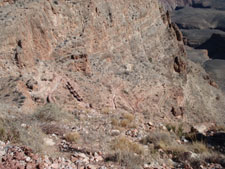
After arriving on Saturday, February 3rd, Kim and I had planned to stay two nights on the rim and day hike part way into the canyon. Due to the Superbowl, many people canceled their Phantom Ranch visits, so we decided to take an extra day and hike to the bottom. Unfortunately, an ankle injury required that we spend yet another day. Thankfully, there were still openings. With a lot of encouragement and some pain killer, the 9.6 mile hike out went better than expected. We certainly enjoyed meeting and sharing good times with the other Phantom Ranch visitors and Bright Angel Campground campers. All in all it was an incredible hike. Somehow, though, it isn’t as easy as it was the first time I made the decent almost 25 years ago.

As a result of spending so much time in the northern part of the state, we only had a couple of days to spend in Tucson. It worked out in the end, especially, since experience buying at past Tucson shows enabled me to overshoot my budget in record time.

I would like to thank Kim for an incredible trip. She is an artist that spends part of the year in Grand Marais and owns the Niemi Fish Net House (around the corner from the museum). I would also like to thank Ken Flood, one of the owners of Keewenaw Gem and Gifts in Houghton, MI, for bringing back all my Tucson purchases. Finally, thanks to Penny and Seth for their wonderful hospitality on our last night in Phoenix.