MINERAL OF THE MONTH: Fall 2007 Malachite

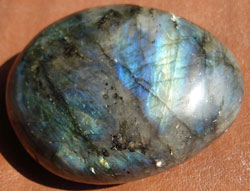
Recently, the museum was able to purchase some incredible museum-quality Malachite specimens to sell in the gift shop. One is pictured below. Malachite is a copper carbonate hydroxide mineral. It forms in botryoidal, fibrous, or stalagmitic masses, usually from the weathering of copper ores.

The stone’s name derives from the Greek word, molochitis, which means “mallow-green stone.” Until around 1800, pigments from this stone were used in making green paints.

Large quantities of malachite have been mined throughout the world including the Congo (Zaire), Tsumeb, Namibia, Ural Mountains, Russia, Mexico, England, and the U.S. There is archeological evidence that it has been mined for over 3,000 years in Israel, and for even longer in Egypt.

Malachite is a soft mineral with a hardness between 3.5 and 4, and a specific gravity of between 3.6 and 4. It is fragile and should be protected from scratching and sharp blows. When cutting or polishing malachite, you should be careful to protect your skin and not breath in the small microscopic splinters. You should also be careful when washing or cleaning malachite specimens because you can easily remove protective finishes.

Malachite is the anniversary gemstone for the 13th year of marriage. Some believe its metaphysical properties help to bring harmony into one’s life. It is also thought to enhance knowledge, patience, and to ward off danger and illness.

CUSTOMER AGATE FINDS: August 2007

Several great agates continue to come into the museum. Some of the rockhounds who were featured in the original web page, which was not archived in the new web page, have taken on the challenge to reappear. Mark and Lynn Boll from Amherst, WI are the first to accomplish this feat. Pictured are four of the many agates they found while vacationing in the Grand Marais area this month. The upper left agate is a spectacular tube agate. The picture does not adequately show how the tremendous translucency allows you to see the tubes from end to end. The upper right specimen is not agate, but it is an unusual orbicular jasper. Mark and Lynn asked me to face polish all four specimens.

Allison Testolin from Iron Mountain, MI found this large 6 ¾ pound specimen. Although it does not have a distinctive fortification pattern, there is agate popping out throughout the rock.

History’s Gem of the Month: Lake Superior Origin from 1957

August 2007

This article was contained in the museum’s archive. It was glued onto a page on which the museum founder, Axel Niemi, wrote that it was written in 1957 by Dr. George M Schwartz from the University of Minnesota. The source of publishing was not noted.

Origin of Lake Superior

Lake Superior, is the largest body of fresh water in the world and also one of the deepest. The term, superior, referring to its position as the upper lake of the five Great Lakes of North America was first used according to Grace Lee Nute in the Jesuit Relation of 1647-1648. The lake is 300 miles long and has a maximum width of 160 miles with an area of about 32,000 square miles. Its normal surface level is 602 feet above sea level and the greatest depth 1,290 feet.

In view of its great size and depth, it is natural that there should be much interest in the origin of the lake. In addition to its size, another fact of importance in considering the origin is occurrence of the lake in the trough of a great syncline or down fold in the rocks. That this structure of rocks has had an important effect on the origin of the lake is certain, but that the down folding of the rocks is the primary cause of the present lake is doubted inn view of the great length of time since the folding. The folding can be fairly closely dated as late Keweenawan or some 600,000 years ago. This would seem to allow plenty of time for any depression formed by the folding to have been filled with sediments.

Another fundamental fact to be considered in the origin of the present lake is the great depth of the bottom of the lake below sea level. The depression could therefore not have formed by stream erosion unless this whole portion of the continent once was much higher with respect to sea level than it is at present. While there have been changes in both continental and sea levels, there is no good evidence that these were on a scale to account for the Superior depression.

There are two main possible explanations: (1) The lake was scoured out by successive ice lobes which probably occupied the rock basin culminating in the Superior lobe of Late Wisconsin time. The glacial erosion was probably guided by a deep river valley in the structural basin. (2) Depression of the basin by faulting at a sufficiently late date for it to have escaped filling with sediment.

Difficulties with the fault hypothesis are the lack of evidence of late faulting anywhere at this portion of the North American continent and the lack of good evidence of faults in the proper positions to account for the depression. Certain great faults are known to exist in the Superior region and it is reasonable to assume that erosion was modified by their existence.

The hypothesis of glacial erosion has more obvious support. The movement of the Superior ice lobe down the axis of the lobe was one of the last great geologic events in the region. The timing to account for the present depression is excellent. Furthermore it is evident form the moraines of the Superior lobe as shown by Leverett’s maps that a great deal of rock debris was picked up by the ice lobe and deposited to the southwest of the present lake. It is also shown by glacial drift to the southwest in Minnesota that earlier ice sheets passed over the superior region and gathered up enormous amounts of rock debris and carried it on to the south. It is reasonable to suppose therefore that the Superior syncline was occupied by previous lobes that moved along the length of the basin gouging it out to a greater extent each time it was occupied by a lobe of ice.

In summary it may be said that Lake Superior probably owes its origin to a combination of conditions. The first important event was the formation of the great syncline following the extensive igneous extrusions and intrusions of the Keweenawan. This syncline no doubt was expressed at a surface by a basin that was filled by later and softer rocks than the older rocks round the edges. Faulting at a still later time modified the structure of portions of the syncline. Some of the faulting has been considered of late Keweenawan age, part of the movement is Paleozoic or later. The immediate cause of the present topographic basin was erosion by successive lobes of glacial ice that occupied the bottom of the syncline and eroded out the soft sediments but modified only in a moderate degree the resistant pre-Cambrian rocks on the sides. It is generally assumed that a large river valley occupied the present site of the lake and guided the early glacial erosion.

MINERAL OF THE MONTH: August 2007 Rain Flower Agate


This month’s featured mineral is Rain Flower Agate from Nanijing, China. For those of you who periodically check which Lake Superior agates are listed on Ebay, you have seen the listings for these “Lake Superior-Like” agates. Rain Flower agates are river washed to a smooth surface featuring translucent, rich, banding patterns. They are found near the ancient site of the Gaozuo Temple and are featured at a museum located on the site. They are so admired that they were taken by the Chinese delegation to the 24th Seoul Olympic Games to represent “Peace Lucky Stone.”

A legend says that during the Liang of Southern Dynasties (502-557), Master Monk Yunguang placed a table on top of the local terrace and expounded the texts of Buddhism. Apparently, this so moved the God that the heaven rained flowers, which later became beautiful and colorful agate stones.

Yuhashi, or rain flower agate, is a compound of quartzite, flint and agate.

CURRENT SCENES OF GRAND MARAIS: August 2007

With the very busy August, I did not get out into nature to take any photographs. Thus, this month’s scenes were taken at the Grand Marais Music and Arts Festival. I must admit, that this year’s festival was one of the best in recent years. Other than a few raindrops on Saturday and some wind that threatened my new art tent, the weather was superb. The rain also treated us to a wonderful rainbow that lasted for over a half hour. Also included below is a picture of the mysterious Stilt Man, a photo of the crowd, and a picture of one of the local bands who entertained us from the new side stage.

Festival CrowdRainbow over the festival
Nick and the bandStilt Man

CUSTOMER AGATE FINDS: July 2007

The agate king so far this summer is Dan Kinney from Sault St. Marie. He found this ¾ pounder, half pounder, and two 1/3 pounders!. The latter two were found on a 20-mile trek near the Vermillion Light House. Since Dan doesn’t have a four-wheel drive, he had to walk 7 miles into the lake shore and back out, plus he searched 3 miles down and back along the shore. Congratulations, Dan — nice agates!

ROCKHOUNDING AND ADVENTURE TRIPS: Moose Lake Agate Days – July 2007

For the second time in a month, I was fortunate to travel to Minnesota to agate hunt. The main reason for travel this time, was to attend the Moose Lake Agate Days. Thanks to my friends, Gerald and Jill Phillips, I again shared their camp site at the city park, which is located next to the school at which the local rock club holds their agate days event. Unlike the previous two years wherein the weather tortured us with 100+ degree temperatures, the weather was much more conducive to agate hunting. We went to our favorite gravel pit as well as tried other spots recommended by some of the locals.

Since the gravel pit was not operating, we had great access to the various piles. Pictured below is Gerald working his magic.

The number of people who attended the 2:00 pm stampede was out of control. If the attendance continues to increase, the event organizers might want to spread out the rocks over two blocks instead of one. Pictured below is the gravel truck spreading its load containing 400 pounds of agate mixed in with the glacial till, the crowded stampede of agate hunters after the cannon went off, and a dog named Pepper, who was very tolerant of the whole event.

And of course, the agates ……

History’s Gem of the Month: Hints on Hunting Glacial Agate Article

July 2007

While looking through the museum’s archives to select this month’s history gem, I came across a draft of an article written by the museum founder, Axel Niemi. I’m not sure if and when he ever published this article, but I thought it worthy of sharing.

HINTS ON HUNTING GLACIAL AGATES

Grand Marais to Whitefish Point are gravelly for the most part. The glacial rocks leave the harder agates and other quartz minerals to be picked by the lucky hunter. There are a number of gravel pits scattered throughout the U.P., but the chances of finding anything of importance in these pits are slim. The author found only one large green jasper moss agate (1 pound), which was identical to a specimen found by a conservation worker on the high banks of the Sucker River. However, rockhounds will have better luck combing the beaches.

Many visitors examine the Gitche Gumee Mineral Museum collection every year and are amazed at the multiple varieties of agate, jasper, and other gem minerals that have come from the local beaches. That the collection was found within a few minutes walk to a couple hour drive from the museum seems unbelievable. To those rockhounds who understand the difficulty encountered in hunting these all but camouflaged mineral gemstones, it is apparent that a great deal of time is required to find these priceless rarities. Those who are willing to put in the time, though, are often rewarded.

The biggest reason beginners are not successful in finding glacial agates is the fact that they give up too easily. Since the agates have become worn to the point that they are rather indistinguishable from other translucent non-gem rocks and opaque stones, the problem of spotting a choice agate is readily understood. To add further to the confusion, until the rockhound becomes accustomed to spotting agate characteristics, it is easy for your focus to be diverted by a host of variously colored pretty jaspers, cherts, and granite pebbles that are thrown into the jumble. Even the experienced agate hunter must avoid being inflicted by “the pretty rock syndrome.”

Another reason why agates are hard to spot is that many are covered with dozens of tiny powdery fractures that may hide the true nature of the interior beauty. If you were more than a billion years old having to contend with the waves and ice of Lake Superior, as well as its predecessor lakes and oceans, you would have a few fractures, too. Thus to be successful it is important that you keep your focus, spend the hours required, and concentrate on looking for the agate characteristics. With such a variety of rocks on the beach, coupled with the need to look through or among millions of other glacial-worn stones, the task to spot the elusive agate is a challenge in itself.

MINERAL OF THE MONTH: July 2007: Labadorite

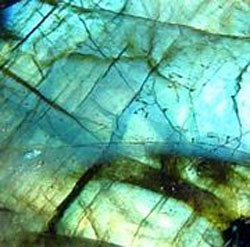
This month’s mineral of the month is Labradorite, which was first discovered in the Labrador Peninsula in Canada. It is also found in Norway, Finland, and Russia. It is truly a captivating mineral that displays a colorful shiller effect when held and moved during observation. The color display is from layers of intergrowth inside the crystal. These intergrowth layers are caused by compatible chemistries at high temperature becoming incompatible at lower temperature that results in a separating and layering of the crystal components. The color effect is caused when light enters the specimen, only to be refracted back and forth by the deeper layers. The refracted light is slowed as it travels through the layers and mixes with other light rays to change and produce a different wavelength of light. The color effect depends on the thickness and orientation of the layers.

Labradorite is a member of the plagioclase series of minerals, which comprises feldspars. It contains sodium, calcium, aluminum, silicon, and oxygen. The color is gray to smoky black. It has a dull to vitreous luster. The crystals are transparent to translucent. It has a conchoidal fracture pattern, a hardness of between 6 and 6.5, and a specific gravity of between 2.70 and 2.74. The flashes of color (labradorescence) can vary between blue, violet, green and sometimes orange and yellow.


CURRENT SCENES OF GRAND MARAIS: July 2007 Scenes

clowns

The July 4th Holiday in Grand Marais was another Gem. Since I did participate in the parade again, this year riding my bike wearing the bear coat (rather than walking), I don’t get much of a chance to see the other participants. Before it began, though, I took this picture of the Bennett clan. On the side of their float, keeping with this year’s theme, the sign said “Don’t Clown Around — Save the Bay.”

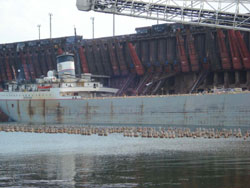
Every once in a while those of us who live in Grand Marais must take trips out of town to purchase items not locally available. While in Marquette, I snapped a couple of pictures of a freighter. The first is the freighter heading into the ore dock. The second shows the freighter loading iron ore pellets. Notice the chutes that swing down to dump the pellets into the ship’s hold.