CURRENT GRAND MARAIS SCENES: Summer 2008

The weather so far this summer in Grand Marais has been like what I remember it was when I was a kid. Unlike last summer with the searing 90 degree days, the temperatures have been in the 70s during the day and 50s at night. Wonderful! Since there has been enough but not too much rain, this has been the year of wild flowers. Everywhere you go, including the sand dunes, there are wild flowers. Pictured below are a couple of pictures to document some of these botanical surprises, as well as a sunset picture taken from the dunes.

The July 4th holiday was another old-fashioned celebration. I decided to take the year off from walking/riding in the parade with the 1895 bear coat — something I do every few years so I can see the parade myself. Pictured below are a few shots I took during the parade and fireworks. There were a few extra boats in the bay as well as kayaks (not pictured) who watched the fireworks from the water. The theme for the parade this year was: “Save the Grand Marais Bay.”


CUSTOMER AGATE FINDS: Summer 2008

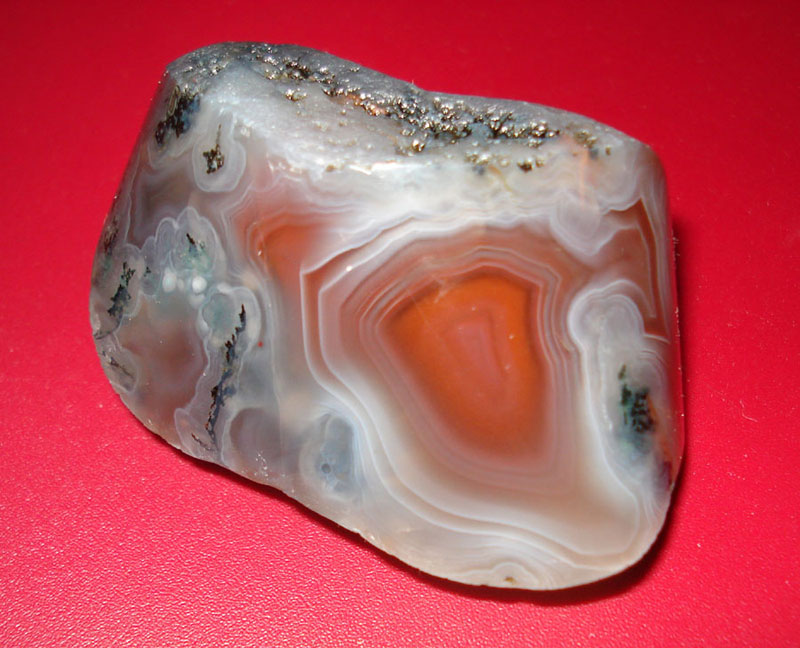
Since I was not in town for half of July, I have fewer customer agate find pictures. There are a couple, though. Actually, the first specimen is one that email pictures were sent to me by Dana Maudel, from McGregor, MN. She said in the email that her boyfriend found this specimen. I emailed back to ask more questions about the weight and location, but did not receive a response. It is unusual and remarkable enough, that I am going it include it in this month’s web page update. It is quite large, over 10 pounds. It appears to have unusual tubes running down the side of the specimen. Has anyone ever seen anything like this before?

The second agate is one found in the Grand Marais area by Michael Webb from Dearborn, MI. He brought it in during Festival Weekend, but I forgot to take a picture of Michael holding the agate. He asked me to face polish the agate and mail it back to him. It is extremely translucent with the carnelian fortification pattern along with various inclusions. Nice agate!

History’s Gem of the Month: Pictured Rocks National Lakeshore Proposal Proposal Proposal Part 1

June 2008

While combing through the museum’s archives, I recently came across the original proposal for creating the Pictured Rocks National Lakeshore, which was established by legislation passed in 1966. Grand Marais is the eastern entrance to the national park. I will relay interesting information from the report beginning this month, and continuing in the next month or so. For brevity, I will edit and shorten some of the sections.

Introduction and Summary

The National Park Service first became concerned with the Pictured Rocks area in 1957-58 during the Great Lakes Shoreline Recreation Area Survey. In the survey report released in 1960, the area was rated as one of the five areas on the Great Lakes of national significance. In June 1961, legislation was first introduced calling for establishment of the park.

The Pictured Rocks — multicolored sandstone cliffs, 50 to 200 feet high, and stretching about 15 miles along the shore of Lake Superior — have long been a major tourist attraction. But, although they are the dominant attraction of this region, people also come to see and enjoy the Grand Sable Banks and Dunes, the Beaver Basin, the picturesque inland lakes, and the numerous waterfalls.

With each season of the year having its own particular visitor attraction — forest wildflowers in spring, cool forests and lakes in summer, yellow birches and scarlet sugar maples in autumn, and snowscapes in winter — the area would no doubt receive year-round use.

The proposed lakeshore would be developed for the optimum use and enjoyment by the public. A minimum land area of approximately 28,000 acres, referred to as the shoreline zone, is deemed essential for protection, development and use of the primary features of the area. This shoreline zone is a continuous strip along Lake Superior, from Munising to Grand Marais, averaging about 1.4 mile in width.

Recommendations

The Department of the Interior recommends:

  1. Establishment, as a unit of the National Park System, of a Pictured Rocks National Lakeshore lying between Munising and Grand Marais, Michigan.
  2. Acquisition by the Federal Government of a 28,000-acrea lakeshore zone.
  3. Designation of a 39,000-acre buffer zone to provide protection of the watersheds and the forest setting.
  4. Construction by the National Park Service of a non-commercial scenic road to facilitate circulation within the lakeshore.
  5. Designation of the Beaver Basin as a natural area, containing only trails and minimum facilities necessary for the visitor’s enjoyment.
  6. Construction of a hiking trail along the entire length with hiker’s campgrounds at convenient locations.
  7. Emphasis is given to providing public use facilities which encourage enjoyment through observation and appreciation of its natural values.
  8. Hunting and fishing in accordance with applicable Federal and state laws.

Development

Private developments within the area are located principally at Miners Beach, Grand Sable, and Beaver Lakes. Of the 164 structures within the proposed lakeshore, 60 percent are seasonal cabins, 25 percent non-farm residence, 2 percent farms, 7 percent commercial, and 6 percent miscellaneous buildings.

Land Ownership

The proposed area would contain about 67,376 acres of land and inland lakes. About 6,320 acres of water in Lake Superior are included within the boundaries. Categories of land ownership are:

Owner Shoreline Zone Buffer Zone Total
Federal 781 1,572 2,353
State 5,140 14,911 20,051
Other Public 77 4 81
Private 22,440 20,868 43,126
Inland Water area 1,765
Lake Superior area 6,320

Total Acres of proposed National Lakeshore 73,696


Note: To be continued next month

MINERAL OF THE MONTH: June 2008 Ocean Jasper

At the request of a customer, I am going to again feature Ocean Jasper as the Mineral of the Month. Ocean Jasper made an appearance on the original web page several years ago, but it deserves to come back.

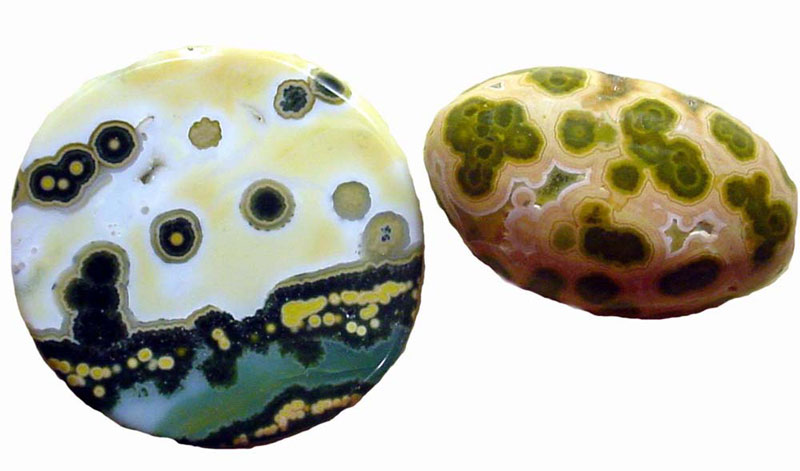
Until I completed an Internet search about Ocean Jasper while preparing this web page update, I wasn’t sure exactly when I first saw Ocean Jasper. Now I realize that it was at the Denver Show in 2000. I remember that I was visiting the exhibits housed in motel rooms. As I walked down the corridor, I passed a room that had a slab of Ocean Jasper that was six foot tall! It stopped me in my tracks! Although their high prices were appropriate given that it was a brand new mineral, I thought I would be smart and check out the Ebay prices when I returned home. I was successful in purchasing some of the magnificent mineral, but I paid for it. I bought the two specimens below from a couple in Great Britain. I paid $150 for the round slab and $75 for the egg. However, they are still two of my favorite pieces of Ocean Jasper. Notice the chrysoprase band in the round specimen and the agate pockets in the pink egg-like specimen.


I also must correct the historical information about this mineral that I have been presenting at the museum. I was told years ago that it was discovered eight years ago by two guys who were rock-climbing on the northern coast of Madagascar. Instead, it appears that the mineral had been discovered at the early part of last century. An article appeared about the unusual mineral in 1922. Then, the mineral was basically lost to the world for over 70 years. In 1997, the Mineralogical Encyclopedia (GRUND Publisher) reproduced a picture of the mysterious jasper showing the orbicular structures. The caption for the photo said that the source of the mineral was unknown. This picture excited rockhounds, including the field explorers for Madagascar Minerals who launched an expedition to locate the source. Their first attempt failed, so they regrouped and decided to methodically search the entire northern coastline of Madagascar. They spent 45 days navigating the coast, stopping in villages to ask locals if they were familiar with the mineral. Finally, they found the 50 x 30 yard deposit in shallow water in a remote area, It could only be seen and mined during low tide. The company had to work from boats, since the isolated region is not near a town and has no road access.

It is rare for new minerals to be discovered in this well-traveled world. Usually, new materials brought to market are usually just new deposits of already known minerals. However, Ocean Jasper is an exception.

It is thought that Ocean Jasper formed as a rhyolitic igneous rock, rich in silica. As the lava cooled, the silica precipitated out of the magma, forming little spherical balls. Later, the entire formation converted to pure silica made up of a combination of microcrystaline agate and jasper, as well as macrocrystaline quartz. The small deposit contains a wide array of color including white, green, red, yellow, and pink. There are also botryoidal and druzy quartz formations throughout the matrix. The genesis of the orbs in this beautiful rock is not known. However, research is being conducted at the University of California at Berkley to try to uncover the mystery.

The mineral is also known as Orbicular Jasper and Fish Eye Jasper. Similar, but less dramatic jaspers are found elsewhere in the world including Poppy Jasper from Morgan Hill in Santa Clara County in California and Rain Forest Jasper from Australia.

The metaphysical properties of Ocean Jasper are thought to: enhance one’s joy, help you better connect in loving relationships, improve cooperation, and help you focus on the positive aspects of life.

CURRENT GRAND MARAIS SCENES: June 2008

This month has delivered almost every type of weather. We have had temperatures range from the 30s to nearly 90. Despite the variation, though, I have kept up my exercise program and have spent a lot of time hiking in the dunes. While hiking, I took this picture of a downhill skier skiing down the Grand Sable Banks. Although it seems scary, the friction of the sand really allowed the skier to keep complete control. It is a long hike back up, though, carrying the heavy skies and ski boots!


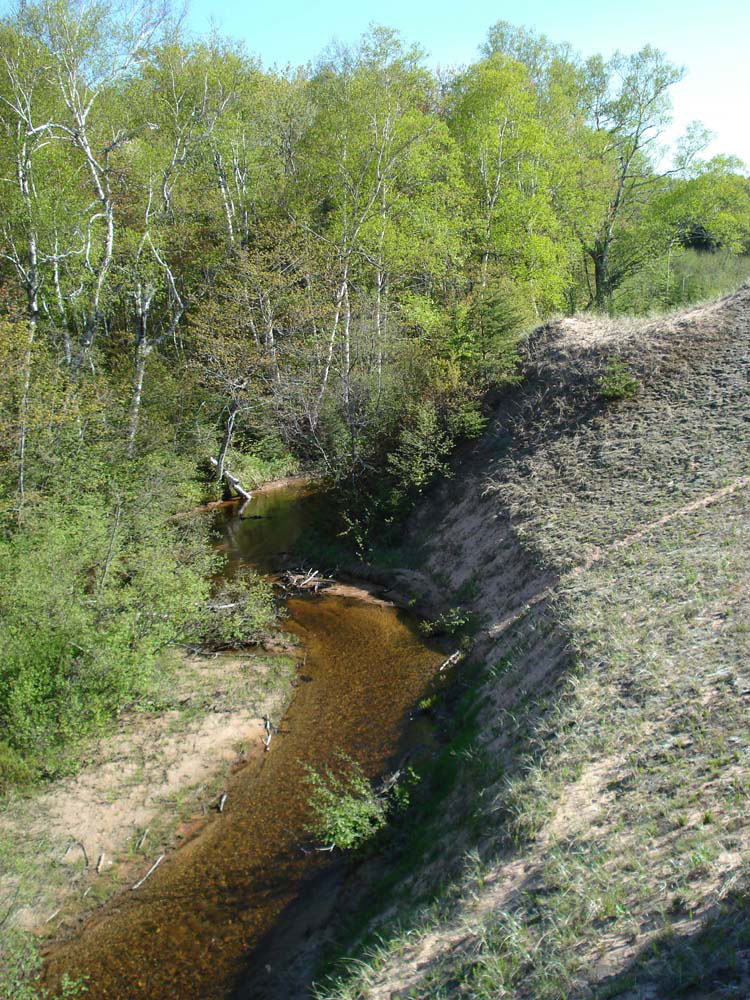
My goal by the end of the summer is to stand on every ridge in the Grand Sable Dunes. While hiking, I’ve discovered many interesting scenes. The picture below was taken from a high dune overlooking Sable Creek.


I also discovered that there are multiple “Ghost Forests.” These trees are uncovered when the wind blows and shifts the sand dunes. I hope that people who are lucky enough to come across these trees respects them and do not break them apart or take any of the pieces. Many of the uncovered trees are thousands of years old.


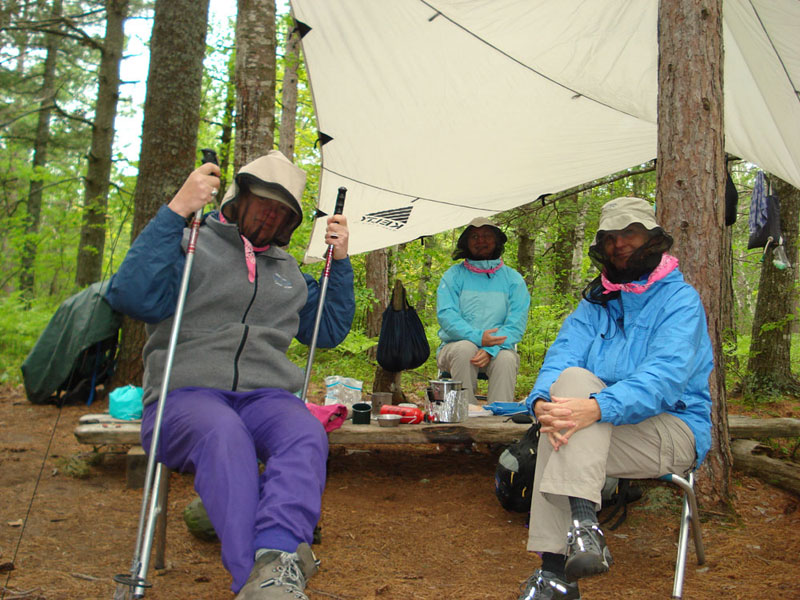
In June, I backpacked into Chapel to spend some time with friends. Here is a picture of the three of us outfitted for the elements. When the wind is from the south, it is sometimes necessary to arm yourself against the bugs. Thanks to Marsha Hendrickson and Denise Reitz for feeding me some wonderful meals at Chapel!


CUSTOMER AGATE FINDS: May 2008

With the melting of the icebergs on the beach has come the early-season agate hunters. Mike Miller makes a return to the web page with his friend, Terry House — both from the Muskegon/Fruitport area. Terry House found this nearly half-pound nodular agate with well defined banding around a quartz center fill. Mike Miller found two nice agates. The first is a small but beautiful agate with a carnelian center. The second is an absolutely amazing water level agate that is around a third of a pound. These agates and more were found east of Grand Marais. Congratulations Terry and Mike!


ROCKHOUNDING AND ADVENTURE TRIPS: Gravel Pits – May 2008

Since former museum intern, Nick Rudell, is now working at Circuit City in Grand Rapids and former intern, Candace Prill, was not sure of the timing of her return from Ecuador, where she has been teaching this winter, there will be a new face behind the counter this summer. Fellow artist, Kim Amthor, will be behind the counter much of July and August. This is necessary in that I’ll be busy with 3 summer shows as well as my son’s wedding.

Although Kim has found a few agates in the past, she needed a crash course in agate hunting. Since I had to go to Minnesota to delivery copies of the agate book to various retail outlets, we decided to also take time to visit the gravel pits. Retired teacher and fellow agate lover, Jill Phillips, went with us on a quick three-day trip. After driving all day, we arrived at our favorite gravel pit on a Monday night and looked for a couple of hours. We agate hunted on Tuesday morning for 3 hours and then for another 2 hours on Wednesday before returning home. We were all quite successful finding around 100 agates one inch or bigger with the largest around 1/3 of a pound. We were hoping to find a “fister” but were not so lucky…

As I explained on the home page, while agate picking the first night, we engaged in conversation with a fellow picker who said he was a part-time employee of the gravel pit. He told us about the vandals who had stolen wire off the heavy equipment, causing $5,000 in damage and shutting down the gravel pit this spring while repairs are being made. He also explained that after years of resisting the trend of closing gravel pits, the owner is now going to close our favorite pit. This is the same owner that kept the pit open to agate hunting even after his three-generation collection was stolen a few years ago.

We were so upset that thieves had ruined it for those of us who enjoy agate picking at the Omar gravel pits, that we decided to meet with the owner to tell him how sorry we are that people don’t respect his generosity. I also decided to gift the owner, Doug Omar, with a free agate window as thanks for many hours of happy hunting in his gravel pits.

After listening to Mr. Omar’s stories, we were even more outraged at the behavior of “visitors” to his gravel pits. Not only was wiring taken off the equipment this spring, but also last fall. In addition, more and more people have been littering at the pits including burying dirty diapers in the gravel. Apparently, when he sells a load of gravel that contains littered garbage, he doesn’t get paid for the gravel. Parents also let their unsupervised kids climb and disrupt the sand piles, and throw rocks around the pits. This rock throwing is dangerous and could harm other agate hunters. Also, the kids mix the rocks from one sorted pile to others. Some agate pickers are also TOO bold. They climb dangerous vertical cliffs risking injury or death should the sand and gravel collapse. They also refuse to stay away from working equipment, often disrupting operations and risking injury. Finally, during nonworking hours, four wheelers tear up the pits. Two who were four wheeling while intoxicated were seriously injured. One had to be airlifted to the hospital. These are just a few stores — there are many more.

Doug, should you read this web page update, I would like to thank you for allowing us access to your pits. I don’t blame you for closing them. On behalf of all those who have spent happy hours looking for agates in your gravel pits, thanks for all the years of happy hunting.

History’s Gem of the Month: Old Postcards

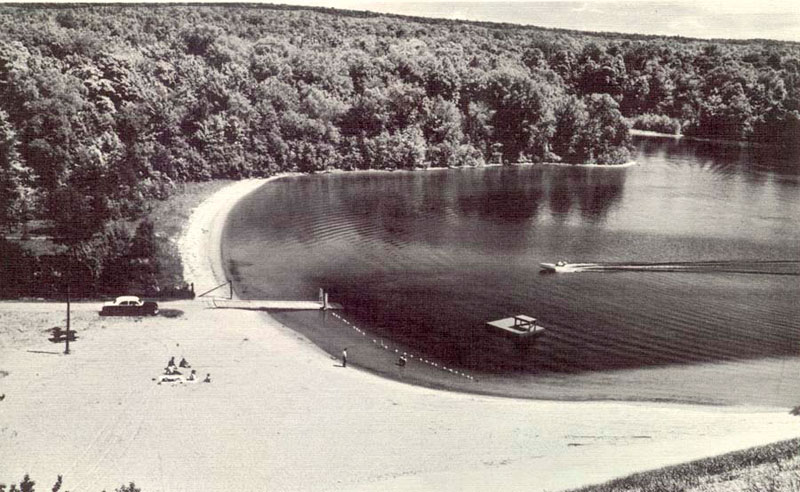
The Gem of the Month for May includes two old postcards I found among my mother’s things. The first is a picture of Sable Lake taken from the bluff of the dunes. The photo was taken by John Penrod of the Penrod/Hiawatha Company out of Berrien Center, MI. On the back there is the following notation:

Grand Sable Lake and Dunes — This is a part of the Pictured Rocks National Lakeshore, a region of outstanding beauty between Grand Marais and Munising, Michigan.

Although there is no date on the postcard, the fact that it mentions the National Lakeshore places it after 1966, when the lakeshore was formed by federal legislation. Also, the existence of the swimming raft and buoyed swim area dates the picture to the late 1960s or early 1970s. Lastly, note that this picture was taken well before the new road was constructed in the 1990s, which changed the shoreline of the lake and eliminated most of the swimming area.

The second picture, also taken by John Penrod, is of an assortment of Lake Superior agates. On the back of the postcard is the following information:

Lake Superior Agates from Northern Michigan. A beauty often hidden by a rough outer surface reveals vivid colors and strong translucent designs when cut and polished.

I am not sure where and when this photo was taken, but there are some nice agates among the assortment!

MINERAL OF THE MONTH: May 2008 Apophylite

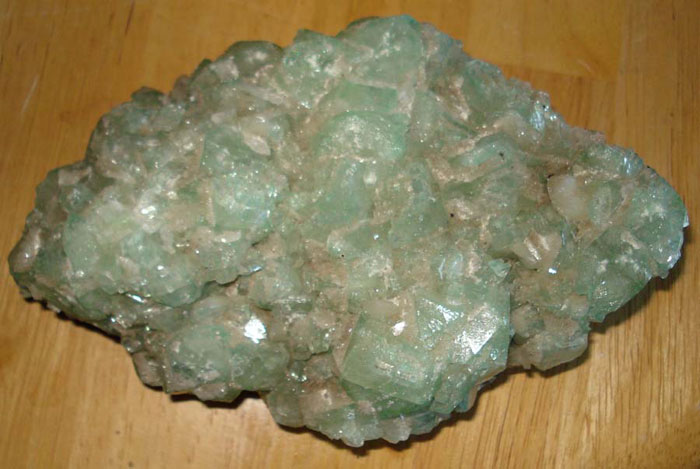
The mineral of the month for May 2008 is Apophylite. This specimen was acquired from a Brazilian dealer who was liquefying his entire inventory at the Tucson show a couple of years ago. He said something about wanting to go fishing. Apophyllite is in the Silicate class of minerals, which tend to be translucent and are lower in specific gravity and harder than most minerals. All silicates contain the silicate atomic structure, whose fundamental building block is the tetrahedron, in which one silicon atom is surrounded by four equally spaced oxygen atoms. Other silicates include quartz, chalcedony, opal, orthoclase feldspar, and amazonite.

Apophyllite is a hydrous calcium potassium fluorsilicate. It can either be colorless or white, gray, green, yellow, or red. It has a hardness of 4 ½ to 5, a specific gravity of 2.3, and has perfect cleavage in one direction. The crystals are tetragonal, usually cube like or tabular and square in cross section. It forms at low temperatures and is commonly found in cavities in basaltic pockets, where it is often associated with zeolites and prehnite. Although this specimen is from Brazil, Apophyllite can be found in the copper mines on the Keweenaw Peninsula among other places world-wide.

The name, Apophyllite, means “to leaf apart” in Greek. The name derived from the tendency of the crystals to peel off when specimens are heated due to the sudden loss of water molecules within the structure. Although collectors refer to this mineral is Apophyllite, it is no longer officially classified as a mineral. Originally, the group name referred to a specific mineral, but was redefined in 1978 to stand for a class of minerals of similar chemical makeup. Apophyllites are popular as with collectors due to their well-defined crystals, color, and abundance.

The metaphysical properties of Apophyllite are thought to enhance your analytical skills and enable you to act in a truthful and honest manner. It can also be used to help you evaluate your behaviors and attitudes so that you can identify and correct any shortcomings.

CURRENT GRAND MARAIS SCENES: May 2008

This month’s Grand Marais Scenes feature photos that were taken while I’ve been on my daily exercise hikes. The first photo was taken from up in Grand Sable Dunes. It shows an interesting angle of the dunes with the breakwater in Grand Marais in the distance. The second picture shows my friend, Scott Wieting, as we were walking back after the long dune trek, after which we climbed down the Grand Sable Banks and returned via the beach. Notice all of the rock on the beach.

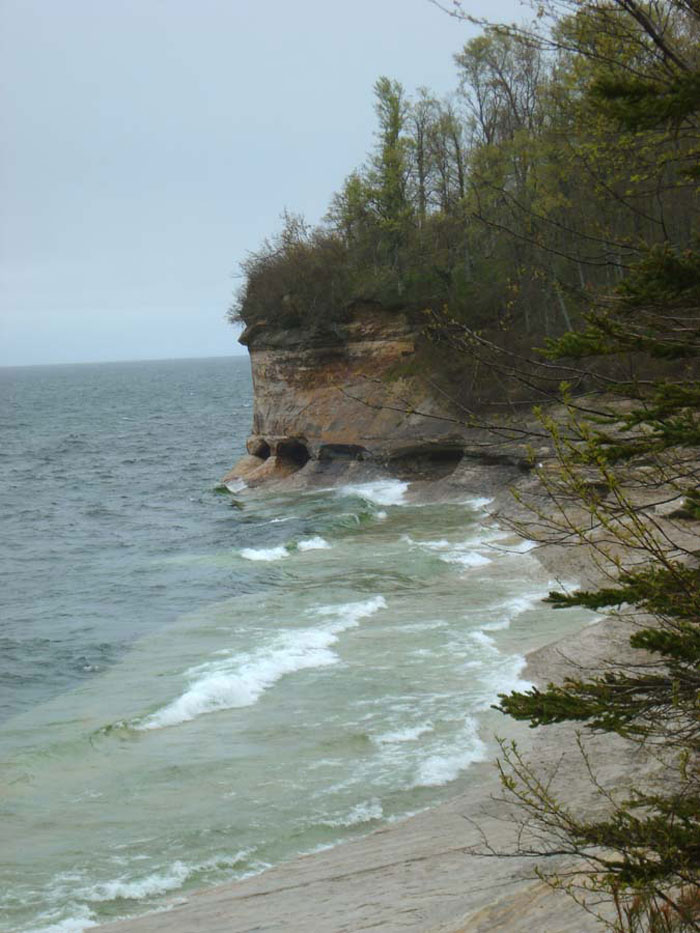
The next two photos were taken on Memorial Day. My friend, Kim Amthor, and I left Grand Marais around 10:30 am and drove through Melstrand to the Chapel Parking Area. Our plan was to hike the “Chapel Loop,” which we successfully accomplished. In Grand Marais, it was 64 degrees when we left. The first picture was taken not long after we hiked past Chapel Rock heading west toward Mosquito Beach. During the next hour or so after taking this picture, the temperature dropped around 26 degrees and the wind increased to more than 30mph. I must admit that I didn’t bring any gloves and had to share the pair Kim brought so that my fingers were warm enough to properly operate my camera. The second picture was taken at Mosquito Beach after the cold front moved through. The moral of the story is that whenever you are hiking on the Lake Superior shoreline, you must be prepared for almost anything. Yet again, I learned this lesson the hard way!