I recently received another email from Tina Allera, from Canton, MI. Pictured below are some more Lake Superior agates that she found in the Grand Marais area.


Gitche Gumee Agate and History Museum
Grand Marais, Michigan

I recently received another email from Tina Allera, from Canton, MI. Pictured below are some more Lake Superior agates that she found in the Grand Marais area.
This month’s featured mineral is fossilized dinosaur bone. For the new agate book, Tom Shearer borrowed samples of fossilized bone from Mark Anderson (www.differentseasonsjewelry.com). The specimens pictured below come from Utah. Although they certainly have agate pockets, technically the fossilization process is different than the agatization process. Therefore, these specimens are classified as fossilized dinosaur bones that have agate pockets.
You might wonder how these bones become fossilized in the first place. The process happened as follows:


Late last year I received an email from Tina Allera, from Canton, MI. They come to Grand Marais agate hunting every year. In her email, she says she loves looking at the other customer agate finds. Well her agates have now made the web page. She found all four of these agates right in town.


Reprinted with permission from J. Carter.
While my friend, Renee Beaver-Stocking, was cleaning out a closet in a home that she is house sitting for this winter, she came across this high school paper written by James Carter in 1953. He later went on to not only own a newspaper in town, but he also published Voyageurs Harbor as well as a book about the Seney Stretch. The paper is 17 pages long, so we will publish it in multiple parts.
To The People of Grand Marais I Dedicate This Story of Our Town
As we look upon Grand Marais today, a peaceful, sleepy fishing village nestled around a picturesque harbor on Lake Superior, there is little to suggest to us it’s colorful past. There is little to tell us of the many famous voyagers who regularly stopped here to seek haven from lake storms; of the struggle of its early pioneers; of the lumber boom; or of the many colorful and somewhat tragic events that took place at this harbor.
As no account up to this time has ever been written of Grand Marais, and because there are virtually none of the original settlers remaining with us to give an account of early events, it has been difficult to write an accurate description of the early existence of the village.
The following is a brief account of the story of Grand Marais.
Grand Marais is a French name meaning Great Marsh. French explorers named the harbor “Le Grand Marais” early in the sixteenth century. This name first appeared on a French map printed by Charlevoix and Bellin of Paris, in 1744. The name apparently stuck with the region, and appeared on nearly all maps of the Great Lakes from that time on. Just where the “Great Marsh” was is not definitely known.
The first settlement at Grand Marais was begun shortly after the Civil War at what is now known as east Bay. It consisted of a group of log houses clustered on the bluffs on the south side of the bay. The little hamlet could boast of only a handful of residents. Isolated as the village was, being accessible in summer by lake schooner and in winter by snowshoe, its hardy pioneers managed to make a living by fishing and a little lumbering.
During the first two decades of its existence, Grand Marais grew very slowly. By 1883 the population numbered only about one hundred – although the village could now boast of a few substantial fishing craft and two small lumber mills. The following year, however, proved to be a rather eventful one for the little hamlet. It was during this year, 1884, that the United States officially made Grand Marais harbor a harbor of refuge; the village plat of East Grand Marais was laid out; and on March 21, the United States Post Office was established with Freeman C. Hogle appointed as postmaster.
At nearly this same time C. Coon began a sizable pine mill at East Bay. The lumber and timbers produced by this mill were shipped by water to Sault Sainte Marie.
The Bountiful supply of fish was also tapped on a fairly large scale. The Conable Fish Company started fishing out of the harbor with two steam-powered tugs and a few sail craft. Shortly after, the Buckeye Fish Company and the Booth Brothers began fishing operations at the village, as did the Endress Fish Company. White fish and trout were plentiful as were other less desired species. The fishing expanded and prospered. The fish were shipped by boat to Marquette, Sault Sainte Marie, and other lake ports.
Grand Marais now began to prosper. The location of the village had by this time moved considerably west of East Bay. New log homes were now being built in the vicinity of Carpenter Creek. It was here that Mr. Rush Beadon built the first frame structure in Grand Marais. It is at present the Ahlgrin residence. Mr. Beadon is also credited with opening the earliest business establishment, a general store.
As the town grew, it gradually expanded toward what is now West Town. Here the main business district started. Mrs. James Commings established the earliest hotel of the village, the “Wabash,” in this new location. The hotel was a huge log structure, to which was later added a still larger frame addition. Mrs. Commings claimed to be the first white woman in Grand Marais.
A few years later, Enos Petitpren began a grocery store in East Town near the present Ahlgrin residence. Mr. Walter Bell also began a general store in West Town, where the present Mannisto Tavern now stands.
The village was growing slowly but surely and in 1890 the official census gave Grand Marais a population of one hundred and seventy-seven. The boom was just ahead. The vast tracts of virgin white pine that lay to the east, south, and west of the village were soon to be cut. Lumbermen, who had depleted the pine forests in Lower Michigan, were soon to pull stakes and move to new fields: the Upper Peninsula and the West Coast.
The time had finally come for Grand Marais. In 1894, the Alger-Smith Logging Company extended its railroad, the Manistique Railway, from Seney to Grand Marais. The saying “the town came in with the railroad” was certainly true. During the winter of 1894, logging camps were established, docks built, and the town’s largest mill, a pine mill, was transported from East Tawas, Michigan, where it had been in operation a short time. It was set up again near the present Municipal Power Plant. The mill began operations in the spring of 1895.

Meanwhile, a passenger coach had been placed in service between Grand Marais and Seney and people flocked to this new lumber center of activity. By mid-summer, the former hamlet had mushroomed into a village of over one thousand inhabitants.
The years between 1894-1900 marked the greatest boom. Saloons reached the number of twenty-five, a large number of which were on the main street. Two newspapers were established – the Grand Marais Herald by A. De Lacy Wood in 1894, and the Grand Marais Leader by George Miles in 1896. Morse and Schneider moved their business establishment from Seney to Grand Marais shortly after the railroad came in, as did W.W. Hargrave (later Hargrave and Hill). Both establishments were leading places of business in the city. Churches were erected. The Catholic Church was the first to hold services in Grand Marais, being established here in 1894. It was followed by the Episcopal and Methodist in 1896, Presbyterian in 1898, Swedish Lutheran in 1900, and the Finnish Lutheran later in 1907. Aside from the establishments and churches already mentioned, Grand Marais had many places of business: three drug stores, two tailoring establishments, restaurant and bakery, jewelry store, two livery stables, three meat markets, two tonsorial [barber] parlors, two photographic galleries, at least a dozen boarding houses, three dry-goods stores, laundry, a number of general stores, dress-making parlor, three candy stores, and two blacksmith shops. The Grand Marais Exchange Bank was set up in the R.E. Schneider building, but never did open for business.

Although we have had snow cover in Grand Marais since early December, the total snowfall amount is much less than in previous years. We’ve only had one big storm, which occurred around Christmas time. In January, we have only received a few inches of snow. There is still a lot of winter left; we will have to see what Mother Nature has in store for us.
This month’s feature scenes are from some of the outdoor adventures I’ve had with friends.
The first couple of photos were taken while on a very adventurous bushwhacking cross-country ski trip in the school forest with friends Andy and Craig. I learned the hard way that it is not easy to ski in deep snow when you have skies meant for track skiing. After three falls and much effort, it was nice to see the Lake Superior beach from the vantage point east of town. The wind was definitely whipping off the lake, so we didn’t hang out at the bluff very long. Notice the beginning of the ice build-up, as well as the floating ice balls, waiting their turn to accumulate and become part of the rows of ice that hug the shore. I skied back to H58 on the snowmobile tracks, rather than bushwhacking. The second photo was taken on the trail next to the Sucker River.


A week or so after that I decided that I needed to get off my writing chair and go down to the beach; the wind had finally diminished after a couple of weeks of blowing, so museum assistant, Candace, and I snowshoed from the boardwalk in town down the beach to Sable Falls, and back. You can see from the first photo that the ice was piled on shore around ten or fifteen feet high. This shot was taken from in front of Woodland Park looking west. The next shot was taken of a teepee built on the beach by pre-winter tourists. They certainly had some time put into that project! Is anyone ready to move in? The third picture is Sable Falls. Yes, the waterfalls are hidden somewhere under all that ice.


The third week of January I went out of town with a friend, Dianna. It was a beautiful sunny day that drew us outside. In the winter, because of lake effect snow and clouds, we don’t have much of an opportunity to see the sun. We celebrated by skiing Canada Lakes in Newberry as well as Tahquamenon Falls, located north of Newberry. Below is a picture of Tahquamenon Falls, as well as a close up of some of the ice hanging from the cliffs next to the falls. The icicles in the latter picture are 70 or 80 feet long!


While at the Muskallonge Show in September at Deer Park, several people brought agates by to show me – all day long! Here are just a few.
Susie Hales from Clare, MI showed me this 10 pound agate found near Grand Marais. She calls it the brain agate.


Donna Sheehan from Cedar, MI displayed several agates, including this interesting paint stone agate with colors from the southwest.


John Marchese from Newberry, MI showed me several agates including this paint stone agate and peeler agate.


Dick Wheeler from Pike Lake, MI found this large three pounder.


Sally Ahrndt from Skandia, MI was showing off this 100 year old Scottish agate broach.


While I was in Minnesota, a friend who wishes to remain nameless showed me this fantastic candy stripped fister. We all wish we could find one like this!


The Fairburn Agate is the state stone in South Dakota. It is named after the town from which the first agates were found: Fairburn, SD. This is an unusual agate, in that they formed in sedimentary rock, rather than igneous rock in which most other agates formed. This sedimentary genesis probably contributed the minerals which cause the brilliant color of Fairburns. These agates are also known for the extreme color contrast in the banding. The agate bands typically have sharp peaks, often resembling a maple leaf pattern. Most Fairburns have concentric fortification banding.
These agates are found in the grassland and badland areas surrounding the Black Hills, located in the southern part of the state. It is believed that the sedimentary rock matrix in which the agates formed were uplifted when the Black Hills formed. As the limestone eroded, the hard agates eroded out. As they moved downstream with eroded material, many of the Fairburns were rounded and river polished.
The value of a Fairburn agate is determined by size (most are small—only a few ounces), color, quality of banding, number of bands, shape of the fortification pattern, and condition (fracture free). As far as I know, a Fairburn agate still has the record for the highest priced agate sold on EBay. Several years ago, a Fairburn agate sold for $13,000.
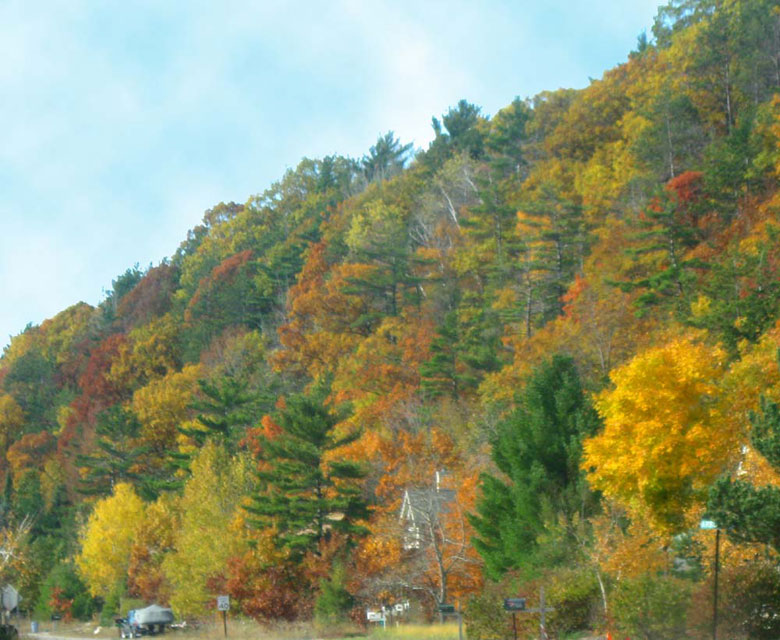
Travel has been occupying my time lately, so I have not been home enough to get out in Grand Marais very much. However, I do have a couple of fall color shots.

During my travels this past year, I have been looking for roadside Americana art. I saw two examples on my recent trip. The first is a fisherman creation in front of someone’s house.


This month I have several customer agate finds to entertain your rockhoundedness. Although the picture does not do the agate justice, a frequent visitor to the Grand Marais area found this bizarre agate that has amethyst bands as well as brecciated agate sections. He also found a fairly large carnelian agate – but the photo of this specimen did not turn out. Sviatoslav Kozakov is from Warren, MI. They make several trips back and forth all summer long to look for agates. His daughter, Zorian, who is two years old, is also a junior rockhound. One of the very first words she spoke was “agate.”


The next series of agates were shown to me last weekend while I was in the Paradise/Whitefish Point area. First is Becki Cornish, who lives in the Paradise, MI area. She first brought in this lacey amethyst agate to the Whitefish Township Library while I was giving my agate lecture.


Then, when I was at the Shipwreck Museum, she brought in this beautiful Lake Superior agate that also has an amethyst section.


With Becki on that Friday, was her rockhounding friend, Sheryl Wegmann. Sheryl spends time in the Paradise area in the summer, but is from Corpus Christy, Texas. She found two incredible agates, both with a yellow cast which is typical of many of the agates found at the eastern end of Lake Superior.


Finally, another agate I saw at the library was brought in by Joan Snyder. At first glance, the agate looks like sandstone. But upon closer examination, especially after we applied water, the beautiful banding was exposed. My guess is that this is an agate that formed in a sedimentary rock pocket. What a beautiful specimen!


In the iron-rich areas around Lake Superior, there are deposits of banded iron formation. In addition to being called banded iron formation, many rockhounds label specimens as Jasperite, Jaspite, or Jaspelite. This is a distinctive type of rock found in Precambrian sedimentary rocks. The structures consist of repeated layers of iron oxides, either magnetite or hematite, alternating with bands of iron-poor chert or jasper. Some of the banded iron formations date back to 3 billion years ago. However, most formed around 1.8 billion years ago: others are much younger.
The total amount of oxygen locked up in the chemical bonds of the banded iron beds is believed to be perhaps twenty times the volume of oxygen present in the modern atmosphere. Banded iron beds are an important commercial source of iron ore. They exist in several areas of the world including Western Australia, Minnesota, and the Upper Peninsula of Michigan.
Scientists believe that the banded iron layers formed in sea water as the result of oxygen released by photosynthetic bacteria. The oxygen combined with dissolved iron in the oceans to form insoluble iron oxides, which precipitated out forming a thin layer at the bottom of the ocean. It seems that the amount of oxygen varied, perhaps by season, so that at other times chert or jasper formed intermediate layers when oxygen levels were lower.
The picture of the Jasperite boulder included above is in a boulder garden at my friends house (Kat and Ken), who live near Aitkin, MN. The other photo I took of a specimen for sale at the Ishpeming Gem and Mineral Show earlier this month.