MINERAL OF THE MONTH: June 2010 – Nantan Meteorite


A meteorite is a piece of a meteor that reaches the earth’s surface. Most of the meteorites found today were not witnessed when they fell. The Nantan meteorite fall is an exception. In May of 1516 during the reign of the Chinese Emperor Zhengde, the meteor hit the atmosphere above the Nantan province of China and broke into thousands of pieces that ranged in size from .35 ounces to 4,400 pounds. It is thought that the total weight of the meteor before it broke apart was around 20,900 pounds! The meteorite pieces were spread over an area that is approximately16 miles long and five miles wide.

A few years ago it was much easier to purchase Nantan meteorite specimens. Today they are very expensive costing around a dollar a gram. The one pictured below was acquired at the Denver Gem and Mineral Show around ten years ago. It weighs a little over one pound. Most of the Nantans that you see for sale are heavily oxidized. This is because large portions of the meteor was composed of iron oxide (rust) and not iron. By contrast this specimen came from the core of the meteor and is composed of approximately 98 percent metal. In addition to 92 percent iron and 6 percent nickel, more than ten minerals have been found in the Nantan meteorites including kamacite, taenite, plessite, scheribersite, triolite, graphite, spherlite, sideroferrite, dyslytite, cliftonite, and lawrencite. The Widmanstattern cross-banded woven pattern that is typical in iron meteorites is obvious in polished Nantan pieces.

What is interesting about these meteorites is that no one paid attention to them until 1958 when China needed a lot of steel to push the country a “Great Leap Forward”. During this period, everyone was told to look for iron ore. Farmers knew about the iron rocks and had found that they were so pure that they could not be melted in a regular fire. They reported the specimens to the government and scientists were able to prove that the “iron ore rocks” were in fact iron meteorites.

P.S.—I didn’t realize until today that I featured Kentucky agate twice in the last few months as the selected mineral. Chalk it up to having too many things to do and not enough time to do them. I apologize for the duplication.

History’s Gem of the Month: Box of Rocks Gets Diploma

June 2010

Reprinted from recoilmag.com, July 2005 issue

Pinconning, Mich. — A historic collegiate achievement was realized Friday when a medium-sized cardboard box containing a half-dozen rocks received a Bachelors Degree of Science in Business and Marketing from University of Phoenix Online, a popular online college. “Congratulations! You’ve graduated!” the box of rocks was informed by e-mail following the completion of the course’s final exam. “Welcome to the exciting world of Business/Marketing! Click here to register for a Masters Degree from University of Phoenix Online, the nation’s leading University for working professionals.”

According to sources, the box of rocks had been able to obtain its degree online in only three years and without having to seek a leave of absence from its current job at a Pinconning residence, where for five years it has been solely responsible for stopping a porch’s screen door from opening all of the way.

The event marked a milestone for the inanimate object, which had previously received no formal education via public schooling or private vocational training. University of Phoenix public relations director Kyle Rise refused to disclose the cumulative grade point average earned by the box of rocks, but confirmed that it had indeed earned passing marks in all of the courses required to receive a diploma from the atypical school.

“That a box of rocks was able to earn its degree through the University of Phoenix’s online program is proof positive that anyone or anything – regardless of social class, cognitive ability or financial resources – can, through hard work and persistence, earn a college degree,” said Rise. Rise speculated that news of the box of rocks’ achievement could spark increased enrollment among demographics previously absent from the University’s student body, such as bags of hammers, telephone poles and other similar objects.

CURRENT GRAND MARAIS SCENES: June 2010

Since I now maintain the blog at www.agatelady.blogspot.com as well as this web page and include photos on both — I was originally going to separate photos and not duplicate. That is difficult so I’ve decided that the photos on this web page will be my favorite from those included during the previous few weeks on the blog.

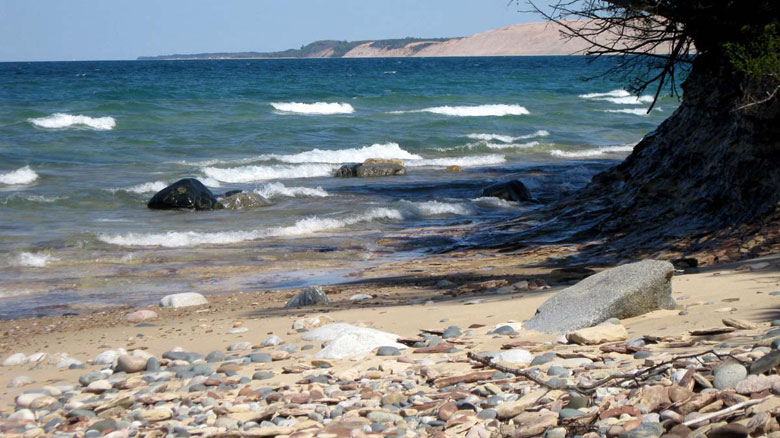
This month I am including a couple of photos taken during a hike from the Log Slide to Au Sable Lighthouse in the Pictured Rocks National Lakeshore. There is a crew of people upgrading the lighthouse complex as well as restoring it to the 1910 era. The lighthouse tower has never looked so good.


Approximately halfway on the hike, there is a bridge that allows you to climb down and gain access to the beach. This is one of my favorite spots in the Grand Marais area.


I have started training early for another Grand Canyon hike that is scheduled for next January. Here is a photo I took during a dune hike of one of the many telegraph poles that at one time connected Au Sable Lighthouse with Grand Marais.


I recently had an invitation to golf on Mackinac Island. I had the opportunity to fly over instead of taking the ferry. Although I have flown over to the island before from St. Ignace, I have never done so during the warm months. The flight provided the opportunity to get this great shot of the Mackinac Bridge.


While on the island I was able to enjoy a sunset from a friend’s property, located on the west end of the island.

CUSTOMER AGATE FINDS: April/May 2010

The rocks are plentiful at the current time due to a lot of spring storms that have, at least for now, pushed the rocks up onto the beach.

Here are a couple of shots of an unusually colored moss agate that I found on Mother’s Day.

John Lubor from Minnesota found this agate very early in the spring.

Sue Wiersom was also out agate hunting in early spring when there was still ice on the beach. She was rewarded with this little gem.


MINERAL OF THE MONTH: April/May 2010 – Kentucky Agate

The mineral of the month is Kentucky agate. It became the state stone for Kentucky in 2000. This agate is quite unique in its coloration. It most typically has bands of yellow, black, and gray. Occasionally there are sections of blue, red, pink, or orange. This distinctive agate was formed in shale and siltstone in the Borden layer of the Mississippian geologic period between 225 and 375 million years ago. They can be found in Estill, Jackson, Lee, and Powell counties. Hunters find them most often in the Buck, White Oak, and Middle Fork Creeks. Due to the hilly terrain, rains cause the creeks to rise sometimes 10 or 15 feet, depending on the location. The rushing water washes the agate nodules out of the sedimentary layers. Since most Kentucky agates have thick husks, successful hunters use a rock hammer or other metal object to hit the rocks in the river. The silica rocks have a “ping” sound, as compared to other river rocks that have more of a “thud” sound. Not all silica rocks found in the creeks are agate, however. There are also silicified fossils, geodes, and quartz balls.

The photos included in this update were taken by Tom Shearer. These are three of the photos from the new agate book Please see the gift shop section of this web page for more information about the new agate book.


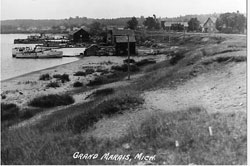
History’s Gem of the Month: The Story of Grand Marais, Part 3

 April/May 2010

Continued from March 2010, Part 2

Commercial fishing had by now reached its peak. In 1904, a record catch of 12,000 pounds of fish was brought in by the “William E.” of the Buckeye Fish Company. The supply of fish seemed inexhaustible.

The blueberry industry was important as a source of revenue for many people of Grand Marais. Families by the dozens camped on the pine plains near the town where the blueberries grew abundantly. Good prices were paid for the fruit; the main purchasing agent was the local railroad.

Between the years of 1894 and 1910 Grand Marais prospered as much as could be expected of a thriving lumber town. The population of the city reached three thousand. Homes and business places were painted and enlarged, sidewalks on the main streets which had been made of lumber were torn up and replaced with walks of cement, and trees were planted along the streets by civic-minded organizations and individuals … in a few short years this was all changed!

All was tranquil when, on May 20, 1910, out of the blue the death knell of Grand Marais was sounded. It came in the form of a posted notice to the effect that the Alger-Smith Company was about to definitely suspend all logging, sawmill, and railway operations. The reason given that the cut of pine had been completed, so the company was transferring its operations to northern Minnesota. Efforts were made to compel operation of the railway in order to preserve the town and remaining industries – all to no avail. The notice of suspension was given six months in advance. During that time the thriving community became nearly a ghost town. The cook, Curtis, and Miller Company was also forced to close because there was no way to transport timber from their mill to outside markets as railroad transportation would soon be not available. Many people moved to Duluth, Detroit, and the West Coast.

The fishing industry by this time became so unprofitable that this industry, or what was left of it, could not save the town.

Nearly all business houses closed doors, although the large Schneider and Hill stores stayed to serve the remaining population. The Grand Marais Herald, which had been published since 1894, closed its printing plant and moved its machinery to Munising on the last train out of town. The value of property hit a low mark – some large homes selling for as little as $500, other smaller houses were sold for as little as $50. Many people left with just what could be packed in a suitcase, left their homes and business places, and never returned. Grand Marais was nearly a ghost town for a few years following 1910, but slowly, very slowly, people returned to find some means of livelihood.

Soon after the railroad was removed in 1910, a road was built on the former railroad grade, from Seney to Haverstock’s Corner, and the following year was extended to the town. However, the township found itself unable to maintain and keep open the road during the winter months, so a collection was taken up and William Leighton, who was supervisor at the time, was sent to Lansing to ask the State to place the newly built road under its care. The State Commission consented, and in 1916 the road became Michigan Highway 77. The road was then improved, widened, and surfaced with gravel. [Note: research by museum staff at the state archive indicated that M77 was actually authorized in 1919, nine years after the railroad closed.]

It was then that motoring tourists discovered Grand Marais. The two-story “Pickle Barrel” house, an exact replica of a pickle barrel on a house-sized scale, was built for Mr. and Mrs. William Donahey of Chicago by Reid, Murcock, and Company in 1926. This was one of the first major attractions as it was widely publicized by the latter. Mr. Donahey, creator of the famous “Teenie Weenies,” was presented with this unique barrel house exactly as he had drawn the house for the Teenie Weenies in an illustration for that company at an earlier date.

Tourists found Woodland Park an ideal spot in which to camp. This beautiful tract of land had been presented to the town by the Gamble Estate to be used as a public park only, and could not be sold or used for any other purpose. The land was, as it is at the present time, covered with beautiful hardwoods and pine.

Perhaps the biggest attraction was the Grand Sable Dunes, highest in Michigan. The early French explorers were so attracted by these dunes that they placed them on their maps as “le Grand Saubles” (the Great Sands) as early as 1688. The settling of Longfellow’s famous poem “Hiawatha,” was supposedly on these dunes.

Grand Sable Lake proved very popular with the summer visitors. The lake was called, in the notes of an early surveyor, “the Diamond of the desert.” In recent years, a number of attractive summer cottages and tourist cabins have been built on the shores of the lake, which has afforded good fishing of perch, pike, and bass. [NOTE: Soon after the Pictured Rocks National Lakeshore was created by federal legislation in 1966, the houses and cabins on Sable Lake were removed.}

Not only did the tourist industry help to revive the village, but the commercial fishing was becoming profitable once again, and a number of tugs began to fish out of the harbor. By the 1930s fishing was again at its peak. Smith Brothers, Sellmen Fisheries, and the Endress and Masse Fish Company conducted fishing operations at this time. This latter company was the only business firm, other than Ostrander’s Drug Store, from the original concerns in Grand Marais. Other smaller tugs began fishing out of the harbor during this decade as well.

The cutting of timer was resumed, giving employment to a number of people. In 1927 a large modern brick school was constructed at a cost of $125,000. The building is one of the finest and best equipped in Michigan for a village of this size.

As Grand Marais is the first harbor west of the Soo Locks, it was rather important during World War Two. Soldiers were stationed near the village at Camp Fox, and the number of Coast Guards was increased at the United States Coast Guard Station.

After the war, Grand Marais prospered as did many small towns. In the period between 1945 and 1951, nearly thirty new homes and cottages were built within the village. In addition to this, new business places opened doors. The 1950 census gave Grand Marais a population of over six hundred. The town can now boast of its largest population since 1910.

The sport trolling industry has proved to be an important factor in attracting visitors to the village, as hundreds of people go trolling here each year. The sport trolling craft numbered sixteen in 1950.

Our large modern United States-Canadian airport and weather station has proved beneficial to the village in that it provides a number of people with permanent jobs, and it also affords a means of air transportation. This means is taken advantage of by many sport trollers throughout the summer season.

Rebuilding of the east pier is surely an asset to the village. The east pier was rebuilt with concrete and steel, and the west pier was repaired with rock and timbers, and a cost of $181,000 and $38,000 respectively. The use of nearly one-half million dollars has been okayed under the Rivers and Harbors bill, for the rebuilding and extending of the west pier although the funds have not as yet been appropriated.

Grand Marais is proud of its new, modern water system which has been recently laid at a cost of $125,000.

The recent raise of township taxes has made possible many improvements in the village and township. With the use of this tax money (approximately $8,000 annually) much will and has been accomplished in the way of improving Woodland Park, the village street lighting system, walks, and streets.

The future of Grand Marais appears to be rather promising, and one thing is certain – the village will never again be numbered as one of Michigan’s ghost towns.

I wish to thank the following people for their contributions.

  • Levi Meilleur
  • Mrs. Ray Meldrum
  • Arthur D. Wood (Munising)
  • Ray Barney
  • Henry Petitpren
  • John Masse
  • Miss Isabe McCell
  • Charles Mattson
  • Charles Newberg
  • Frank Lee
  • Mrs. Alfreda Mulligan
  • Vernon Maurer
  • Mrs. Joseph DesJardine
  • Louis Dowell
  • John Seymour
  • Axel Newberg
  • Mrs. John Peterson
  • Axel Niemi
  • Mr. Roy C. Hill

History’s Gem of the Month: The Story of Grand Marais, Part 2

 March 2010

Continued from February 2010, Part 1

The city had many fine civic clubs and organizations. Among these were the Kenningston Club and the Grand Marais Club. A fine opera house was built and it was frequented by many famous actors of the day. The Grand Marais Cornet Band was a favorite not only in Grand Marais but in the surrounding counties as well. The band was presented by the city with a fine bandstand, which stood near the Community Methodist Church. There were numerous unions for the local employees such as the Longshoremen and the Modern Woodmen of America. A unique club house, the interior of which was completely paneled in birch, was erected between the present Green Shingles and Goupille Service Station. Many memorable social events took place in this club house. The building caught fire and was totally destroyed along with many other establishments in the fire of 1905.

Education was by no means neglected in the midst of the boom. A frame high school and three elementary divisions were built, all four schools having a total enrollment of over nine hundred students.

New industries moved to the village at this prosperous time. A small cigar factory was begun by Thomas Regan. [NOTE: The cigar factory building is now the Gitche Gumee Museum.] His “closed Tuck” cigar was a favorite. The Walker Hardwood Veneer Plant, known as Birdseye Walker, was built where the village baseball diamond is now located. This plant was later turned into a stave factory. The large pine mill owned by the Alger-Smith Company was by no means idle. It was running twenty-four hours a day and turned out 150,000 feet of choice pine lumber during that time. The two band saws and the two circular saws of the mill were kept running constantly. The Cook, Curtis, and Miller Company built a large, modern hardwood mill which had a capacity of ten million feet of lumber annually. A shingle mill was also begun, and one of the earliest mills of the town, that of C. Coon, was sold to Charles Stone and continued operations.

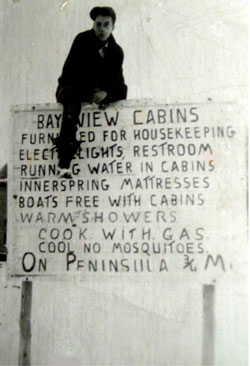
The leading hotels of the town, such as the Wabash, Nettleton, Grand Marais, Carpenter House, and the Bay View, were doing a fine business. Grand Marais was then as now, a tourist and hunting center. As the passenger train made only one run into the village daily, many salesmen were required to stay overnight at the hotels. Hotel Nettleton was a favorite lodging place for these men because of the fine fish dinners served there by its proprietor, Bill Nettleton.

To comply with the needs of the people, the large three-story Bay View Hospital was moved at this time from Oscoda, Michigan, to Grand Marais and reassembled opposite the Community Methodist Church. Doctors Wier and Anderson were its proprietors and surgeons.

Grand Marais could boast, too, of an up-to-date water system. In the spring of 1896, water works had been laid at a cost of $25,000. Previous to that time, however, the town was dependent on Mr. Peter Beaulieu who had delivered water at a consumer cost of twenty-five cents a barrel. A few years later, the Alger-Smith Company enlarged its electric lighting plant, wired the town, and furnished current at a moderate cost.

By 1897 the town had begun to settle down. A description of Grand Marais in the Grand Marais Business Directory, published here by Doig and Wood in 1897, reads as follows:

Grand Marais is a flourishing young town of three thousand industrious inhabitants, nestled on the flats at the foot of a steep terrace surrounding Grand Marais Harbor, an inlet on the south shore of Lake Superior, one hundred miles west of Sault Sainte Marie and eighty miles east of Marquette, and connected by the Manistique Rail Road with the Duluth, South Shore, and Atlantic Rail Road at Seney, Michigan, the former company having its terminus, car shops, and load offices at this town. The great natural resources and advantages of the town were dormant until 1894, when the Marais Lumber Company purchased their property from the Grand Marais Mil Company, after which they enlarged, rebuilt, and refurnished with first class machinery, having one of the best saw mills in the upper Peninsula, with a cutting capacity of over 150,000 feet of timber per day, this company shipped forty million feet of choice lumber the past year. In addition to the car shops and large mill, Grand Marais had a shingle mill owned by George W. Cowell, a square timber mill, and Hale, Booth, and Company, and Endress Brothers deal extensively in fish, the three concerns employing upwards of two hundred men. The town has a large number of business houses, every business being represented by practical and experienced men who all work together for the interests of the people of their thriving young town. The land companies have been diligent in their efforts to advance the town, and sell property at reasonable rates and on easy terms, giving poor men a chance to make homes. The town has many nice business buildings, three churches, and the largest and best school building in the county, well furnished and the instructors are first class and up to date teachers. Besides being a lake town having a safe harbor, Grand Marais has first class railroad communications, having regular daily trains to Seney and return. Naturally Grand Marais is a resort town, giving first class fishing and hunting as well as some of the grandest scenery of the country within a few miles of town. In addition to the above natural advantages, this town is backed up by the largest tract of agricultural land in the Upper Peninsula, which is being sold to settlers at very reasonable rates and on easy terms.

The harbor was a busy one—as many as forty-eight large craft have been counted in the harbor at one time. Passenger and freight steamers were making weekly runs between Grand Marais, Duluth, Marquette, and other lake ports. The United States Coast Guard established a life saving station at the harbor in 1899, with Benjamin Trudell in command.

To be continued……

CURRENT GRAND MARAIS SCENES: April/May 2010

CURRENT GRAND MARAIS SCENES

April/May 2010

Other than the day we had some snow in early May, which melted right away, it has been a beautiful spring. As is true everywhere else, the trees are leafing out, the trilliums are up, rocks are again exposed on the beach, and the days are getting longer. This transition in spring is even more dramatic in Grand Marais than it is in other areas. We especially enjoy the spring because all of the roads open up. It is great to be able to take a drive to see the beauty that is all around us.

Below are some shots that document spring in Grand Marais.


ROCKHOUNDING AND ADVENTURE TRIPS: Kentucky Agate Hunting – April 2010

In April during spring break, friends Gerald and Jill Phillips and I drove down to Irvine, Kentucky to go agate hunting. We teamed up with Scott and Melinda Hardy to learn the tricks of the hunt. I must admit it is totally different than looking for Lake Superior agates.

First of all, you need a pair of fishing waders. Although they call them creeks, in my opinion they are rivers. Not only was the current swift, but we had to portage around deep holes on several occasions. As I also explain in the Mineral of the Month update this month, you search by using sound. When you find round rocks in the river, you hit them with a rock hammer or other metal object. The silica rocks have a certain “ping” sound, as compared to other river rocks.

I must admit that the river was beautiful. It had a brilliant aqua blue green color. We hunted for six hours walking upstream in the river where ever we could and down a four wheel trail on the way back to our car. It was certainly a good time.

Here is a shot of the river and a couple of shots of Melinda, Gerald, and Jill.

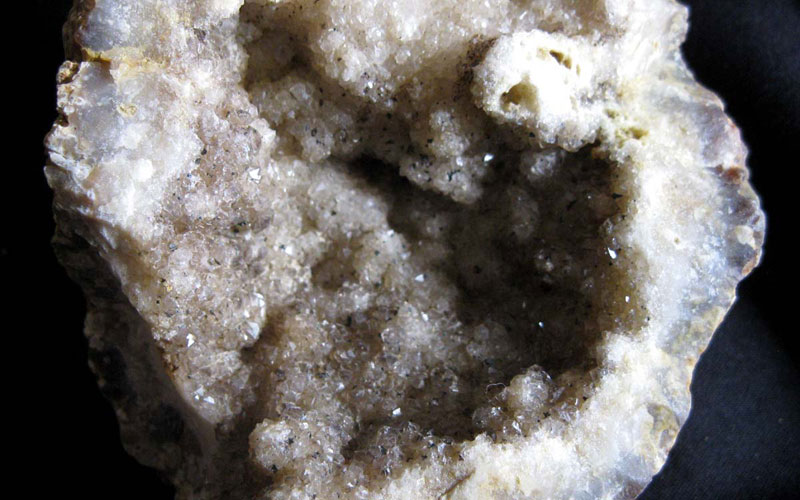
I have not yet cut any of the possible agates I found. However, I did buy quite a few from Scott Hardy. I have a great assortment for sale at the museum for prices that are far less than what you see on the internet. Here is one of the agates I purchased from Scott.

In addition to agates, there are a lot of other silicified rocks you can find in the river.


CURRENT GRAND MARAIS SCENES: April 2010

Since I update the blog www.agatelady.blogspot.com on a regular basis, I have decided that from now on any photos that I include in the regular web page update will be different than those that are included in the blog update.

Of all the snowshoe and ski adventures I have been lucky enough to participate in this winter, the best adventure took place yesterday. It was in the 40s with brilliant sunshine. Friend, Wendy Lynn, and I headed into the dunes from Sable Lake and headed northwest. Our goal was to get to the highest point in the dunes, which is at around 900 feet above sea level. The sun has been so intense lately. This combined with the warm southerly winds has caused most of the snow in the dunes to have already melted. I would estimate that the spring thaw is at least a month ahead of schedule.

The views yesterday were incredible. Here is a photo I took from one of the highest dunes looking east. You can see the channel lighthouse in the upper left of the photo. In the upper right of the photo, you can see a small section of Grand Marais Bay as well as what is left of Lonesome Point.

From the bluff around 1/3 of the way across the dunes walking east to west, you can see how the southwest winds are pushing some of the “pancake” ice back out into the lake.

At this rate of snowmelt as well as ice break up, we will have early agate picking in Grand Marais this year. That is, of course, if we don’t get a late season snow storm.

Here is one more shot that was taken from up in the dunes, looking back toward the dunes that are next to Sable Lake.