History’s Gem of the Month: Hints on Hunting and Finding Agates

 September 2009

While looking through the museum’s archives, I found this article drafted by the museum founder, Axel Niemi. I’m not sure if he ever published the article, but it is worthy of inclusion as this month’s history gem. I’ve also added a few pointers, so actually this is a joint article written by Axel and me.

Hints on Hunting and Finding Agates
By Axel Niemi and Karen Brzys

Michigan’s Eastern Upper Peninsula (Alger, Luce, and Chippewa Counties) is home to unique agate and jasper rocks. For the past 30 years, the author has picked pretty objects called quartz family minerals. This article presents an interesting view on how you, too, can assemble a collection of unique quartz treasures.

This Eastern Upper Peninsula of Michigan is covered for the most part by enormous sand-gravel-clay deposits. Few areas have yielded so wide a variety of quartz minerals, as well as other rocks. Few areas also show such promise of steady and continuous yields. Each year, ice bergs break off shore, move around the lake, get pushed up onto distant beaches, collect rocks from that beach, break free only to get pushed by northwest winds to their final resting spot on the beaches in the Eastern Upper Peninsula to melt and dump their loads. After 8,000 years of this happening, our local beaches truly are a melting pot of all the rocks found around the lake, as well as a new supply of agates each year. This combined with the till deposits left by the glaciers makes our local beaches a rockhounders paradise.

Many friends have examined the multiple varieties of agate and related quartz minerals on display in my agate shop. After telling them they that the specimens had come from gravel-sand deposits within a few hour’s to a few minute’s ride, I have sometimes been called a liar. Yes, although my success has resulted from patience and many hours of searching, I admit to the difficulties encountered in hunting these all but camouflaged mineral stones.

The difficulty in finding these gravel deposited elusives, arises in keeping one’s mind on finding not one but any of the host of varieties of quartz minerals. The average picker would be quite happy to find a nice banded agate or red carnelian. After examining what I had picked and finding them beautiful, tourist friends say they had thrown oh so many good specimens away. This I have learned is unlikely. One of the faults of most beach combers is that they are ignorant of the existence of these quartz treasures, and they usually cannot tell the difference between the different types of quartz rocks. Another challenge to looking for quartz minerals is the tremendous amount of tiny powdery fractures that camouflage the true nature of the mineral. Finally, while on the beach you are challenged by the fact that very few agates are scattered amongst billions of other iron-bearing red rocks and want-a-be agates. To be successful, you must be prepared to pick up and examine all the possible quartz minerals, while trying to avoid being distracted by other pretty rocks.

Agate hunting is a real challenge to those with good eye sight, and not recommended for those with eye defects. Of course, those with eye problems may have to resort to sitting and digging, rather than walking erect – which usually allows you to examine a larger quantity of rocks. As more and more pickers hit the beach, the supply of agates and related quartz specimens will be impacted. However, the wave-water action as well as moving ice will continually move the piles of rocks, wear new material into view, or transport new rocks to the Grand Marais beaches each year.

The area that is best for looking for agates runs from Au Sable Point in Alger County, across the northern edge of Luce County, to Whitefish Point in Chippewa County. This stretch of beach contains some areas that have easy access by car, as well as some remote sections not often explored.

The tips on how to successfully find agates are listed below.

  1. Walk and look, scanning the rock piles as thoroughly as possible.
  2. Look closely at every stone. You never know which one is the agate treasure.
  3. Practice, practice, practice. At first, your neck, leg, and back muscles will be sore and tired. The more you look for agates, the more your body will be up to the task.
  4. Read books and acquire samples of agates so that you know what you are looking for.
  5. Look near the very edge of the water. The water will help accentuate the banding.
  6. Also look in the dry rock. When dry, the shiny waxy luster and the conchoidal fractures will be more apparent.
  7. If you have hip boots or are willing to walk in the water, it is possible to spot agates – but the water must be calm. Also, agates are denser than other rocks and sometimes they tend to work their way below the surface of the rock piles located out in the water.
  8. If there are multiple rows of rocks on the beach, left over from surf with various wave heights, look for the related gold cherts and red jaspers. They are also microcrystalline quartz with the same density as agates. Thus, as the waves return back down the slope, agates, cherts, and jaspers will “fall out” of the wave at the same time.
  9. Look where others have not looked. The farthest you walk from road access the better.
  10. Be the first on the beach after a storm. This is when the gravel is moved around exposing new material.
  11. Do not cover too much territory too fast. It is better to look over one section carefully. Nothing pays off better than careful looking. Sometimes I’ll even walk over the same section 3-4 times, only to be rewarded by finding an agate that was previously missed.
  12. Concentrate on picking up only agates and other quartz rocks. Avoid the pretty rock syndrome. Let’s say you pick up 500 rocks in an afternoon of looking. If 400 of those are just pretty rocks that are obviously not agates, then you have only a 1 in 100 chance of finding an agate. If all 500 of the rocks you pick up are agates or want-a-be agates, you have a much higher chance of being successful.
  13. When you see an agate candidate – you must pick it up; even if your back tells you that you don’t want to bend down. Of course, the use of an agate scoop can also help. For what ever reason, the obvious banded sections of specimens are very often facing down, out of view. Thus, if you don’t pick up the rock, you may miss that it is an agate.
  14. Most agates have some apparent banding showing, or have some translucency. Usually if you are not sure it is an agate – it is not.
  15. Use proper protection for your eyes, such as a Visor cap. Although some may have success wearing sunglasses, I find that it is harder to spot agates while doing so.
  16. Use a bright flashlight, or carefully use the sun, to check specimens with backlighting. Sometimes backlighting will expose banding that you cannot otherwise see.
  17. Walk toward the sun (east in the morning and west in the evening). The translucency of agates will cause them to “glow” at you.

Some of the mineral treasures you can find on the beach, in addition to banded agate, include: red jasper, banded jasper, gold silicified fossils, banded chert, red translucent carnelian, water-level onyx agates, eye agates, sagenite agates, moss agates, tube agates, and shadow agates. You can also find some red, pink, and green unakite, limestone fossils, and feldspar.

Happy Rockhounding!

CURRENT GRAND MARAIS SCENES: September 2009

This month’s featured photos include a mixture of scenes. First, I’ve included a few from Whitefish Point, taken last weekend when I was there with a booth and teaching agate classes. The first is a picture taken from my booth on the porch of the gift shop, looking out over the museum complex. I must admit that the number of tourists was surprising, as was the care that the historical society has taken to preserve buildings, add new structures, and present information about Great Lakes shipwrecks. If you have never visited Whitefish Point, located 11 miles north of Paradise, I highly recommend that you plan a trip.

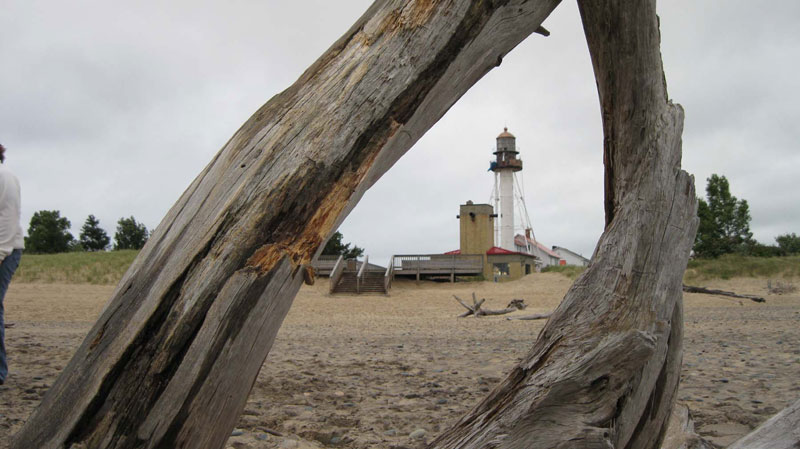
I didn’t get much of a chance to enjoy being at that location, due to the booth and the classes. However, early on Saturday morning, I did venture down the beach for a short time. The next picture was taken from the water’s edge, looking back at the lighthouse – taking advantage of an artistic piece of driftwood.

Whitefish Point had the first operating lighthouse on Lake Superior in 1849, although the current tower was erected much later. Since navigation began on Lake Superior, there have been approximately 550 wrecks, most of which occurred on the south coast. As a result, the south shore has been nicknamed “the graveyard coast.” More vessels were lost in the Whitefish Point area than any other part of Lake Superior. There are three major reasons for the high loss of ships in this area. First, the eastern end of the lake is very congested where the lake narrows down like a funnel. Up and downbound ships must pass through this fairly narrow channel-like bay. Second, poor vis

ility from the fog, forest fires, and snow caused numerous collisions and groundings in this narrow, congested bay. Finally, over 200 miles of open water with predominant northwest winds can build up terrific seas during storms, making navigation into Whitefish Bay quite a challenge.

Collisions were more common in earlier times because there were more vessels, and, of course, none of the modern navigational technologies. In the 1880s over 3,100 commercial vessels traveled Lake Superior, compared to less than 200 today. Since the first known shipwreck of a commercial vessel, The Invincible, in November 1816 to the Edmund Fitzgerald on November 10, 1975, approximately 320 lives have been lost along the Graveyard Coast. Below is a photo of makeshift memorial markers for 3 of the 29 crew members lost during the wreck of the Edmund Fitzgerald. I’ve also included a photo of a passing ore freighter to illustrate how close to shore the vessels must travel to get into or pass out of Whitefish Bay.

After returning home and working the museum one-day last week, my friend Renee Beaver and I went camping east of town. Pictured below are our cooking fire and the view we had of Lake Superior. Later that night, a fantastic lightning storm moved from southwest to northeast over the lake. Although we had hoped for Northern Lights, which have been nonexistent this year, we were satisfied with the incredible lightning show.

CUSTOMER AGATE FINDS: August 2009

The cool windy weather has tested agate hunters during the past month. There have been a few good days, though, and a few great agates found locally.

The first one to be featured this month is a different looking brecciated agate found by Larry Feist of Grand Rapids, MI. A breccia is a fragmental rock whose components are angular, which compares to a conglomerate that has water worn rounded pebbles. This brecciated rock seems to include fragments of amethyst and chrysoprase, as well as some banded sections.

While attending the Moose Lake Agate Days show, I also was shown this very large brecciated agate. Notice how the matrix in which the fragments are cemented is completely different than the Feist agate.

Just the other day this ¾ pounder was brought into the museum by Jeff Robbins. It has almost a perfect concentric banded face on top. This treasure was found by Jeff Robbins from Lake City, MI. He found it on the beach near Muskallonge Lake, east of Grand Marais.

MINERAL OF THE MONTH: August 2009 – Goethite

Goethite (pronounced: “Gertite”) forms by the oxidation of iron-rich deposits. It was named after the German multi-disciplinarian Johann Wolfgang von Goethe. It usually occurs as massive, botryoidal or stalactitic formations and tends to be found in soil and other low-temperature environments. It is in the hydroxide group with a hardness of 5 to 5 ½ and is blackish brown, or reddish to yellowish brown. It is opaque and has an orange to brownish streak. The luster is usually dull, but can be shiny on the crystal faces.

Goethite has been used since prehistoric times for its use as a pigment. Evidence has been found of its use in paint pigment samples taken from the caves of Lascaux in Southwestern France, dating back over 16,000 years. It was first described in the scientific literature in 1806 for occurrences in the Mesabi iron ore district of Minnesota.

Goethite is found all over the planet, but the most significant deposits are found in England, Australia, Cuba, Michigan, Minnesota, Missouri, Colorado, Alabama, Georgia, Virginia, and Tennessee. It was also found by NASA’s Spirit Rover, providing strong evidence for the presence of liquid water on the planet Mars at some point in its geologic past.

The metaphysical properties of goethite are believed to help you to enjoy the journey in life. It inspires pragmatism with imagination, bringing energy to pursuits of discovery. It also is thought to enhance communication and to provide for intensified concentration. It can facilitate body-building and also be used in the treatment of disorders associated with the ears, nose, throat, intestines, veins, and esophagus.

History’s Gem of the Month: Ship Travel on Lake Superior

August 2009

During the late 1800s and early 1900s, ship travel on Lake Superior was at its heyday. To help rescue ships that suffered the wrath of Lake Superior’s storms, the United States Lifesaving Service operated five stations along the southeastern section of the lake’s shoreline. Due to all the accidents, this section is often referred to as the “Shipwreck Coast.” There were stations in: Grand Marais, Deer Park, Two-Heart River, Crisp Point, and Vermillion Point.

The Grand Marais station was located at the west entrance to the harbor. It was built and placed into service in 1899. When it was completed, the station was considered one of the best in all of the Great Lakes. The station had 2 surf boats, a 34-foot self-righting life boat, and a full complement of beach apparatus.

Over the years of service, the crew from Grand Marais made hundreds of rescues. By 1935, 700 cases of assistance had taken place. The most spectacular rescue occurred on November 14, 1919. The Lifesaving crew, along with 4 civilians (Joseph Graham, Ambrose Graham, Ora Endress, and James MacDonald) set out to rescue the crew of the stranded steamer H.E. Runnels. The weather worked against them with blizzard conditions and monstrous waves. The rescue was complicated by ice covering the decks of the steamer. Although some of the rescuers were washed out of the lifesaving boat, no lives were lost. The crew members were awarded a Gold Lifesaving Medal including John O. Anderson, Alfred E. Kristofferson, Leon E. Alford, George Olsen, Glen Wells, Edward J. Spencer, Russell Martin, William Campbell and Joseph G. McShea.

The original lifesaving station was replaced with a new Coast Guard Station in 1940. Although it is still standing, it is now a ranger station for the Pictured Rocks National Lakeshore.

CURRENT GRAND MARAIS SCENES: August 2009

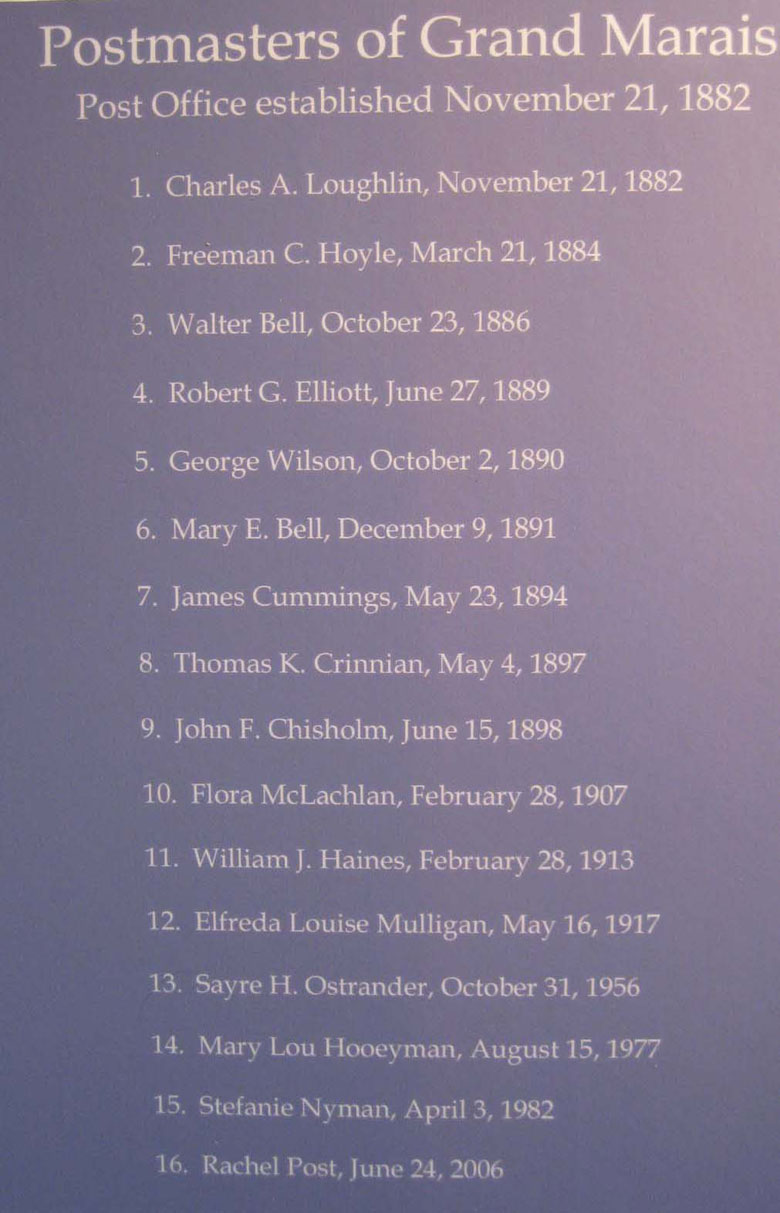
On July 25th there was a lot happening in Grand Marais. At noon, the historical society had a ribbon-cutting ceremony for the new Post Office Museum. This unique 5-sided building served as the Grand Marais post office for many decades. The building was moved from its original site to Main Street last year and has now been restored. Grand Marais has had a post office since 1882. The front section honors the postmasters who have served Grand Marais, including Elfreda Mulligan who served for 40 years, beginning in 1917. Although it has not been definitely proven, the historical society reports that she may have been the longest serving postmaster in the country.

The rear of the post office has been turned into a historical display, with information and graphics describing the history of Grand Marais.

I would like to congratulate the historical society for a job well done!

CUSTOMER AGATE FINDS: July 2009

While I was at the Muskallonge Show a couple of weeks ago, a woman drove from the museum to Muskallonge to show me the following agate:

I was so busy that I forgot to take a picture with her and the rock, and I forgot to get her name. However, it is such an unusual specimen that I wanted to include it anyway in this month’s update.

One of the other dealers said he thought it was man-made. I don’t agree. I have seen similar agate-looking rocks which are actually accumulations from paint booths. However, those usually include more brilliant colors and those specimens are opaque – all of the bands. Furthermore, those paint-rocks all have solid bands, not any with miniature geode gaps.

This specimen looked a lot different than anything I’ve ever seen. Some of the bands appear to be clear chalcedony. I didn’t take a picture of the top of the specimen, but there was sedimentary matrix showing on the top.

My guess is that this is a seam agate that formed in sedimentary rock in a marine environment, perhaps in the tidal flats.

The person who showed me the rock said she purchased it at an estate sale down state.

Do any of you have any more ideas about the genesis of this specimen?

MINERAL OF THE MONTH: July 2009 – Obsidian Needles

Obsidian is a dark volcanic glass. It is rich in silica and breaks with a very sharp conchoidal fracture. It is formed by the very rapid cooling of viscous acid lava.

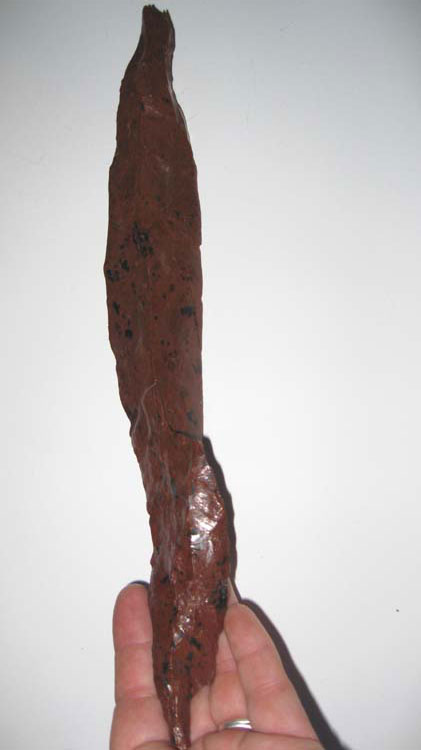
Although black is the most common color, it is also found in a variety of other colors from mahogany to red, green, pink, blue, silver, and rainbow. Obsidian Needles are a naturally occurring fracture. This one was dug out of the mountains near Davis Creek, California. Over thousands of years the razor sharp edges of the original fractured pieces have been smoothed by the minerals in seepage from rain and snow melt. Native Americans used these “needles” for leather work tools, hunting weapons, ornamental designs, and cutting utensils.

Obsidian is considered to be one of the main protection stones by many of the Native American tribes.

History’s Gem of the Month: History of M77

 July 2009

When I dismantled the display of Axel’s Numbered Agates, I also took down some of the memorabilia that was above the rock shelves. Below is a photo taken by W.H. Hadley of Royal Oak, MI. It shows the original museum sometime around the late 1960s. Notice that there is a large tree to the west of the museum, which is no longer there. Also there is a different house to the east of the museum. On the top of the frame, Axel labeled the photo: Gitche Gumee Agate Shop, Mineral and Historical Museum.

The second photo included this month is one of Axel walking in the July 4th parade. The picture is a little out of focus, but it is still a kick to remember Axel in that coat. As many of you may remember, he always wore the 1895 bear coat in the parade. I have honored that tradition many years. I haven’t decided if I am going to do so this year. I’ll wait to see what the weather is like.

CURRENT GRAND MARAIS SCENES: July 2009

Unfortunately, my busy schedule has not allowed me time to go hiking this past week. However, before that, we were able to hike in the dunes many a day. The bugs have been a bit of a challenge on some of the days, but bug shirts and bug hats allow us to be outside and still enjoy the scenery.


On the day that the above photo was taken, we walked north on the Masse Homestead Trail (half way between Sable Lake and the Logslide). We needed our spring hiking outfits while walking in the woods. There is a good access spot to get up into the dunes around a 12-minute hike down the trail. Once in the dunes, we were able to take our bug gear off.

We then headed west to the Logslide, where we stopped and had lunch, and rested. Finally, we walked back to our car down the Masse trail. It was a beautiful day to hike!


The next photo was taken when my friend, Kim, and I went to Marquette. She had never been to the Michigan Nature Association property in Munising, located across from Sand Point. This is a picture of Memorial Falls. I just love the area, with its grottos and peaceful waterfalls.


Although they have slowed down a bit now that flowers are in bloom and it is warmer (after an incredibly cold spring), the hummingbirds are still active. For a while, it seemed like 10 or 12 hummingbirds were fighting for the feeders all day long. I have never seen so many hummingbirds. In fact, there were so many battling it out for the feeder, that my cats were afraid of them!