ROCKHOUNDING AND ADVENTURE TRIPS: Moose Lake Agate Days – Summer 2009

I attended Moose Lake Agate Days, located around an hour south of Duluth, for the fifth year in a row, second with a booth. Since the event was mentioned on the Travel Channel’s Cash and Treasures show, the number of people in attendance was almost out of control. On Saturday, there were definitely too many people in the gym. However, sales were great and the agates this year were even better than last year.

I was able to spend a little bit of time agate hunting. However, the owner of my favorite gravel pit is leasing out the pit to an asphalt company. There are so many trucks coming and going, that it is not safe. As a result, Doug has asked people to stay away until the contract is over in two years or so.

Thus, my friends and I tried our luck at farm field hunting again. We returned to the Aitkin, MN area and went with permission to the field in which I found the semi-fister in May. I didn’t find any big ones this time, but my friend, Jill, did.

Below are some of the photos I took to document the big agates that were either available for sale, or at least displayed. The first two show some of the booths inside and outside. The other photos show some of my favorite agates that I saw and was able to document.


CUSTOMER AGATE FINDS: Spring 2009

While in Minnesota earlier this month, I went agate hunting with Kat and Ken from the Cuyuna Gem and Mineral Club. Kat Thomas showed me this cool eye agate that she found. She calls it her Owl Agate.

One of the best local agate hunters is Mary Capogrossa. She has been busy this spring and has not had much time to get out, but pictured below are some of her recent agates.


MINERAL OF THE MONTH: Spring 2009

Coyamito Agate from Chihuahua, Mexico

The mineral of the month is the Coyamito Agate from northern Mexico. It is mined on a ranch located around 40 miles from the world famous Laguna Agate location, which is around 75 miles south of El Paso, Texas. The ranch is in the middle of the Chihuahuan desert at an elevation of just under 5,000 feet. For the past 50 or 60 years, the Coyamito has been one of the most sought after Mexican agates. They display a wide array of colors with fine banding, and the most unusual pseudomorphs of any agate on earth. Both of the specimens featured in the photos below are agates that formed when silicon dioxide replaced aragonite crystals.

When a highway was built through this desert during the 1940s, rockhounds began venturing into the area. Mineral claims were made in the late 1940s and prospectors have been searching for these valued agates ever since. By the 1960s, most of the agates were already extracted. More searching resumed in the early 1990s, when two people died while using explosives. Rockhounding on the ranch was prohibited until the last few years, when special permission was given to a few well-known agate collectors. These prospectors had to quarry directly into 38 million year old andesite, and carefully, but with much difficulty, remove the nodules from the very hard matrix.

The specimen pictured on the two left photos is a sagenite-like pseudomorphs that has botryoidal formation on the top and back. The specimen on the two right photos is a pseudomorph Coyamito agate with a drusy quartz layer on top. The appendages most likely formed when agate replaced a needle-like mineral, such as goethite. You can see in the far right picture that in cross-section, the agate bands have an eye-like stalactite formation. I purchased this specimen already cut into the three sections. I am selling this unusual group as a set. If you are interested, please send me an email to karen @ agatelady.com.


History’s Gem of the Month: History of M77

Spring 2009

Although people started living full time in Grand Marais in the mid 1800s, the town really didn’t grow until 1893 when the railroad was extended from Adam’s Trail north to town. Within a few short years, Grand Marais was a thriving community with a couple thousand residents, as well as other transient workers that were employed by the lumber companies. They thought at the time that the vast woodlands around Grand Marais had an endless supply of timber. That was not the case. By 1910, the forests around Grand Marais were clear cut. Thus, the Alger-Smith company that owned the railroad took the tracks and their train with them when they moved to Minnesota.

A few families stayed in Grand Marais, despite its then isolated location. My family (Hills) stayed, as did the Niemi family. It was a hard way to exist, though, since there was no longer a railroad – and there certainly were no roads. During the warmer months, schooners supplied the town from lakeside. Sleds could also be pulled in the winter, except for when the snow was too deep for the horses.

Finally, with a lot of lobbying, M-77 was constructed in 1920 from Blaney Park beginning at M-12 (now US-2), and ending in Grand Maris for a total distance of 42.57 miles. M77 is one of only four north-south cross-peninsular M-numbered state highways in the U.P. During the 1950s, two sharp turns in the route, one 11 miles north of Seney at Lavender Corner and the other four miles south of Grand Marais, were bypassed with short segments of new highway. Also, in 1958 and 1959, the last two segments of gravel-surfaced M-77 were paved from Germfask to Seney and from Snyder Lake to Grand Marais.

Pictured below is a picture taken from the top of the hill in town, looking north. This photo was taken before M-77 was constructed. I’ve also included a map of M-77, and a photo of the termination point taken from Dan Garnell’s Michigan Highway Ends website.


CURRENT GRAND MARAIS SCENES: Spring 2009

When I left for my trips in late April, it was still winter in Grand Marais in that there were still five-foot snowbanks in my yard. When I arrived home two weeks later – the snow was melted, the flowers were beginning to bloom, and the trees were budding out.

I’ll include a few of my favorite pictures in this update. However, if you want to see more photos, please go to my blog at www.agatelady.blogspot.com.

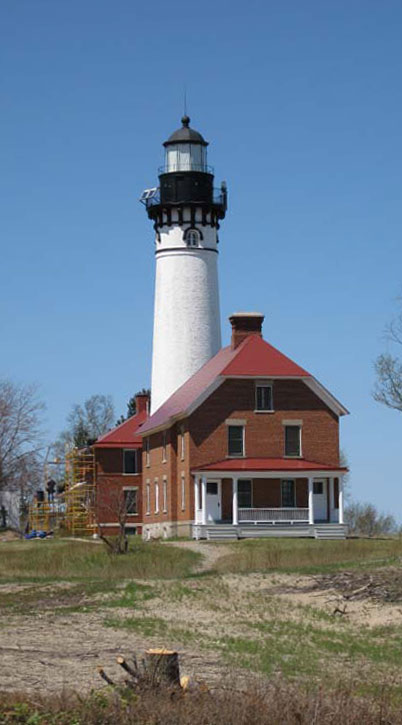
Although this is a standard “tourist” photo, it was so beautiful yesterday with the waves wrapping around Au Sable Point, that I had to take this shot and include it.


On the same 10 mile hike yesterday down the Masse Homestead trail from H58 West to the Log Slide, and then to the lighthouse and back, I also took a photo documenting the beginning spring wildflowers, as well as a shot on the beach near the rustic campground on Au Sable Point.

On the same 10 mile hike yesterday down the Masse Homestead trail from H58 West to the Log Slide, and then to the lighthouse and back, I also took a photo documenting the beginning spring wildflowers, as well as a shot on the beach near the rustic campground on Au Sable Point.


Finally, I took this sunset photo while on Mackinaw Island the end of April.

Finally, I took this sunset photo while on Mackinaw Island the end of April.

CUSTOMER AGATE FINDS: March 2009

I received an email a few weeks back from a Michigan Technologic University student, Phillip Schichtel. He is an avid agate hunter who looks on the beaches in the Keweenaw, as well as by his family’s cabin near Muskellunge Lake, located 20 miles east of Grand Marais. I must admit that he has found some dandy agates!

For those of you who wish to display your agates in a similar manner, here are a few tips:

  1. Make sure the glass in the jar is strong enough to adequately support the weight of the rocks. If possible, use glass jars that are made of tempered glass.
  2. To prevent the growth of algae, add a little bleach to the water. For smaller jars, just add a few drops. For larger jars, add up to a capful.
  3. If the jar you are using is fairly wide, rather than take up space in the middle with agates, either use other rocks to fill the middle space, or insert a skinny glass or other jar in the middle, and fill the outer space with your agates.
  4. Change the water in your jar a couple of times per year.
  5. Note that if you display your agate jars on a sunny window sill, the sun can influence agate banding. I have had some people tell me that sunlight improves banding in some agates in a manner similar to heat treating. Others have told me that prolonged exposure to sunlight negatively affected the banding in their agates. In most cases, though, sunlight should not impact agate banding, especially if your agates were found on the beach and have already had prolonged exposure. The greatest risk of keeping your jars on a window ledge is that other people walking by your house will be able to see them. This is especially a problem if you are not in the habit of locking your doors. .I have heard of more than one case wherein someone returned to their unlocked home to find their agate jar missing.
  6. DO NOT fill the jar with baby oil, or other type of oil. A friend of mine did this several years ago and the baby oil penetrated into the agate bands and decreased the quality of the banding.

MINERAL OF THE MONTH: March 2009 Selenite Desert Rose


Several different minerals form into rosette shapes including chalcedony, aragonite, hematite, barite, and selenite (a form of gypsum). This month’s mineral is the selenite “Desert Rose.” It is most similar to barite roses, but its edges are sharper and the crystalline structure is less hard. Thus, Desert Roses are brittle and can break quite easily.

These natural sculptures form in arid sandy environments through the evaporation of shallow saltwater basins. The “petals” of selenite desert roses are usually well defined and are crystals flattened along the cleavage planes. This mineral is also known as: sand rose, rose rock, gypsum rose, and gypsum rosette.

It is believed that selenite rose can enhance clarity and improve awareness. It is used by some in meditation to help them connect to the higher self. Others use selenite rose to improve their positive outlook on life.

Selenite rose is found in arid desert areas throughout the world including California, Libya, Egypt, and Saudi Arabia. Most of the commercially available selenite rose, including this specimen, comes from Mexico.

History’s Gem of the Month: Lake Superior Agate Poem

March 2009

Several years ago, museum visitors Frank and Karen Miller sent me this poem, which was written by their mother, Ruth Finch Franklin. Given that we are all itching to hit the beach to look for the elusive agate, I thought that the reprinting of this poem may inspire our spring rockhounding. May the agate Gods be kind to us in 2009!

SUPERIOR THRILL

Look, look, what do you see?
Beautiful rocks to be had for free.
Red rocks, white rocks, black and green.
All shapes and sizes to be seen.

Is there an agate amongst the lot?
Maybe there is but probably not.
They are not found just everywhere
But once in awhile you shout, “There’s one there!

Oh what a thrill when one you see!
Superior agates, pretty as can be.
And the fresh clear air as you walk the beach,
Searching all stones within your reach.
For recreation it can’t be beat,
And finding an agate! That sure is neat!

CURRENT GRAND MARAIS SCENES: March 2009

Although I have enjoyed cross-country skiing and snowshoeing this winter, I must admit that I am ready for spring. Even though spring officially has begun, we still have a lot of snow in the woods. The warmer temperatures have made the deep snow slushy, so we have been hiking and snowshoeing in the dunes for exercise. I would like to thank my new exercise partners, Kathy and Steve Correll, for several great hikes these past few weeks.

The images below were taken during some of these dunes hikes. The first photo was taken from the Grand Sable Dunes bluff in the Ghost Forest, which is near Sable Falls. The second picture of Sable River was taken while hiking from the Sable Visitor’s Center to the Ghost Forest.

A few days after these pictures were taken, Grand Marais experienced a huge spring storm with winds well over 60 mph. Unfortunately, the resulting waves broke up many of the icebergs. I was hoping that the bergs would reform to create even higher structures, but it doesn’t look like that is going to happen. The storm also knocked down hundreds of trees and branches. On a snowshoe yesterday from the Sable Visitor’s Center to the Ghost Forest, we had to step over a lot of downed trees. I must admit that the forest looked like a destruction zone.

The three shots below were taken during some of the dune hikes, near Sable Lake.

The last image featured this month was taken while I drove back to Grand Marais from the Escanaba art show last Sunday. My friend, Renee Beaver Stocking, went with me to the show to help out. We decided to take a different route home and drive through Trenary. When we stopped for dinner, Renee noticed the cat sitting on the old fire truck. I would like to thank Renee for her help at the show. Set up and tear down go a lot faster with two people. I would also like to thank her brother, Kevin Beaver and his wife Martha, for letting us stay at their house over the weekend.

CUSTOMER AGATE FINDS: February 2009

With our mountains of snow, agate hunting is at least a couple of months away. If I were to guess, unless there is a massive thaw, I don’t think anyone will be rockhounding our beaches until at least late April, if not May.

So again to appease all you agate fans, I have included photos of a couple of lakers I have for sale. The first is a nice sized laker with smoky quartz fill. The outer bands are translucent carnelian. Along the top, there are some terrific candy stripe bands that very likely will exhibit a shadow if polished. The center, which is exposed at one end, shows some exquisite smoky quartz crystals. It weighs a little over 5.5 ounces and is 2.5” x 2.25” x 1.5”.

The other laker is a peeler depicting differential erosion of the various bands. The bottom of the agate is translucent carnelian. The upper half that exhibits the peeler bands is more opaque with paint stone colors of orange, yellow, and tan. Concentric banding pops out at various places, including one whole end of the specimen. It weighs just under 7 ounces and is 2.5” x 2.25” x 1.625”.

If anyone is interested in purchasing either of these Lake Superior agates, the retail cost is $40 each plus $5 s/h and sales tax if applicable. Give me a call at 906-494-2590 or send an email to  if you are interested.