History’s Gem of the Month: John Keating

March 2012

I wish I had a picture of John Keating. I do not. He was quite a colorful character that owned the Keating Knitting Factory in Grand Marais, MI at the turn of last century. He was born in Ireland on November 10, 1869. When he was 23 years old, he immigrated to the United States in 1892 and initially settled in Sault Sainte Marie, MI. On December 14, 1895 he married Matilda (Tillie) Porter, who was born in 1871 in Canada. According to census records the couple lived in McMillian in 1900 with two children. By 1910 the family moved to Grand Marais with three children. After the shutdown of the mills in Grand Marais and the closing of the railroad, most left Grand Marais prior to 1914. But according to the 1920 census records, the family with three children was still living in Burt Township.

As far as I have been told, there are only a couple of Keating sweaters known to still exist today. Apparently the Keating family has one and the Gitche Gumee Museum has the other. I found the following article in the museum’s archives. Axel retyped it from “The Evening News,” published in Sault Ste. Marie, MI. (Date unknown)

Rugged Grand Marais Giant Knits Sweaters For a Living By John T. Nevill

Among “inconsistent vocations” we’d like to cite that of the late John Keating, of Grand Marais, Mich., a rough-and-tumble gentleman, who lived in an era when fists sometimes were more potent than law in maintaining one’s status in the workaday world.

Keating, who towered well over six feet tall, was a hardened iron-muscled giant who taught boxing to hardy young buckos around the Grand Marais sawmills, and once in a while, when provoked into it, gave a brief but painful lesson in the science of self-defense to a would-be “tough guy” of the lumber camps. But boxing was not Keating’s vocation; it was strictly a hobby. Believe it or not, Jack Keating made his living by knitting sweaters.

In those days Grand Marais was a noisy, bustling lumber town. At least a half dozen lumber mills were in full operation. Boats sailed out of the harbor daily with fresh cut lumber stacked high on their decks, and Alger-Smith trains were continually chugging into town from the south carrying more logs to feed the yawning mills. Other logs, by the thousands, were driven down the Sucker River, and brought into town from the East end of the bay. There were 16 saloons within the tiny confines of the town.

Those were the days a Keating-made sweater was something worth fighting for. They were double-knit beauties, obtainable in almost any color a man might fancy, and they are said to have been nearly one-half inch thick. They were particularly prized by the hard-working jacks in the surrounding lumber camps; men who battled bitter cold from the darkness before down to the darkness after sundown.

But few, if any, men ever had to fight for a Keating sweater. John Keating saw to that by turning them out in quantity, loading 50 or more on his dog-sled, and visiting the lumber camps at fairly regular intervals. Once in the camps, he disposed of them easily at $8, $9, or $10 each. Many’s the time Grand Marais old timers say that when Jack Keating drove his yapping dogs back into town after one of his swings around the territory, with his sled empty and his pockets bulging with money. Mr. Keating’s sled was similar to the one pictured below.

Keating sweaters were available in either buttoned or “pull-over” style, and with or without high colors, which, of course, could be turned up to protect the back of the man’s neck and hood from the frequent sub-zero temperatures. They apparently were as rugged as Keating himself because few of them ever wore out.

Why, man-alive, they tell you in Grand Marais some of the sweaters John Keating made were still seen occasionally on the streets of the town 40 or 50 years later. No lumberjack, therefore, ever was in the market for another Keating sweater, having bought one, unless he wanted one “for dress” in the spring when he came into town to blow his hard-earned money.

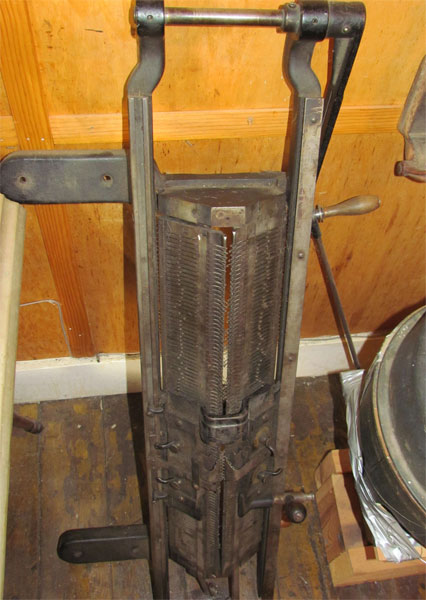
Jack Keating started his unusual business by knitting the first dozen or more sweaters by hand, but he soon obtained a machine which speeded up his production many times. No one presently in the area seems to know where Keating learned his trade. But learn it he did – and well.
They know, however, that Keating was no softie. No thermometer ever dipped too low, or no snow drift ever was too high for Keating to strap on his snowshoes and mush out of town with a load of sweaters for the boys deep in the tall timber. But he was never too busy making or delivering sweaters to perform a public or humanitarian service. Take for example, the tragic late fall storm which struck Lake Superior one bitter cold November. Two barges, loaded with lumber and human beings, broke loose from their tow and were swept by mountainous seas against the rocky shores. There, while angry and icy water battered the barges to pieces, many of their occupants perished by drowning. But that, comparatively, proved to be a merciful death. Others among them tried to make it ashore by swimming, then walking to safety over the ice – and froze to death attempting it. Jack Keating, manning his dog-sled, was among those who went out into the howling, sub-zero weather to journey up and down the Grand Marais area shoreline for miles looking for, finding, and picking up the frozen bodies. A total of 31 bodies, both men and women, were found and brought into Grand Marais.

Grand Marais, often a target for Lake Superior’s violence, will never forget that tragic storm, and that’s one reason Grand Marais can never forget Jack Keating. Keating, the father of two sons and one daughter, passed away decades later – although the exact date is not known. One of his sons was killed in World War II. His daughter, Marie, married Commander Stanly Herbst of the Navy. They had planned on retiring in Grand Marais, but Mr. Herbst died before they could make the move. So unfortunately there are no more Keatings left In Grand Marais today to contribute their hard work and tenacity.

CURRENT GRAND MARAIS SCENES: March 2012

This seemingly has been the winter that wasn’t. Sure we have had cold temperatures, but for the second year in a row, I did not register any readings at my house below zero. The coldest my thermometer read was around 2 degrees F. During most of the winter the high temperatures were in the 20s and 30s. This week in mid-March we have seen temperatures in the 60s. Until the beginning of March, we didn’t even really have a full blown snow storm. In that storm, we received almost two feet of snow. I just called the County Road Commission and found out that the snowfall total in Grand Marais this winter has only been 148 inches. This measurement is taken south of town in the lake-effect snow belt, so in town, the total is much less. The contact person at the county thinks this may the lowest annual snowfall total ever recorded in Grand Marais.

Despite the mild temperatures, I have still captured some worthy winter scenes. But first is the picture I took of the March full moon. This shot was captured at the end of Coast Guard Point in Grand Marais. OK. I’ll admit it. This image is actually two photos merged together. The actual rising moon is much smaller relative to the pancake ice floating in the channel. It is still a cool image.

The next image was taken from the bluff on the bay looking east toward the harbor lighthouse. It features interesting colors from the sunset.

The next photo I took from Sand Point in Munising, MI. It is a picture of the ice hanging down from the cliffs on Grand Island.

The next two pictures are late-winter beach photos showing some of the shore ice.

These next two photos I took in front of the museum of UP 200 dog sled race teams. Because of lack of snow race officials had to change the route. Instead of starting and ending in Marquette, this year the mushers made two round trips between Chatham and Grand Marais, finishing for the first time on Sunday in Grand Marais.

Although the one winter storm we had was fierce, I bundled up and headed for the beach where I captured this next shot of shore ice.

The last two pictures I took while snowshoeing near the School Forest east of town right after the winter storm. Everything seemed to be covered in snow.

CUSTOMER AGATE FINDS: January 2012

This is the slow time of year for people to submit pictures of agate finds. Even this fall I did not receive very many emails. There are a few that I can feature in this update, though. The first is an interesting seam agate found in the Grand Marais area. It also has tubes, or perhaps they are stalk aggregates. This agate was found by Celt and Karen Hicks, who are from Sparta, Michigan.

I received an email from Mark Buda, who lives in the Bay City, Michigan area. They were rock hunting in a gravel pit down state. In amongst fossils and other quartz rocks they found these agate-like specimens. With their thick husk they are not translucent. Since I have not seen them in person I cannot determine if they are agates or banded jasper or chert. I like them so I am including photos below.

For the past year I have been corresponding with David Jude from Ann Arbor. He is a research scientist in the School of Natural Resources. Since I received my bachelor’s degree from this school, I always enjoy corresponding with David. He found this agate near Paradise, Michigan.

I also received an email from Andy Johnson, who lives in the state of Washington. He sent me two pictures of agates he found near Mount Saint Helen as well as some of the beach agates he found on the Pacific Ocean shore. The Mount Saint Helens agates appear to be similar to agates found in Luna, New Mexico as well as in Panama.


MINERAL OF THE MONTH: January 2012 – Mary Ellen Jasper

The mineral of the month for this update is Mary Ellen Jasper. Unless you live in Minnesota, you may not be familiar with this interesting form of microcrystalline quartz. This rock formed more than two billion years ago in the area that is now the Mesabi Iron Range in Northern, Minnesota. At that time one of the early life forms evolved in the ancient seas. These blue-green single-celled cyanobacteria contained chlorophyll and were able to harvest the energy of the sun to photosynthesize and produce their own food. Energy from sunlight was used to split carbon dioxide into carbon and oxygen. The carbon was absorbed, becoming part of the growing organism, and the oxygen was released into the atmosphere. Prior to the evolution of cyanobacteria, there was almost no oxygen in the atmosphere. Once these organisms developed, they proliferated and helped to trigger drastic changes in the earth’s atmosphere, climate, and environment.

Some of the cyanobacteria lived in colonies that produced macro-scale structures called stromatolites. A drawing depicting what a stromatolite shoreline may have looked like during the latter part of the Archean period is shown below. Evidence of fossil stromatolite formations have been found throughout the world so these mushroom-shaped mounds dominated the shores of all the newly developing landmasses, including the area where the Mary Ellen Jasper developed.

The earliest stromatolite of confirmed origin dates to 2,724 million years ago. A recent discovery, however, provides strong evidence that microbial stromatolites extending as far back as 3,450 million years ago. These organisms were extremely resilient and adaptable, allowing them to be a major constituent of the fossil record for the first 3,500 million years of life on earth, with their abundance peaking about 1,250 million years ago.

Until the mid-1950s, scientists thought that stromatolites were long since extinct. That all changed in 1956 when living stromatolites were found in the Hamlin Pool located on the south end of Sharks Bay in Western Australia. Since then, live stromatolites have also been found in several sites in the Bahamas. Pictures of both are included below.

Stromatolites are stony structures built up by algae and cyanobacteria. The microbes live in gooey mats on the top surface of the structures. These mats trap fine sediments carried across them by tidal currents. As the mats fill in with sediments and become opaque, the microbes move upwards seeking sunlight. Stromatolites differ from normal fossils because they are formed by the activities of micro-organisms. They result from a combination of trapping, binding and precipitation of sediment.

One of the biggest impacts that stromatolites had on the earth was the release of free oxygen, which was a byproduct of their photosynthesis. When stromatolites first evolved, the earth’s atmosphere had less than one percent oxygen. After the stromatolites evolved, significant amounts of oxygen did not accumulate in the atmosphere right away because of the vast quantities of oxidizable materials in the earth’s crust as well as the dissolved eager-to-combine iron in the oceans. For more than a hundred million years, these materials absorbed any free oxygen that was produced. Mary Ellen Jasper developed not only from the remains of the stromatolites, but also from the oxidization of iron that was present in the area that is now northern Minnesota.

A few more pictures of Mary Ellen Jasper are included below. The first two pictures are of a thin polished slab. The first is displayed with front lighting and the second with back lighting.

Coincidently, I just polished a piece of Mary Ellen Jasper for a customer a couple of days ago. Here is a picture of that specimen.

CURRENT GRAND MARAIS SCENES: January 2012

Winter has been slow to start up in the Grand Marais area. There are no official snowfall totals for Grand Marais, but there are for Marquette. We are down at least 30 inches of snow so far this winter. Only half of the ski runs are open at Marquette Mountain. Many of the snowmobile trails are barely usable – some are not. I cross country skied the Grand Marais trails today. Although they have been groomed, grass and twigs show through on the track. The lack of snow is not only a problem here but throughout the country. Only 22 percent of the nation was covered by snow on January 4th. Compared to the last decade or so, it is the smallest area of snow cover. The second smallest total for this date was in 2007 at 27 percent of the country.

The national map showing snow cover as of January 4th is below.

Since I have not executed a web page update for a while, I’ll include some fall as well as a few early winter photos. If you would like to enjoy additional photos, please go to my photo journal blog at www.agatelady.blogspot.com.

CUSTOMER AGATE FINDS: Winter 2011

I have a variety of agate photos featured in this update’s “Customer Agate Finds.” First, here are a couple of shots of a Lake Superior agate found by Chris Cooper at the mouth of the Two Hearted River, located an hour and a half east of Grand Marais.

Next are a couple of agates found by Janice Chamberlin in the Whitefish Point area. Janice is from n Diamondale, MI.

Finally, I have some more Australian agate find photos submitted by John Nedwich. Notice how similar these Queensland Australia agates are to Lake Superior agates.


MINERAL OF THE MONTH: Winter 2011 – Argentina Condor Agate

During the past several years Argentina has become one of the new hot beds for agate prospecting. The condor agate was introduced to the U.S. market in 1992 by the former Argentinean actor, Luis de los Santos. Since then he discovered the puma agate in 1993, the crater agate in 1997, and more recently the Black River agate. Prospecting and mining these agates is difficult. Not only are the locations extremely remote, but the work must be done at elevation where the weather is often not cooperative. Luis named this agate after the large Condor birds that were flying over him during the trip that he discovered the agate. It is mined at over 6,000 feet. The site can only be reached by horse back.


History’s Gem of the Month: Old Postcards and Pictures

Winter 2011

When I was visiting my friends in Marquette, Jim and Helen Riley, Helen donated a couple of old Grand Marais pictures. These were given to her by her namesake aunt, Helen Olli, who is 91 years old. The first is a picture that she thought was the Wabash Hotel. I researched the photo and found out that it is in fact the Bay View Hospital, which was owned by Dr. James Anderson and Dr. D. H. Weir. It stood at the base of the hill entering Grand Marais, a few building south of what is now the Superior Hotel. It was built in the 1890s and served the medical needs of Grand Marais for a number of years. In the picture you can see the doctors’ buggy, used to make house calls.

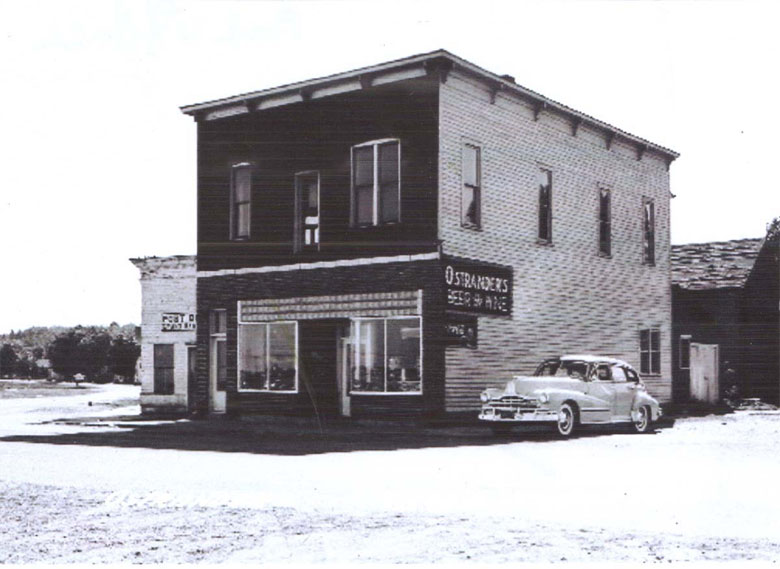
The second photo donated by Helen Olli is a picture of the Ostrander Drug Store. This building has stood in Grand Marais for over 100 years. After it was the Ostrander Store, it was the Beaver House, General Store, Grand Marais Gazette, and is now a private residence after it was renovated a few years ago.

During my travels last year I purchased these old post cards that feature pictures from the logging days a century ago. Logging was certainly a tough way to make a living.

CURRENT GRAND MARAIS SCENES: Winter 2011

It was difficult to select pictures to feature in this update’s current Grand Marais scenes. If you would like to see others that I did not select, please visit my photoblog at www.agatelady.blogspot.com.

We’ll start out with a shot I took the day before the full lunar eclipse, which happened on December 21st. I posted some of the photos on the blog of the actual eclipse, but I like the full moon shot the best.

The UP 200 dog sled race took place the weekend of February 19th. The event has been going on for over 20 years. The race is limited to 40 dog sled teams, although only 19 teams signed up this year. Mushers included 8 from Minnesota, 4 from Michigan, 3 from Wisconsin, 2 from North Dakota, 1 from Ontario, and 1 from Ohio. Three women participated this year. In addition to the UP 200, there was also an 89-mile midnight run race with a route from Gwinn to Deerton and then ending in Munising.

The UP 200 route starts in the Marquette area traveling east to Grand Marais and back — usually a 240-mile round-trip distance. Because of the icy conditions, race officials shortened the race this year to end in Wetmore, which is located just east of Munising.

I did decide to open the museum this year, which took some work since I had to unpack all the items from the last art show plus the things I purchased in Tucson. It worked out well so I’m glad I decided to heat the building and open. The starting gate for the mushers to continue the return trip of the race is located right in front of the museum.

Fourteen of the teams finished this year’s race. Ryan Anderson from Ray, MN finished first as Team 2 with a total time of 21:42:24. He finished with 11 dogs, averaged 13.2 mph and had 10:34 rest time. Nathan Schroeder from Chisholm, MN finished second as team 4 with a total time of 22:00:29. David Gill as Team 13 finished third with a time of 22:21:37.

The event is possible because of hundreds of volunteers at each of the checkpoints, as well as the race officials, trail maintenance crew, timers, team runners (to help the teams get to the starting lines), and members of the community who work the trail to held direct the teams at intersections and at major turns in the trail.

Although we certainly are still in the midst of winter here on the south shore of Lake Superior, it has been the third winter in a row with lower than average snowfall amounts. I talked with one of the local road commission workers the other day who told me that the official snow amount received in the Grand Marais area so far this year is 170 inches. They measure the snowfall amounts several miles south of town. A few years ago we had over 325 inches of snow.

Below are a few winter shots taken in the Grand Marais area. First, a photo was taken from First Creek located just west of Woodland Park. Notice the remnants of a snowmobile track. For those who are not aware, it is illegal to drive any motorized vehicles including snowmobiles on the beach.

I have continued snowshoeing in the dunes this winter. Here is a picture that was taken from the Ghost Forest area near Sable Falls. When the wind breaks up the ice, many times the smaller chunks form into floating pancake ice. Also, notice the iceberg “blow hole” in the center of the picture. It is not safe to walk on the icebergs since sometimes you cannot see the blowholes as they may be covered over with snow.


During a recent thaw, we had alternating freezing and thawing temperatures. These changing temperatures can add to the beauty of the ice formations.


CUSTOMER AGATE FINDS: September 2011

Since I have not had time to implement a web page update for quite some time, I’ll include LOTS of customer agate finds. First, let’s start with one of my favorite agates found this summer. This candy striper was found by Andrea from Troy, MI.

Next is a Becky B from Pittsburgh, PA She found this ¾ pounder that has a carnelian center with white floater bands just to the left of the boardwalk right in town. Of course, the wind and waves were blowing for three days prior to her find, which helps to mix up and bring new rocks up the beach.

Bonnie (Singleton) Parker from Newberry, MI came by the Rock On agate show in Deer Park to show me her terrific finds. The one in the upper left looks like a Botswana, Africa agate, but Bonnie swears she found it on the Lake Superior beach. I totally agree that she did. It just goes to show you that when it comes to agates, there are no absolutes.

Claudia Wyrick from Rochester Hills, MI spent a good deal of time in Grand Marais agate hunting this summer. She brought in many unusual and splendid finds, including this terrific and rare sagenite agate. The picture shows the specimen after I face polished it.

Doreen Johnson and Rose Ritter both came by my booth at Muskallonge State Park to show me the water level and the 1.8 pound agate they found.

I don’t have a picture of Gary Darling, but here are a couple of shots of a 15 ounce agate he found east of Grand Marais.

Peggy from North Street, MI found this unusually round water level agate in the Grand Marais area.

Rebecca Reed from Kalamazoo, MI found this unusual specimen. Is it an eye agate? An unusual amygdaloidal basalt? A complex rock with miniature thunder egg formations?

Steve Hollingshead from Germfask, MI has been by a few different times. Pictured below is a 1.1 pound cherty agate, as well as a large owl-like silicified fossil, and a nice candy striper.

Last but not least is the nicest large agate I’ve seen this summer come off the local beach. Local resident, Cathy Goulet, was walking her dog down the beach when she saw this 1.33 pounder rolling in the pea gravel. It is a jasper agate, but it has incredible banding! I don’t have a picture of Cathy, but I was able to get a few shots of her incredible agate!