CUSTOMER AGATE FINDS: September 2012

It has been a crazy summer. I have pictures of several customer agates below. I must admit that my camera has been having some issues with the way it is saving the image files, so I am not exactly certain which of the cards I kept with the names and dates of the agate finders go with which of the images. So I am going to give it my best shot. PLEASE send me an email to  if I have made a mistake with any of the agate and agate finder match ups.

L Bergen (Roseville, MN) found this amethyst center filled Lake Superior agate in a construction zone.

Chris Cooper stopped by the museum showed me some incredible specimens of agate as well as greenstone, thomsonite, and other rocks. Check out the copper replacement agate that Chris found and face polished, as well as the whole nodule with intact husk that he pried out of basaltic rock out in Lake Superior off the shore of Copper Harbor. Sorry that I didn’t get a picture of Chris.

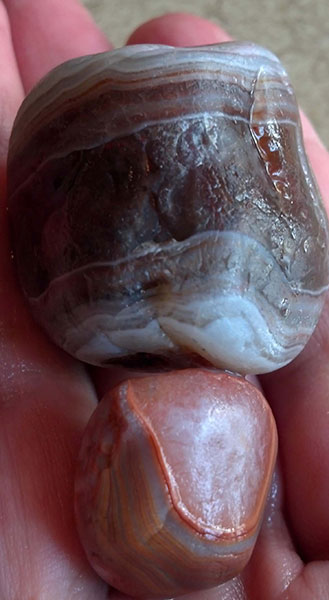
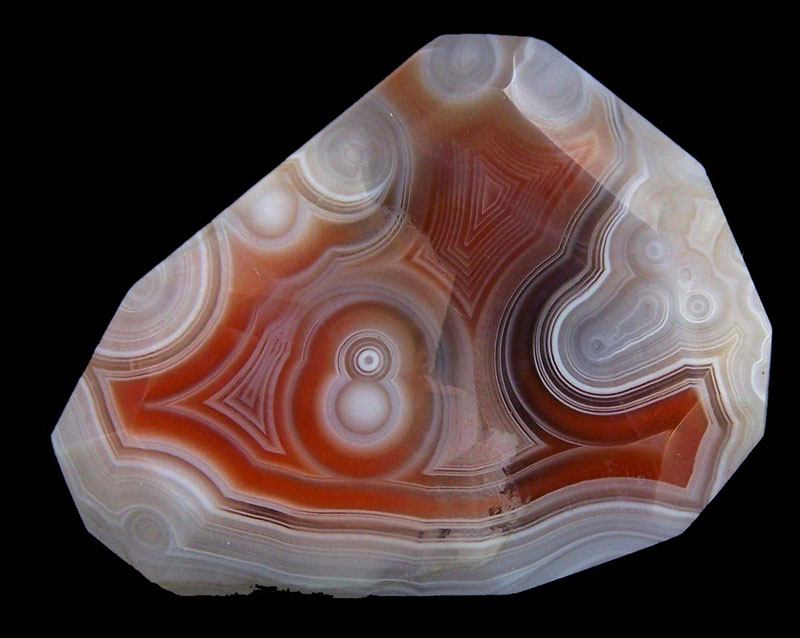
Ethan from Kalkaska, MI found this large specimen that measures 3” x 2” x 1.5”.

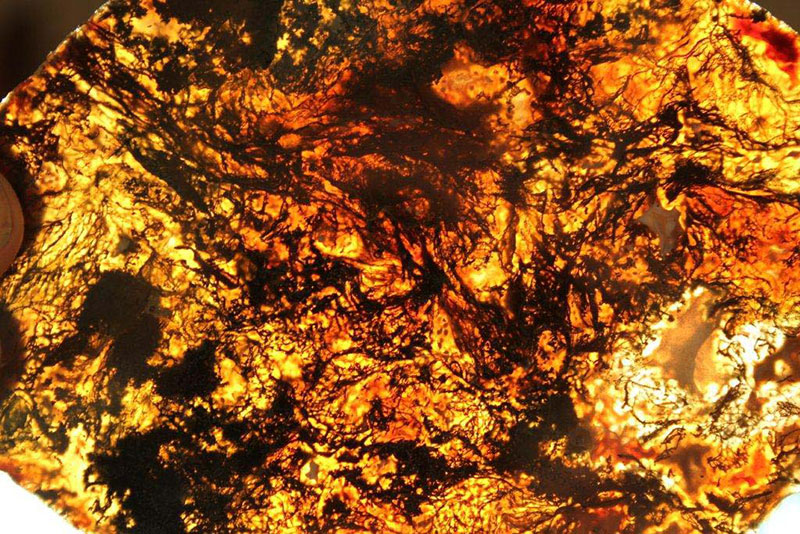
The next agate is a rare iron lace agate that formed in seams between metamorphosed iron ore layers in the Ishpeming, MI area. Most of these rare agates were found back in the 1970s. Gloria Town (Hillsdale, MI) acquired this nice specimen from Jeff Anderson at the Ishpeming show.

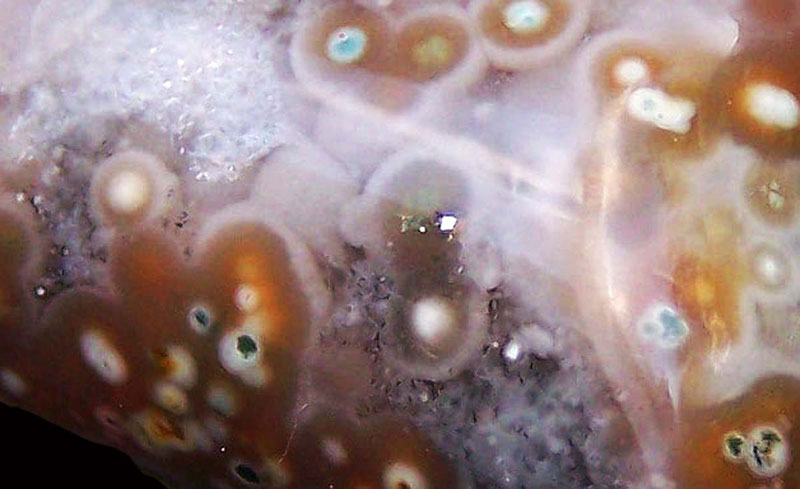
Jason Brandt emailed me this photo of an amygdaloidal basalt with small agate pockets.

Larry Dorau emailed me this terrific picture of a moss agate.

Patty and Bob Zummer (Ann Arbor, MI) are up in Grand Marais for their annual camping trip. They have had great success agate hunting this year on the beaches east of town.

Patty O (Bear Lake, MI) found this gray, tube, shadow agate in Grand Marais.

Rhonda Riebow emailed me this picture of agates she found east of Grand Marais.

Ryan Ailie found this Lake Superior agate.


MINERAL OF THE MONTH: September 2012 – Chlorastrolite Greenstone

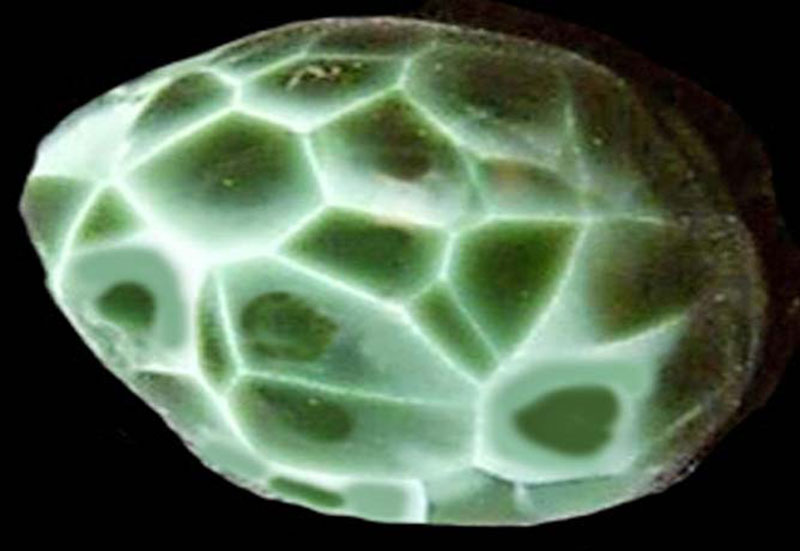
The mineral of the month is Chlorastrolite, also known as Isle Royale greenstone. This mineral was designated as the official state gem by Michigan’s 76th Legislature (Act 56, PA 1972). This legislation was introduced by Representative Russell Hellman of Dollar Bay. This mineral is a green variety of the mineral pumpellyite, and has a pattern of star-like crystals which forms a turtle-shell pattern. Greenstones are found in the waters and on the shores of Isle Royale, where it is illegal to collect due to the island’s national park status. It can also be found in the Michigan Copper ranges in the western Upper Peninsula. Many of the old tailings left over from the mining era have greenstones in them. They appear as dark green, small round or almond shape nodules in the basaltic rock. In some cases these nodules have weathered out of the volcanic rock and can be found along the shoreline. Unfortunately, only a small percentage of the green nodules are actual greenstones, as most are chloride, prehnite or some other mix of minerals. And of course, of all the greenstones found, perhaps only a few out of every hundred are gem quality.

It is difficult to identify an unpolished pebble of chlorastrolite. Most gem quality greenstones are very small, and it is rare to find one that is larger than a half inch. The largest gem quality stone is in the Smithsonian and measures 1.5 by 3 inches.

Since it is illegal to search for these gemstones on Isle Royal, the best localities now are the waste rock piles located in the old Keweenaw Peninsula mines in the western Upper Peninsula of Michigan. Some possible search sites include the Central, Central Exploration, Cliff, Phoenix, Mandan, and Delaware mines as well as some of the shoreline outcrops near Eagle Harbor.

History’s Gem of the Month: The Shark: Post 2

 September 2012

This is the second History’s Gem of the Month posting featuring a thesis written in 1995 by Jim Williams for a class at Western Michigan University. The curator of the Michigan Maritime Museum gave me a copy of the thesis when the museum also gifted me with the Shark. The thesis is several pages long, so I’ll include it over three postings.

Shark: A Lake Superior Fish Tug

By Jim Williams

Ingredients for a New Boat

The Builder

Otto Niemi learned early how to work with his hands. As a boy, he did odd jobs around boat yards, learning from journeymen boat builders. He studied boat yards in the harbors where he sailed as a teenage crewman on the run from Finland to England. When it came time to build his fourth boat, Otto combined his memories of European boat yards with his experience building the Elk. He also drew upon his years of fishing experience to design a boat suited to conditions on Lake Superior.

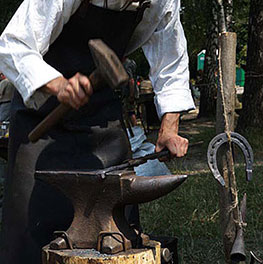
Otto’s skill with his hands extended to metal-working. He learned blacksmithing as a young man, at one time having the offer made of an apprenticeship in the trade. The skill served him well when it came time to fashion the iron and steel fittings for Elk and Shark.

Otto Niemi no doubt counted the talents of his sons among his boat-building resources. The Niemis stand out as a family of energetic, resourceful, sharp-witted people. Building the Shark clearly involved all the male family members, to one degree or another.

Building the Shark took nearly two years. The Niemi boys worked alongside their father whenever they could, during that time. Axel had the most ongoing involvement, since he stayed home while his brothers went off to college. The other sons, Alfred, Arvi, and Arvo, pitched in whenever they had a break from their studies. Shark reflects the spirit of co-cooperation that the immigrant Finns brought to many ventures in their adopted homeland.

The Boat Type

Boats used for work, travel, and transport on the Great Lakes took many shapes. A boat design evolves to meet two requirements: its intended use, and the conditions the boat will face. From the Indian canoe to today’s thousand-foot bulk carriers, each design fits the boat’s niche in the maritime economy of the lakes. The fish tug typifies that type of evolution.

The fish tug of Shark’s type reflects a development process that began with early bateaux, tracks its lineage through the Mackinaw boat, and reaches a mid-point with the sailing workboats of the nineteenth century. This paper cannot hope to trace the workboat heritage of the Great Lakes, or even that of Lake Superior; it represents far too massive an undertaking. The venerable Mackinaw boat, with the uncertainty about its derivation and regional variants, serves as a case in point.

Howard Chapella, in his American Small Sailing Craft, catalogs several variations of the Mackinaw boat type. He says that “the Mackinaw boat was also known as the “Collingwood skiff.” He goes on to say that the Collingwood skiff originated with a small skiff built on Lake Ontario, about 1854. Grace Lee Nute, in her book Lake Superior, says that “by 1825 the Mackinac boat had largely supplanted the canoe on the south shore of Lake Superior.” This apparent contradiction represents two different time lines for the same boat type.

Disagreement even exists over exactly what constitutes a Mackinaw boat. Nute says a Mackinaw “was a barge of red or white oak board with a flat bottom and rather blunt ends over a stiff heavy frame.” Chapelle, on the other hand, applies several different descriptions to boats of the Mackinaw type, suggesting that no such distinct type existed. Clearly, the evolution of Great Lakes boat types needs much more research in order to clarify even the most basic questions.

Like the Mackinaw boat, no thorough tracing of the evolution of the Great Lakes fish tug exists. Robert Grunst’s unpublished work stands out as probably the most research on the type done by anyone. Talking with Grunst leads one to some basic generalizations about the boats.

The ancestry of fish tugs like the Shark goes back to sailing workboats that plied the Great Lakes in the mid-nineteenth century. With the advent of steam power, many owners retrofitted their boats with engines. The made-over workboats found employment in the lakes developing barge-towing trade. Later, when barge towing began to slacken, fishermen bought idled tugs, adapting them to work in the fishery. A recent find of an 1870 newspaper article points to Erie, Pennsylvania, as the building place of the first steam tug built expressly for fishing on the Great Lakes.

The first fish tugs had open decks, with only the wheelhouse and engine covered over. The next stage of evolution saw fishermen roofing over the sterns of their boats, but leaving the bows open for lifting nets. When fishermen began to install mechanical net lifters in their boats’ bows they found it no longer necessary to have open foredecks; they could close in that part of the boat, getting the crew out of the weather. The called this a “turtled-over box.”

Two power-plant advances affected fish tug design in the mid-1930s: the Collemberg semi-diesel, and powerful, efficient gasoline engines. Better engines brought bigger boats. Most fish tugs of the time fell into the size range of thirty-eight to sixty feet long, with a beam ranging from thirteen and a half to fourteen feet.

Location of a fish tug’s wheelhouse reflects how the fisherman uses his boat. Placement of the wheelhouse at the boat’s stern enables two people to work the boat; the helmsman tends the net setting from the stern hatch while the other person works in the bow lifting nets or carrying boxes back and forth. A boat with her pilot house sitting amidship, as a rule requires a crew of more than two people, usually three or four; the helmsman cannot easily reach either bow or stern from his middle-of-the-boat position to help with fish and nets. “Mid-house” boats run to the upper size range, averaging from forty-eight to fifty-five feet long.

Otto Niemi’s design for the Shark reveals how he intended to use her. He planned his boat for thirty-three feet long, with her wheelhouse in the stern. He clearly expected to fish with only a small crew, perhaps even single-handed on occasion. Shark’s relatively small size shows that Otto did not intend to bring home overly large catches; her carrying capacity for both gear and fish show her owner’s modest expectations. For power, he planned to use the same 1919 Fordson tractor engine that drove the Elk.

Building the Shark

When Otto Niemi wanted a new fishing boat, he hoped to have it built by the Wiinika Brothers, a boatyard on the Lower Portage Ship Channel, near Chassel, Michigan. Wiinika’s had a reputation for building good boats; over the years their yard built more than thirty tugs for the Great Lakes fishery. Niemi found the Wiinika’s price more than he could afford, so he and his sons decided to build the new boat themselves.

Otto had in mind two changes from the design he used on the Elk. Elk’s fantail stern proved itself a weak point, showing the most deterioration as the boat aged. Otto meant to remedy Elk’s stern weakness by giving his new fish a transom stern. Alfred says that his father also wanted to build the new boat narrower.

“The Elk was too beamy,” says Alfred, in any kind of a sea, you had to keep from getting caught on the quarter, or she’d roll very badly.”

Otto designed Shark to have an overall length of thirty-four feet and a beam of ten-and-a-half feet. Alfred remembers that his father sat down with a 1-feet by 2-foot pine board and sketched out the new tug on it. Otto drew an elevation of the boat, then a top view; he worked over his sketches until he got just the hull shape he wanted. He then marked on those views just where he would place his station molds when he set up to build the hull.

Axel responded to a question about how his father arrived at Shark’s design with a chuckle.

“I probably shouldn’t tell you this,” he said, “I never told anybody else. When we were at Wiinika’s yard we walked around and looked at the boats they were building. We said, “We can build the boat ourselves.” So we took a good look at Wiinika’s boats and how they were putting them together, and we went home and got started.”

Niemi ordered White Oak for the hull from a mill near Corunna, Michigan. The oak arrived in Grand Marais fresh from the mill, “real green,” according to Axel. The Niemis didn’t realize until later what problems the unseasoned lumber caused.

The family laid down Shark’s keel timber first, a stick of oak measuring “about six inches by at least eight inches by thirty feet long.” They set up the oak stem and the station molds on the keel, then built a jig to bend the ribs around. Always inventive, the Niemis turned a cast-off hog scalder into a steamer for softening the rib stock.”

Otto wanted a boat capable of taking the punishment that Lake Superior dishes out, so he planned shark as a heavy-built vessel. Most boats of Shark’s size get framed with matching pairs of ribs spaced along the keel. That way the heal of each rib fits into a mortise in the keel. Niemis bent Shark’s ninety-six ribs in single pieces, so that they pass from side to side over the top of the keel. They then put a 2 ½ inch x 3 inch oak keelson on top, sandwiching the ribs between it and the keel. Niemis finished the keel framing by putting sixteen-inch bolts through keel and keelson, clamping the ribs in place.

The Niemis built the Shark in an unheated shed along the waterfront. As the first winter of boatbuilding pressed on, Otto came down with pneumonia from working in the cold. While he lay sick in bed for several days, the boys noticed a flaw in the boat’s design. Eyeballing the hull as it began taking shape, they decided that the Shark carried her beam too far aft, making her too wide in the stern. Taking it upon themselves to remedy the situation, the Niemi brothers took down the transom mold and cut six inches form each side. Replacing the transom, they continued planking the hull. Otto left the change alone when he came back to work, apparently agreeing with the boys’ design change.

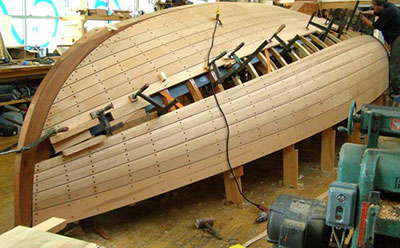
Planking the hull presented its own set of problems. First of all, they bought the plank material rough cut, planning to hand plane it. By chance, a man with a portable electric planer came to town. When he saw that Otto and his sons had all that hand work to do, he offered to plane it for them. In the end, he charged them $15.00 to plane what Axel remembers as 1,500 to 2,000, board feet of green white oak down to 1 ¼ inch thickness. Axel laughs when he talks about how much work that man saved them.

Axel remembers that as they started planking, he realized that they could not just lay straight planks up to the boat’s stem. Instead, each plank needed a taper cut in it, so that as it bent around the curve of the bow it would lay fair to the stem, and to the planks above and below it. They had no power tools, so they tapered each plank using a hand saw and plane. They also planed the edge of each plank to accept caulking.

Planking became a time-consuming process, according to Alfred. The process started by steaming each plank until it softened enough to allow bending to the shape of the hull. When the plank became workable, the builders took it out of the steam box, clamped it to the ribs, and marked it for shaping. They then took it off the ribs and either sawed or planed to the marks. Then the plank went back into the steam box for re-softening. Once it got soft again it came back out of the steamer and re-hung. The clamp, mark, cut, and re-steam process continued until the plank fit properly.

They clamped the fitted plank to the ribs and drilled through both pieces. They then drove galvanized nails through the tight-fitting holes, leaving two inches of nail inside the hull for clenching over. The Niemis worked at each plank in that manner, the archetypal “cut-and-try” method. Both Alfred and Axel have vivid memories of the lengthy planking process.

As the oak dried during the planking process, the seams began to open up wider than expected. The Niemis realized the problem when caulking began. Instead of narrow seams requiring a single strand of cotton caulking, many seams opened wide enough to require two or three strands. Axel remembers that this problem dogged the boat as the planks swelled and shrank. The Niemis occasionally had to lay in extra strands of caulking in order to keep the boat dry. As a side note, Axel carefully points out that they did not use oakum to fill the Shark’s plank seams, but used only spun cotton caulking. When they finished caulking and painting the hull they gave Shark an “ice iron, ´a piece of galvanized iron mounted on the stem at the waterline to protect it from ice damage.

CURRENT GRAND MARAIS SCENES: September 2012

I must admit that the summer schedule did not allow much time to hike. This is the first year that I worked most of the hours, other than when I was away at shows. The blog keeps me honest, to a degree, so I was able to get some good shots to document the beauty of the Grand Marais, MI area.

Twice this summer I hiked from the Hurricane River to Au Sable lighthouse. It is a great section of beach that is dotted with shipwreck remnants.

The lighthouse was built in the late 1800s to warn passing ships of the sandstone rock that extends a mile out from shore. The view from the top is amazing.

Progress on the new break wall, which will protect the mouth of Grand Marais bay, continues.

The waves of Lake Superior usually do not kick up their heels until October or November. These past few years, however, we have had strong winds much earlier. This year we had two extreme wind events in August!

Summer is the time when we in Grand Marais enjoy some fantastic sunsets. In the winter, the sun sets too far south.

CUSTOMER AGATE FINDS: June 2012

I have had a number of people stop by the museum in the last couple of weeks to show me some incredible agates. Several people have also sent me pictures via email.

Let’s start with some agates found by Brian Wolbrink from Allendale, MI. He has been agate hunting for several years, but lately has really turned it up a notch. He purchased some used equipment from me last year and is compiling even more equipment. Some of the agates below are still in the rough, while others have been “dressed up.”

First, here is a picture of Brian and then two photos that he submitted via email.

Brian’s next agate is an unusual ruin again. The horizontal streak through the specimen is a healed fracture.

Brian’s next agate is a very translucent carnelian agate.

The next agate has some interesting iron oxide plumes.

Brian’s next agate is a cute candy striper.

Here are a couple more of Brian’s agates. In the second photo below, notice the bright mineral inclusions near the top of the specimen.

The next series of agate photos were submitted via email from David Schuder who lives in the Keweenaw Peninsula in the western U.P. of Michigan. He loves to cut open rough looking Lake Superior agates in hope of finding interesting inclusions or other formations. Most of the agates were found in the Sedar Bay area. The first two agates shown below are sagenite agates.

Check out this terrific eye agate.

This submitted photo is not completely in focus, but I love the tubes and the character of this agate.

The first email I received from David included information and pictures that correct the list of agate formations included in my agate book for Michigan. Previously I have never seen a Lake Superior agate with dendritic formation. I stand corrected.

This terrific Lake Superior candy striped agate belongs to my friend, Jill.

The next series of agates were brought into the museum by Nolan and Doreen Johnson who are from St. Johns, MI. These first two pictures show both sides of a nice Laker.

Here are a couple more of their agates plus a picture of Nolan and Doreen.

Recently Wayne from Three Rivers, MI came into the museum to show me this incredible agate. This specimen weighs around 7 ounces.

Although agates from different geographic areas tend to vary in their characteristics, this is less true for an agate found in Washington state by Toni from Toledo, WA. Other than its huge size, it looks a lot like a Lake Superior agate. Despite its large size, notice that the agate is still translucent. This agate was found in a river. Since it is a whole nodule, there are no fractures that expose the banding.


MINERAL OF THE MONTH: June 2012 – Moqui Marbles


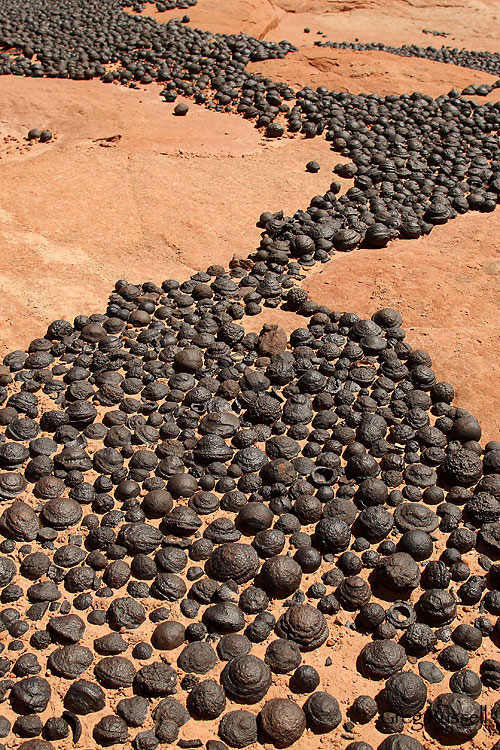
The mineral of the month for this update is an unusual type of iron concretion called Moqui Marbles. These round rocks form in the Navajo Sandstone formations spread across northern Arizona, northwest Colorado, and Utah. Most are found in the numerous national parks in the area, so they can no longer be collected. I recently purchased a large quantity of moqui marbles that were collected legally many decades ago.


The wide range of colors exhibited by the Navajo Sandstone reflect alteration by groundwater fluids over the last 190 million years. The different colors are caused by the presence of varying mixtures and amounts of iron minerals such as hematite, goethite, and limonite. These minerals fill the pore spaces between grains of sand, causing the variation in colors in the sedimentary layers. The iron in these strata originally arrived via the erosion of iron-bearing silicate minerals. Variations in the type and proportions of precipitated iron oxides resulted in the different crimson, vermillion, orange, salmon, peach, pink, gold, and yellow colors of the Navajo Sandstone.

The Navajo Sandstone is also well known for its iron concretions. They are believed to represent an extension of Hopi Native American traditions regarding ancestor worship (“moqui” translates to “the dead” in the Hopi language). Informally, they are called “Moqui marbles” after the local proposed Moqui native American tribe. Thousands of these concretions weather out of outcrops of the Navajo Sandstone within south-central and southeastern Utah within an area extending from Zion National Park eastward to Arches and Canyonland national parks. They are quite abundant within Grand Staircase-Escalante National Monument. The Utah concretions formed around 25 million years ago when minerals precipitated from groundwater flowing through much older Navajo sandstone.


The iron oxide concretions found in the Navajo Sandstone exhibit a wide variety of sizes and shapes including discs, buttons, spiked balls, hollow pipes, round spheres, and others. Although many of these concretions are fused together like soap bubbles, many more also occur as isolated concretions, which range in diameter from the size of peas to baseballs.


These concretions are regarded as terrestrial analogues of the hematite spherules, called Martian “blueberries” or more technically Martian spherules, which the Opportunity Rover found on Mars.

Many people like to buy Moqui Marbles in pairs. The “male” spheres have ridges whereas the “female” spheres are smoother. Used together they balance the masculine and feminine energies. They are believed to be among the most energetic stones on earth. Their major properties are claimed to be cleansing, relaxation, and they provide a great boost to meditation.

History’s Gem of the Month: The Shark: Post 1

June 2012

I was looking through the museum archive to look for something to post in this update’s History’s Gem of the Month when I came across a copy of a master’s thesis written in 1995 by Jim Williams for a class at Western Michigan University. The curator of the Michigan Maritime Museum gave me a copy of the thesis when the museum also gifted me with the Shark. The thesis is several pages long, so I’ll include the first part in this web page update, and continue it with the next.

Shark: A Lake Superior Fish Tug

By Jim Williams

Introduction


The Lake Superior fish tug, Shark, stands out as an artifact from a nearly extinct culture. Not many years ago, one saw fishing boats in nearly all communities that lay along the Great Lakes’ shores. Depletion of the fish stocks, economic pressures, and other factors combined to all but erase commercial fishing as a way of life on the lakes. Large companies dominate the little commercial fishing that remains on the lakes. That has not always been the case.

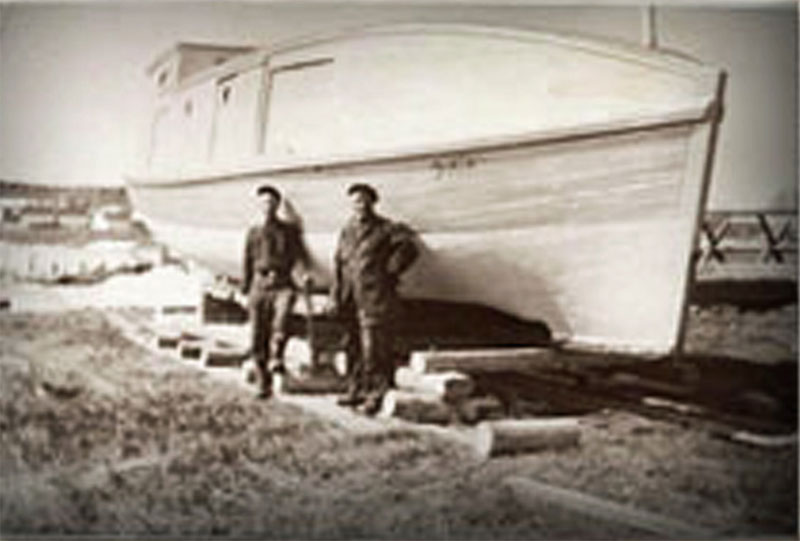
Otto Niemi planned and built the Shark so that he might earn a living fishing Lake Superior. He and his four sons labored winter and summer for nearly two years to create just the right boat for their needs. The Niemi family knew every nail, every splinter of wood in her. They, men and boat, became intimately connected. The boat’s story intertwines with the human story, giving the boat immeasurable value to the study of human history.

Shark’s Vital Statistics
Length Overall 33 feet
Beam 10.6 feet
Depth 3.8 feet
Number of Ribs 96
Hull Material White Oak
Horsepower 44
Main Engine 1919 Fordson 4 Cylinder
Back-Up Engine Model T
Net Lifter Pentwater
Capacity 11 gross tons – 7 net tons
Crew 2

Setting The Stage

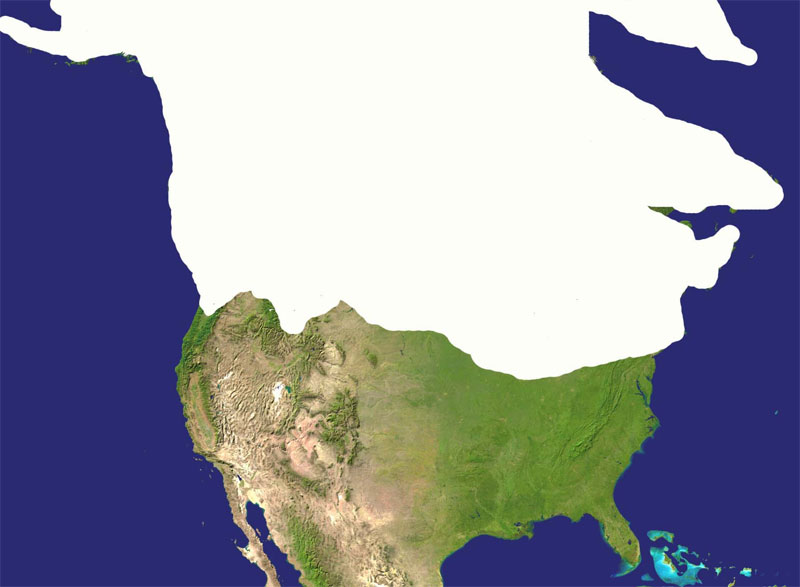
The forces of nature began to shape the Great Lakes at the beginning of the Pleistocene Era, about a million years ago. General cooling of the planet resulting in increased snowfall and short, cool summers gave rise to great masses of ice that covered much of North America. Two-mile-thick glaciers pushed slowly southward from Hudson’s Bay, reshaping landforms as they went. Over time, the glaciers began to alternately advance and retreat. Geologists call the last great glacial period the Wisconsin Stage.

The Wisconsin glaciers reached as far south as Illinois, Indiana, and Ohio. One theory holds that as the glaciers inched their way over Michigan, they followed paths of least resistance presented by ancient river courses. The glaciers scoured out the relatively soft river bottom soils, widening and deepening the channels into basins. Warming of earth’s climate halted the glaciers’ southward movement short of the Ohio River, starting a grand retreat that gave rise to the most complex succession of fresh water lakes known to geologists.

Many pauses and occasional small advances marked the glacial retreats that took place over thousands of years. The receding glaciers left behind landforms composed of glacially tilled soil that sometimes acted as barriers to the runoff of melt water. With nowhere to run, melt water ponded in the glacier-created basins, resulting in the formation of the first lakes in the Great Lakes region, some 18,000 years ago.

An immense lake system lay in the retreating glacier’s wake. As the glacier began to retreat past the Lake Superior basin, about 8,500 years ago, its melt water formed what geologists call Lake Duluth. It took about 2,500 more years for the glacier to move northward past the Great Lakes region. The earth’s crust, relieved of the unimaginable weight of a continent-sized sheet of ice, began a process geologists call “crustal rebound.” Simply put, the earth’s crust started to bounce back to its pre-glacier elevations. Crustal rebound continues today in the Lake Superior region, where the landforms increase in elevation at the rate of about six inches per century.

In the post-glacial period, the Nipissing Great Lake formed in response to changing land elevations that shifted drainage patterns. Geologists note this era as the largest of all the Great Lakes stages. Lake Nipissing itself, occupying the Lake Superior basin and beyond, began to diminish about 3,000 years ago. The lake discharged its water through just one outlet: the St. Mary’s River. When the water surface dropped to the level of the sandstone sill in the St. Mary’s River, Lake Superior was born.

Lake Superior Country

No fresh water lake on earth exceeds Lake Superior in size. It measures 350 miles east to west and 160 miles north to south. The lake has a total surface area of 31,820 square miles. Superior’s cold blue waters reach a maximum depth of 1,290 feet. In all, Lake Superior drains an area of nearly 81,000 square miles.

The rugged Lake Superior shoreline shows its ancient Lake Nipissing origins. Bedrock that bore the grinding passage of glaciers stands exposed. Massive boulders left behind by the glacier’s retreat dot the landscape. Swamps and bogs fill vast low areas scoured out by glaciers. Remarkable geologic formations line the lake’s perimeter. The coast of Lake Superior contains the strongest and most spectacular shore features in the entire region, according to some geologists. The lake’s shoreline acts as a stage setting for the lake itself.

Looking out over Lake Superior makes one think of an ocean, except no salt tang hangs in the air. That a body of fresh water of such vastness exists seems incomprehensible. Superior’s mercurial temperament, however, may be its most prominent characteristic. The lake has a legendary ability to change moods almost instantly; from serene to unbelievably violent, without warning. Even people who don’t know the lake treat it with respect, if not awe.

Men and the Lake

France began sending expeditions to the New World in the late sixteenth century. French missionaries pushed into the Great Lakes region by the early seventeenth century, looking for a route to the Far East, while converting Indians to Christianity. Driven by a sense of adventure, the Frenchmen also wanted to exploit the riches of the new land for their mother country.

French eagerness to explore the New World placed young Etienne Brule in the position of becoming the first white man to set eyes on Lake Superior. Historians believe that Brule explored as far as Sault Ste. Marie in 1618 or 1619. In 1621 or 1622, Brule and a companion paddled a canoe up the St. Mary’s River and into Lake Superior, giving them the distinction of being the first European boaters on the big lake.

Brule’s discovery of Lac Superieur, as the French named it, helped open the way for French explorations to the west. Explorers and missionaries followed the Indians’ lead in using the lakes as primary transportation routes. The French learned to make birch-bark canoes from the Indians, adopting it as their vessel of choice for wilderness travel. Throughout the seventeenth century the French used canoes to crisscross the lakes, exploring, trading, trapping, and doing their missionary work. The canoe stands as forerunner to a vast array of watercraft to see service on the Great Lakes since settlement began. Likewise, those early French explores foreshadowed a multitude of immigrants of diverse racial, ethnic, and cultural background who came to the upper Great Lakes seeking their fortunes.

Emigration

When Finlander, Otto Niemi, decided to emigrate to the United States, he followed an established trail. Finish settlers helped establish a settlement called New Sweden at the mouth of the Delaware River. Between the settlement’s beginning in 1638 and the time the Dutch conquered it in 1655, about five hundred Finns landed there. New Sweden did not result in significant Finnish immigration to the New World, however. Instead, most Finns who settled in this country in the ensuing centuries came from the ranks of seaman who found the land to their liking. Finnish immigration to this country began in earnest during the middle 1860s.

Immigration statistics reveal the extent of Finnish immigration. U.S. immigration records show 1,942 Finnish arrivals in this country between 1871 and 1883. Between 1883 and 1920, the peak years of Finnish immigration, the total number exceeded a quarter million. The 1900 federal census contend 62,641 Finns living in this country, 47h percent of them in just two states: Minnesota and Michigan. The number of Finns in Michigan totaled 18,910 inn 1900. Ten years later, the census showed a total of 55,548 Finns living in Michigan, more than 31,000 who claimed Finland as their birth place. By 1920, some 149,824 U.S. residents made that claim.

Finnish immigrants landed in all parts of the United States. They followed the pattern of most ethnic groups, gravitating to settlements composed of their country men and women. As a people of the upper latitudes, the vast majority of Finns have continued to reside in the northern states, where thee stony soil, the long winters and abundant snowfall, the myriads of lakes dotting the landscape, and the blanket of evergreens so strongly resemble the homeland. Some Finnish immigrants tried to start settlements in the south after the turn of the century, but those efforts failed, soon falling before the unceasing onslaughts of mosquitoes and grasshoppers and the oppressive heat.

A tangled skein of factors lay behind the Finns’ desire to leave their homeland for a new life in the United States. They moved because of economic concerns, burgeoning population, food shortages, and political uncertainties. Without question, emigration from Finland was essentially the departure of the landless from rural areas.

The Czarist Russian regime that governed Finland during the late nineteenth and early twentieth centuries created a grim atmosphere which heightened the appeal of emigration. Compulsory service in the Russian Army, along with curtailment of freedoms propelled many Finns from their homeland in the years surrounding the turn of the century.

Some people left Finland simply to make their fortune or to seek adventure. Some left because relatives already in America wrote glowingly of life in their adopted home. Otto Niemi falls into the latter category.

Coming to the Country

According to Alfred Niemi, his father had distant cousins living in America who wrote home about the opportunities available here. The tales of life in America caused Otto to contract with an immigration agent known as Wooden Leg Mattson for passage to America. Mattson arranged for Otto’s passage to a place called Grand Marais, Michigan, in exchange for a fifty dollar fee that Niemi promised to pay back in installments. Alfred remembers that with Otto’s meager earnings, it took ten years to pay back Mattson’s fee.

Otto landed in Grand Marais, on Lake Superior’s south shore, in 1905. He took a job in a saw mill there. The saw mill’s owners shut it down five years later, when the White Pine stands played out, leaving Niemi without a regular job. Otto then spent several years earning a living by trapping and small scale farming. By this time he had a small family starting, so he decided to try fishing as possibly more lucrative.

Otto started his life as a fisherman using nets that he stretched out from the lake shore near Grand Marais. This method did not work well, according to Alfred Niemi. Otto’s short stature, just 5 foot 1 inch, combined with the often turbulent and always ice-cold lake water worked against his success. This method also limited Niemi to fishing shallow water, another factor working against him; trout and whitefish only frequent the shallows during certain seasons, and for limited times. Otto improved his prospects as a fisherman by acquiring his first boat: a short, heavy skiff powered by oars.

No good information survives about Otto’s first fishing boat, other than what Otto’s sons recall. Confusion exists over whether Niemi bought the skiff or built it. Previous accounts relate that he built it, but both Robert Grunst, who did extensive research on Otto Niemi, and Niemi’s sons say now that he possibly purchased the boat, after all.

In any event, Otto began earning a living by fishing from the skiff. The boat had several obvious drawbacks. It had a limited capacity for either fishing gear or fish. It had a limited ability to withstand heavy weather on the lake. It limited Otto’s fishing grounds to those he could reach by rowing. The skiff served an important purpose for Otto Niemi, in spite of its limitations: it proved to Otto that the fishing business would support his growing family.

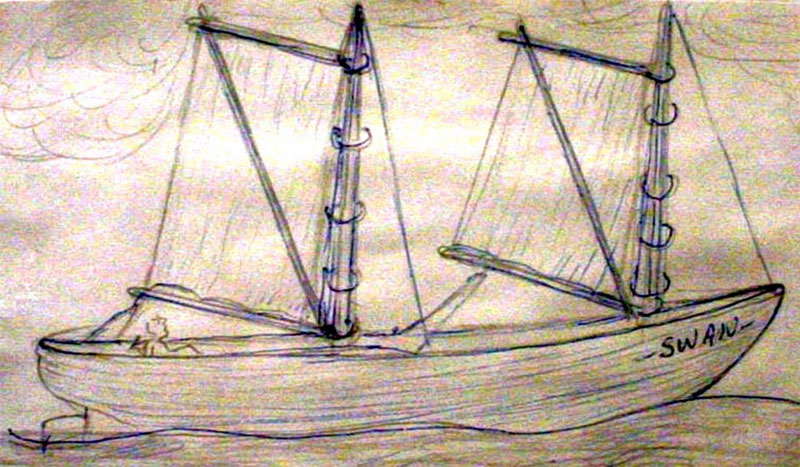
Otto felt ready for a bigger, more efficient boat by 1917. That year he bought the twenty-three foot sailboat Swan. The new boat increased Niemi’s range out of Grand Marais. He and a partner, Charlie Mattson, took the Swan as far as fifteen miles west of Grand Marais to fish the Grand Sable Banks. The patch of thirty-fathom water off Au Sable Point became, over the years, Otto Niemi’s favorite fishing grounds.

As Otto and his partner lifted their nets off Au Sable Point a hard south wind sprang up. In no time the lake turned violent and the fisherman pointed the Swan southeast for home. Driving the Swan close-hauled into the teeth of the gale, Otto rounded the breakwater and made the harbor in three tacks. Captain Truedell, who commanded the Coast Guard Station and had a nearly-legendary reputation for seamanship, met Otto on the pier to pay him a compliment. It seems that Truedell watched the whole episode play out with his lifeboat at the ready, expecting to have to rescue the Swan’s crew, or at best, tow them into harbor. Alfred recalls this episode with unabashed pride in his father.

Niemi eventually added a single cylinder Sears and Roebuck engine to the Swan. The engine increased the boat’s speed and made her less vulnerable to vagaries of wind. By 1922, Otto felt the need for a bigger boat, so he set out to build one himself.

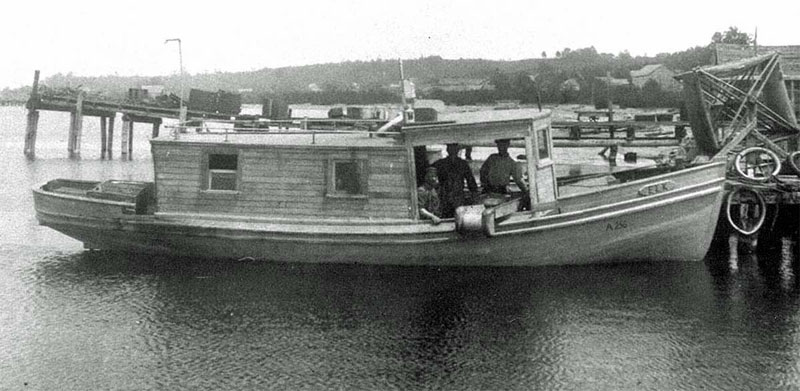
The current opinion holds that Niemi’s third fishing boat represents his first attempt at boat building. With the Swan, Niemi had an open boat, forcing him to work while completely exposed to the elements. Otto intended to rectify this with his new boat, which he called the Elk. Niemi planned the Elk as a thirty-three foot tug which, but for eight feet at the bow and six feet at the stern, would be housed over.

Otto built the Elk with no plans other than in his mind. His plan called for the boat to have a fantail stern, a design that he thought would take a following sea better. He also planned her to have a flared bow that would deflect sea and spray.

Otto searched the woods and beaches for timbers with natural crooks that he could use to shape the Elk’s curved timbers. Alfred remembers that much of the material for the Elk came from drift logs hauled from the beach. Otto and his helper sawed the logs into 2 ½ inch square boards that became the Elk’s frames and planking.

Otto equipped the Elk with a 1919 Fordson Tractor engine and a Pentwater net lifter. These modern improvements promised to make his work easier and more efficient. Otto launched the Elk in the spring of 1923. He fished the boat for seventeen years, putting her in the water every spring and hauling her out every fall. Wooden boat era fishermen say that fifteen to eighteen good years was all you could hope to get out of the best wooden hull. In 1939, with the Elk beginning to show the effects of years of wear and tear, Otto began building a new boat. He called his new boat the Shark.

CURRENT GRAND MARAIS SCENES: June 2012

I have been busier than normal the past few months, but I still make time to get out to hike and take pictures. I cannot afford the time daily, but I try to get out a few times a week.

For this web page update, I am including a variety of pictures from the Grand Marais area. First, here are a couple pictures taken from the bluff of the Grand Sable Dunes.

During one sunset hike in the dunes, an ore freighter was passing by.

Here is a picture that was taken of one of the ghost forests in the Grand Sable Dunes.

My friends, Gerald and Jill, bought a house located near Carpenter Creek on the east side of town. I have never walked up that creek bed to see the grotto waterfalls – at least until a week or so ago. I just love falls that tumble over grotto walk formations.

On Memorial Day weekend I walked out the channel break wall to get pictures of the sunset. I have never seen so many people. There were more than 100 people enjoying the beautiful evening. This is VERY rare for Grand Marais.

The wildflowers have been terrific again this year. I especially enjoyed the trilliums.

One of the best parts of spending time in Grand Marais is to enjoy sunsets on the shore of Lake Superior.

Things have been busy in Grand Marais relevant to the building of the new break wall. I am in favor of making sure that our bay will serve as a harbor of refuge. This certainly requires protecting the mouth of the bay. I just wish that they would spend the extra money and build the break wall to follow the shoreline, rather than dissect the bay. The area east and northeast of the new break wall will fill in with sand. Plus there could be other unforeseen consequences. Let’s keep our fingers crossed that these are minimal.

CUSTOMER AGATE FINDS: March 2012

Given that beach rocks are still for the most part not accessible, I do not have any submissions for recent agate finds. However, Jeff Carlson submitted the following picture in early winter. He found this basaltic matrix rock with a carnelian agate pocket and other brecciated fill. The rock was found at on an undisclosed Lake Superior beach.

Last summer I posted a few pictures of Claudia Wyrick’s agates. She recently sent me some photos of Lake Superior agates her parents found on Isle Royal in the mid-1950s. These agates found by Bud and Gloria Norris include a candy stripped agate, plume agate, sagenite agate, and white agate.

I have been posting customer agate finds for several years. On my blog a month or so ago I included close up photos from some of these agate finds. I’ve decided to include them here, although I spent a bit more time cleaning up the pictures files.

MINERAL OF THE MONTH: March 2012 – Mexican Crazy Lace Agate


The mineral of the month for this update is Mexican Crazy Lace agate. Crazy lace agate, also known as Mexican agate, is an attractive, multi-colored agate that is patterned like a beautiful, multicolored paisley cloth. It is found in Northern Mexico in the state of Chihuahua. This is the largest of the 31 Mexican states – slightly larger than Great Britain.

Although Mexican agates were first documented in 1895, it wasn’t until some 50 years later that a few American rockhounds found a few small agates not far from the newly constructed highway they were travelling between Ciudad Juárez and Ciudad Chihuahua. Many different types of agates are found in this region, mostly in isolated deposits within andesites, rhyolites, and ash flow tuffs that range in age from 38 to 44 million years old. The only exception is Mexican Crazy Lace Agate which is uniquely found in a limestone layer of Cretaceous age (90 to 65 million years old). The Crazy Lace deposit is located southwest of Villa Ahumada.

In ancient times, this agate was worn to placate the gods, and to give courage. It will improve eyesight, illuminate your mind, allow you to be more eloquent, and give vitality. It keeps the wearer well-balanced, focused, and improves ability to accomplish goals and overcome adversity. Like other agates and silica rocks, Crazy Lace agate is a good general healing stone.