It was a good year agate hunting in the Grand Marais area this past season. As some of you know, my theory about how most rocks reach the Grand Marais beach is due to shelf ice that breaks off shorelines all around Lake Superior with a change of wind direction and float around the lake during the winter. Shelf ice forms early winter on top of rock piles and incorporate some of the pebbles into the bottom of the shelf ice. In the spring, we get predominant northwest winds that blow the floating ice to the southeast shoreline, including the Grand Marais area. Some years we have little to no ice floating on the big lake. This past spring, though, there was A LOT of floating ice. When the icebergs get blown up onto shore for the last time, they melt and dump their rocks. So, this year there were more rocks on the beach than we have seen in many years.
When someone comes into the museum with an agate find, I sometimes ask permission to include photos on these web page updates. If the customers say yes, I have them write their chosen personal information on the back of a business card. I then date the card (to correspond with the date of the photos) and keep the cards until the next web page update. During the craziness of the summer, sometimes I misplace some of these cards. That is the case for this first set of photos. Not only did the customer bring in some killer Lake Superior agates, but he also had a collection of meteorites, including one that fell in the last year or so in Hamburg, MI. Many of the meteorites were picked up less than a half mile from where I lived prior to moving to Grand Marais. If you are the person who showed me the meteorites and these agates, can you please email me at karen@agatelady.com to give me your name (first name is OK). I will then update this paragraph.
First, the meteorites……
Second, his agates……
On September 2nd, sixteen-year-old, Anna, from Alma, MI came into the museum with this awesome water-washed 8.4-ounce Lake Superior agate found in the Grand Marais area. Anna was shy and did not want to be photographed.
On August 30th, Elias from Au Train, MI visited the Gitche Gumee Museum to show off this colorful Lake Superior agate.
Late summer the Evoy family displayed some of their agates. This included Steve, Jade, and Lily – from Wolverine, MI. They found several beautiful gems!
Nina Nyman, from Grand Marais, also did not want to be photographed. But she was happy to show off her agates, including an 8.4 ouncer!
Another photo shy person, Karen Shreve, from Livonia, MI showed me her large, beautifully banded Laker on August 31st. What incredible banding this agate has!
During the third week of August Brian and Keola Trudell, from Escanaba, MI, came into the museum with their find. Keola found one of the few Lake Superior sagenite agates I saw all summer.
One of the better agates brought into the museum this summer was a 7.4 ouncer, found by Erin Vlietstra. She is pictured with Mark. They are from Kalamazoo, MI.
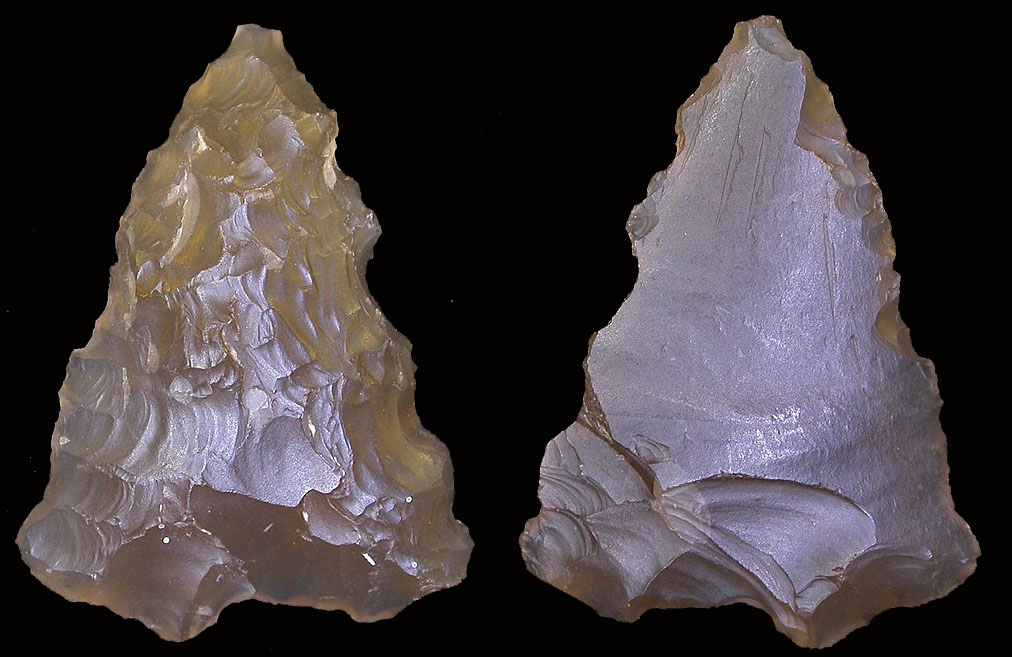
Ohio flint is the official gemstone of Ohio.It was designated the state stone in 1965.There are ridges and other deposits throughout Ohio, but most can be found in the eastern and central parts of the state.
Click to Enlarge
Flint is a microcrystalline variety of silica (quartz).It is very closely related to Jasper and Chert since all three are made up of extremely small round crystals of silica.The microcrystals pack together so tightly (like BBs in a jar) causing these rocks to be opaque.Agate is a “first cousin” variety of microcrystalline silica, but its microcrystals are fibrous in shape and are translucent.
Click to Enlarge
Flint, as well as chert and some jaspers, were highly prized by Native Americans since the rocks were able to be knapped to make arrowheads, spear points, beads, and other objects.Many Native Americans in the mid-West traveled to Ohio to collect flint.These tribes, as well as those living in Ohio, traded flint with other tribes in a wide geographic area.
Click to Enlarge
The most famous deposit of Ohio flint is found in a six square mile ridge located in eastern Licking and western Muskingum counties.Flint from this ridge is called Vanport flint, which formed during the Pennsylvanian period between 286 and 325 million years ago. The actual deposit of flint ranges in thickness from one to twelve feet.
Four years after the Niemies retired the Shark, she was sold to a fisherman in Cheboygan who was determined to catch sturgeon in Lake Huron. After two years with no success, he sold the tug to a pleasure boater in southwestern Michigan. Its ownership was transferred a couple of more times before it was used at least once more for commercial fishing in Lake Michigan.
After purchasing the museum, I decided to head down to southeastern Michigan to interview Arvi Niemi. During our conversation, he said that he thought the Shark was on display somewhere in South Haven. I drove another hour south and while doing some shopping, I asked the cashier if she knew of somewhere in South Haven that an old fish tug might be on display. She said: “You mean a boat?” She directed me to the Michigan Maritime Museum. When I introduced myself to the museum curator, Ken Pott, and showed him some pictures of the Niemies and their fish tugs, he got very excited and invited me to the museum library wherein he relayed his story.
Mr. Pott explained that in 1994 an article was published in the Inland Seas Journal about the Niemies and the three fish tugs they had built. Inspired by the article, he convinced the museum’s board to acquire and renovate an old fish tug. A couple of weeks later, as he was driving outside of South Haven he spotted an old fish tug next to a corn field. He stopped and asked the farmer about the tug. The farmer replied: “I don’t know much about her, but I think she was built in the Upper Peninsula. I only bought her so I could take out the Fordson motor, put that motor in my tractor — and now my tractor works just fine!” After conducting some research, Mr. Pott discovered that this was indeed the same tug described in the recently published article. The farmer gave the tug to the museum. However, the museum never renovated her as it was decided instead to renovate a larger fish tug.
When I explained to Mr. Pott about reopening the Gitche Gumee Museum, the agreed to donate her so that the Shark could come home. During the time that the Maritime Museum owned the Shark, a student from Western Michigan University studied her. It was determined that the Shark was the last hand-made fish tug left intact in the Great Lakes Region. A professional boat hauler was hired, who charged by the quarter mile for an 800-mile round trip. We turned many heads as we traveled up the highway and over the Mackinaw Bridge on the long road home to Grand Marais.
Click to Enlarge
Unfortunately, a couple of years ago the Shark’s condition deteriorated.I contacted several historical groups hoping to get some help in paying for a complete renovation.I had already put thousands of dollars into the tug over more than a decade.I could not find any funding and was left with no choice but to have the tug hauled away.
The article below appeared in the Grand Rapids Press on February 12, 1995.
Click to Enlarge
Maritime Museum Accepts Historic Fishing Tug
By Kristin Hay
A 33-foot boat built by a Finnish family that fished the waters of Lake Superior80 years ago has been donated to the Michigan Maritime Museum in South Haven.
The fishing tug, named “Shark,” was built, owned and operated by the Niemi family I Grand Marais, said Kenneth Pott, curator of the Michigan Maritime Museum.
“We are excited to acquire such a rare and well-preserved example of an early folk tradition of commercial fishing in Michigan,” Pott said.“We are thankful that this boat survived the years and trials of its career and was donated to us.”
Along with the boat, the museum learned of the vessel’s colorful history from Axel Niemi of Ontonagon.Niemi is the youngest of the four sons who worked in the family fishing business.
He said the Niemi family’s patriarch, Otto Niemi emigrated to Grand Marais in 1905 from Finland at the age of 21, landing a job working in the sawmills.The mills shipped pine timbers to England while the pine forests lasted.
But after the mills closed in 1910, Otto Niemi built a rowboat, purchased a sailboat and later built two other larger boats, one of which was the Shark.
Niemi said it took the family about a year (1939 to 1940) to construct the Shark.They fished the waters of Lake Superior [with the Shark] from 1941 to 1953.
Click to Enlarge
Pott called the boat “extremely well documented.”All four sons are still living and are willing to share their stories about fishing on the Shark.
Many fishing tugs similar to the Shark were lost in storms that blow up frequently on Lake Superior, said Niemi, who recalled one memorable spring storm during which he watched his father battle 12-foot waves.
“My dad and my brother-in-law got caught in the storm,” Niemi said.“The waves tossed the boat around like a surfboard.A big swell twice the height of the boat picked it up and pushed the tug beyond the east side of the entrance of the pier.
“Each time the boat would disappear below the swells, you’d think the boat was gone.My dad learned a lot about sailing on a hundred-ton stoop in Finland, so he was a good sailor.He dove into the swells and kept coming through the trough of the sea,” Niemi remembered.
Another boat out in the same storm wasn’t as lucky.Two out of three fishermen aboard drowned when their boat filled with water, he said.
There were other storms, some worse, Niemi said, but they always managed to escape in time.Whenever a storm started brewing, they’d pull up their nets and head for shore, he said.
The Niemi family fished for lake trout until 1953, when they hauled up their nets for the last time because the sea lamprey had killed off the trout. “The lamprey are still there and you can’t get rid of them,” Niemi said.“Some fishermen believe they came in on the side of ore carriers that came through the St. Lawrence Seaway.”
After 1953, the Niemi family sold the shark to a buyer in Cheboygan, and it eventually wound up in St. Joseph.Pott said it’s believed it may have been owned for a time by Michigan Indian fishermen.
Robert Trowbridge, a South Haven resident with maritime interests, acquired the tug and recently donated it to the museum, Pott said.
The boat will become part of an exhibit on traditions of commercial fishing in Michigan, Pott said.
Two other intermediate sized boats planned for the exhibit are the Mackinaw, a 19-foot sailing craft used in the early years of commercial fishing, and the Evelyn S., a sturdy, 50-foot wooden fishing tug which formed the backbone of commercial fishing fleets on the Great Lakes from the 1940s into the 1960s.
Click to Enlarge
Unfortunately, the Maritime Museum later acquired a different fish tug and renovated it instead of the Shark.So the Shark sat on a dock until I came along in 1993.Once the Shark was in place in the yard west of the museum, thousands of dollars were spent to fill in the gaps between the hull’s boards, do what we could to preserve the aged wood, build a cover over the hole cut on top of the Shark by the farmer who extracted the engine, and re-paint the tug.A local youth group received a grant that included funds for community service projects.The kids voted to help with the Shark’s renovation.I wish she was still sitting outside the museum, but at least we were able to preserve the historic fish tug for more than twenty extra years.
This web page update covers from late April through the beginning of August.We experienced a late winter storm in April, so there was still some ice hugging the Lake Superior shoreline.
Click to Enlarge
Click to Enlarge
While visiting Sable Falls with friends, we noticed a failed attempt by beavers to fall a tree.
Click to Enlarge
In the spring the deer are hungry.When the snow starts melting in town and the grass shows through, the deer munch away.
Click to Enlarge
One of my favorite things about spring is the blooming of the trilliums.My favorite spot to check out the trilliums is the trail between the Sable Visitor’s Center and Sable Falls.
Click to Enlarge
Once all the shore ice melts, it is always great to see the rocks along the shoreline.This year we have more rocks on the beach than we have had for the last few years.
Click to Enlarge
One night this summer I walked out to the breakwall to enjoy the sunset.Several people were fishing, others were walking the breakwall to enjoy the beautiful evening, and a freighter went by Grand Marais.
Click to Enlarge
Click to Enlarge
Click to Enlarge
Although I have not gone on very many hikes this summer due to my busy schedule, I did go on one hike on the Masse Homestead trail in the PRNL.The forest seemed healthy and happy.
This has been an interesting summer of agate hunting in Grand Marais.There is more rock on the beach than there has been in several years.Despite the number of beach pebbles, there have not been as many agates brought into the museum as I expected.Perhaps people are finding them, but not just bringing them in.However, I have seen some great agates.
Jill Haldeman found two nice agates in the Grand Marais area.One agate has nice feathered fortification structure.The other has some of the most bizarre eyes I think I have ever seen.
Click to Enlarge
Click to Enlarge
Click to Enlarge
James Lloyd, from Northville, MI, found a beautiful red and white agate in Grand Marais.His chosen hunting technique is to “swim” across the rocks on his belly scooping and digging as he goes.He dug down several inches to get this beauty.He is pictured with his kids, Ava and Auden.
Click to Enlarge
Click to Enlarge
Click to Enlarge
Kurtis Kares from Mears, MI found several agates in the central and eastern U.P.He is especially fond of the Eastern U.P. water-washed agates.
Click to Enlarge
Click to Enlarge
The last agate was found by my friend, Claudia, who stays in Woodland Park with her husband for most of the summer.She came by the museum to show me this cool agate she found yesterday.It is not the biggest in the world, but it has awesome structure and extremely nice color.
Fordite, also known as Detroit agate or Motor Agate, is not actually a rock or a mineral. However, it is used in lapidary to make amazing pieces of jewelry, some of which sell for hundreds of dollars. Fordite is actually old automobile paint which has hardened into layers. Decades ago, the process used to paint automobiles was different than it is today. Back then cars were hand sprayed. The color used in the spray booth changed as the production schedule changed. Layers of the enamel paint built up on the tracks and skids on which the car frames were painted. The layers of oversprayed paint became hardened when the car bodies went into ovens to cure the paint. When the build up of paint became too thick, it was removed and discarded.
The original decades-old “Fordite” often display incredibly beautiful and complex, agate-like layers. Eventually people realized these beautiful slag-like layers were patterned like psychedelic agate and could be cut and polished into jewelry.
This spray process has now been automated with an electrostatic process that essentially magnetizes the enamels to the car bodies. This leaves little overspray.
Some say Fordite is no longer produced in car factories, but this is not true. A customer came into my museum who has the job of cleaning the electrostatic painting equipment to remove the still accumulating layers of paint on the equipment. Although much of the modern paint layers are not as colorful as those from decades ago, there is still some jewelry-compatible material being scraped off car painting equipment. In some cases, this new material offers interesting shapes instead of bizarre colors.
Also, some people are making their own Fordite by layering and baking enamel paints in their studios.
If you have acquired a piece of Fordite jewelry, keep in mind that it is a relatively soft material. However, if you do see scratches on the surface of the Fordite, pull out your car wax and a 100 percent cotton cloth and give it a good shine!
Thanks goes to Kyle Koskinen for his photos, video, and samples. I am hoping to find room in the museum to create a “Fordite” display for the 2018 summer season.
NOTE: More Grand Marais scenes are posted often on my blog at www.agatelady.blogspot.com and on my main personal Facebook page listed under Karen Ann Penegor Brzys.
I love taking photos in the Grand Marais area all times of the year, but I think I like winter photos the best. But the first photo included in this webpage update was taken on the south side of the Straits of Mackinac showing the blue ice. Apparently, blue ice rarely forms on the Great Lakes. The phenomenon is much more common on glaciers in Antarctica and the North Pole. It happens because of three processes. The first is that water absorbs the other non-blue colors of the spectrum. The second cause is the lack of bubbles in the ice, allowing the blue wavelengths to continue through the ice and not be scattered by the bubbles. The third factor is the ice thickness and density. All these conditions were perhaps the best locals in the straits area have seen in many, many years.
When people think about walking on the Grand Marais beach, most envision the summer beach. However, the winter beach can be VERY dynamic and beautiful.
My other favorite place to take winter photos is the Grand Sable Dunes in the Pictured Rocks National Lakeshore. I’ve taken a few snowshoes in the dunes. This time of year you cannot drive to Sable Lake, so you have to park at the Sable Lake Visitors’ Center and snowshoe to Sable Lake. To get these photos, I snowshoed from Sable Lake, across the dunes to the Lake Superior bluff, and back.
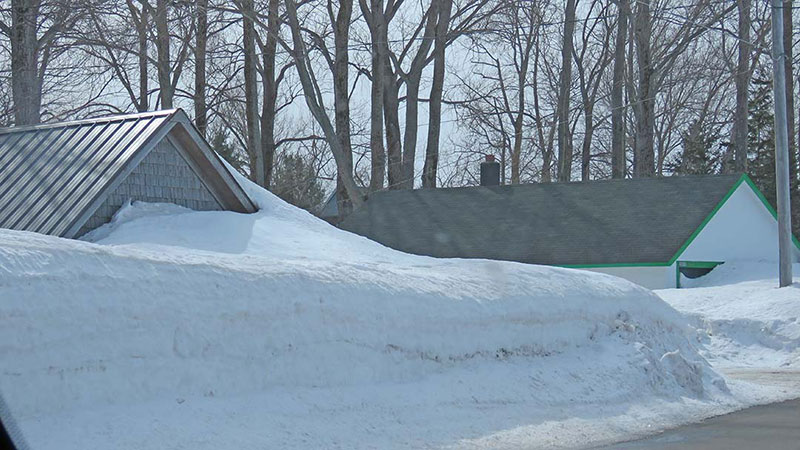
I am not sure how much snow we have received this winter season, but we have to be getting close to 300 inches with this late winter/early spring dumping. Here is a photo I took on Coast Guard Point showing how high the snow piles up.
Perhaps the best winter event in Grand Marais is the UP 200 dogsled race, which takes place mid-February. The race teams start in Marquette and travel on well-marked trails to Grand Marais for a required rest period before returning to Marquette. This year the weather was perfect for the race!
As I said in the introduction on the home page, spring has not yet sprung in Grand Marais. There is still considerable snow and ice on the Lake Superior shoreline and the back roads around the Grand Marais area are not yet open. It is hard to determine when winter will loosen its grip on the Upper Peninsula, but there most likely will not be decent agate hunting until sometime in May. The good news, though, is that there has been considerable moving ice on the Big Lake. It is ice that moves rock (including agate) to the south shore. So, hopefully, the agate hunting in the Grand Marais area will be good this year!
For this web page update, I would like to feature agates found in southeastern Wisconsin and northwestern Illinois. I received emails with photo attachments from Lars Adams. Although I have seen specimens and other photos of agates found in Wisconsin, these are more translucent with well-defined structure. He also is finding a wide array of silicified fossils and pseudomorphs. Lars has decided to call these agates “Lake Michigan cloud agates.”
History Gem – 1932 Petition submitted by the Grand Marais Womens’ Club to the Burt Township Board
After the railroad closed in 1910, the population in Grand Marais declined from thousands of people down to just a few hundred. Since there were no roads yet, the only way to get to Grand Marais was by ship, during the non-winter months, or by an over-land stage. Finally, M77 was completed in the mid-1920s that made life in Grand Marais a bit better. Just when things were improving, the depression hit. Those living in Grand Marais had to be self-sufficient and survived by fishing, hunting, and gardening. Many families also had cows to supply their families with milk and meat. However, most families did not have yards big enough to coral their livestock, so the cows were allowed to roam around town. The free-roaming bovine created friction when they knocked down fences around gardens and consumed neighbor’s gardens.
The oldest club in town today is the Grand Marais Women’s Club. Back in 1932 women in this club took action and created a petition to try to remedy the situation. The text of the petition is below.
The Grand Marais Women’s Club
Grand Marais, Michigan
September 5, 1932
To Chairmen of the Township Board of Burt Township
Gentlemen:
We, the undersigned qualified voters submit the following petition to have all cattle, horses, mules and pigs kept off of the streets in the town of Grand Marais, and Burt Township.
We believe for the future of Grand Marais, that the above animals on the streets are detrimental to the town in general. Gardens have been destroyed, fences broken down, and complaints have been made by tourists that they were unable to sleep on account of the cow bells.
We believe by bringing more tourists to town we will not only increase employment but also increase the sale of milk products and farm produce, which will help the owners of said cows and keep the town in a sanitary condition.
Mrs. J. Spencer
Mrs. A. J. Goupille
Otto Newberg
Mrs. A. Newberg
Mrs. A. Mattson
Mrs. Joe DesJardin
Mrs. Edward Erickson
J Rainthir
Mrs. Jas H. Buckland
J.H. Buckland
Pearl Martin
Mrs. A. S. Tulloch
E. J. Spencer
Irene Endress
Herman Wood
Isabelle McCall
Mrs. Donald McCall
Mrs. J Plant
Joe Plant
Mrs. Chas Duval
Mrs. R. E. Schneider
Mr. R. E. Schneider
A Goupille
Mr. Torrzes
Mrs. Torrzes
Kathleen Richards
Bernice Bennett
Etta Barney
Pearl Masse
Agnes Petitpren
Henry J. Petripren
M Thoupsow
J Thoupsow
Denise Thompson
Grace Chilson
Marie Petitpren
Chas Goodman
Ambrose Graham
May Meldrum
Ray Meldrum
Clarence Nettleton
Violet Nettleton
Mrs. M. Propst
Manley Propst
Chas Propst
C. J. Power
Mrs. C. J. Power
Hilda Peterson
John Peterson
Mrs. Mary C Demsey
Fred Demsey
Mrs. Irene Rathburn
D. M. Rathburn
Mrs. Elizabeth McDonald
Mr. Robert McDonald
R. J. Cook
Marner Keating
G. S. Hill
F. G. Petripren
John A. Peterson
Oiva Erickson
John W. Williamson
Mrs. J. W. Williamson
Mrs. Jay Lee
Jay Lee
Mrs. E. J. Gross
E. Gross
J. E Sayen
Mrs. J. E. Sayen
Mrs. D. H. Pratt
Geo S. Denny
Fred W. Denny
Cecelia Cherrette
Mrs. Elizabeth Nettleton
Mr. G. E. Nettleton
Geo S. Butler
Mrs. Wood
Ora Endress
Margaret M. Soldenski
G. S. Tullock
Mrs. Larson
Mrs. Frank Vaudreid
Charles Dunol
Mr. Frank Vandersal
Mrs. Mary Petripren
Janice Thomas
H. T. Richards
B. J. Trudell
Jean Trudell
Vivian Trudell
Lily B. Waggoner
Allen Tweedy
Alice Tweedy
Mrs. Florence Butler
Paul Reynolds
Mrs. Eldon Reynolds
Mr. Jesse Jones
Mr. A. L. Phoenix
Mrs. Mae Phoenix
NOTE: The signatures on this petition were written in pencil. Although efforts were made to correctly interpret the handwriting, I apologize in advance for any errors.
The lack of ice flow on Lake Superior this past winter and spring definitely impacted the quality of agate hunting along the shoreline over the summer. Despite fewer agates being found, people still brought some nice agates into the museum.
This first Lake Superior agate was found mid-August by Ann Blanchard, who is from Port Washington, WI.
Cassie Bogotka sent me an email with photos of coldwater agate. It is a marine sedimentary agate mostly formed in Devonian age limestone, which is 416 to 358 million years old. This agate is significantly different than the 1.1 billion year old Lake Superior agate that formed in igneous basaltic rock. Although interesting, coldwater agate has little to no value.
A nicely banded Laker was found by my friend, Claudia, at the end of the season. She and her husband stay in Woodland Park most of the summer.
Adrian Gauthier, from Cheboygan, MI, brought these two beautiful agates into the museum in July. The agate on the left is a beautiful water-washed agate. The other is an unusual brecciated agate.
Margaret Kline visited the museum in August. She found the specimens shown below during the 1960s and 1970s. The first picture is Keweenaw prehnite. The other specimens are Lake Superior agates.
I received several emails from Keweenaw seasonal resident, David Schuder. The first is an usual Lake Superior agate found near Eagle Harbor. The green, he says, is Celandonite. The second Laker contains several crystal impressions (the original crystals either popped out or wore away). The third photo he describes as a “hematite plume-like agate,” which was collected at the Calumet & Hecla # 21 Copper mine in Houghton County.Mi.






.jpg)