CUSTOMER AGATE FINDS: March 2009

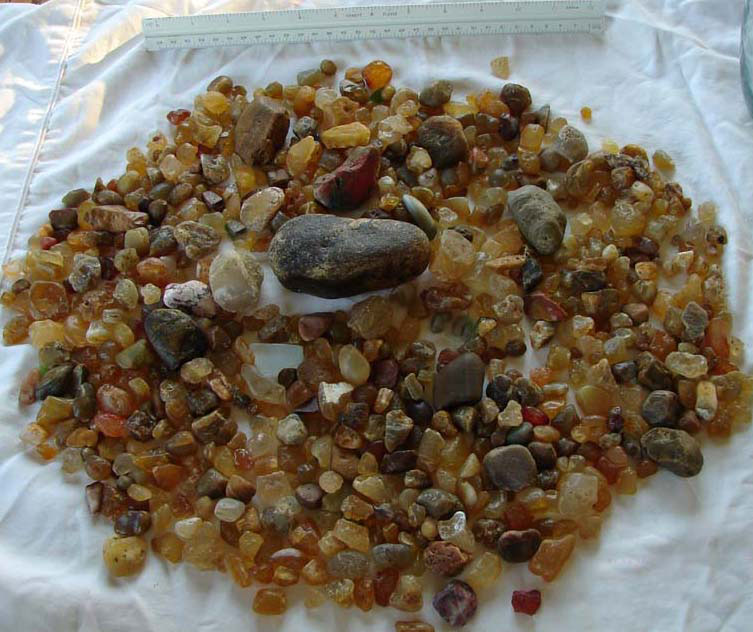
I received an email a few weeks back from a Michigan Technologic University student, Phillip Schichtel. He is an avid agate hunter who looks on the beaches in the Keweenaw, as well as by his family’s cabin near Muskellunge Lake, located 20 miles east of Grand Marais. I must admit that he has found some dandy agates!

For those of you who wish to display your agates in a similar manner, here are a few tips:

  1. Make sure the glass in the jar is strong enough to adequately support the weight of the rocks. If possible, use glass jars that are made of tempered glass.
  2. To prevent the growth of algae, add a little bleach to the water. For smaller jars, just add a few drops. For larger jars, add up to a capful.
  3. If the jar you are using is fairly wide, rather than take up space in the middle with agates, either use other rocks to fill the middle space, or insert a skinny glass or other jar in the middle, and fill the outer space with your agates.
  4. Change the water in your jar a couple of times per year.
  5. Note that if you display your agate jars on a sunny window sill, the sun can influence agate banding. I have had some people tell me that sunlight improves banding in some agates in a manner similar to heat treating. Others have told me that prolonged exposure to sunlight negatively affected the banding in their agates. In most cases, though, sunlight should not impact agate banding, especially if your agates were found on the beach and have already had prolonged exposure. The greatest risk of keeping your jars on a window ledge is that other people walking by your house will be able to see them. This is especially a problem if you are not in the habit of locking your doors. .I have heard of more than one case wherein someone returned to their unlocked home to find their agate jar missing.
  6. DO NOT fill the jar with baby oil, or other type of oil. A friend of mine did this several years ago and the baby oil penetrated into the agate bands and decreased the quality of the banding.

CUSTOMER AGATE FINDS: February 2009

With our mountains of snow, agate hunting is at least a couple of months away. If I were to guess, unless there is a massive thaw, I don’t think anyone will be rockhounding our beaches until at least late April, if not May.

So again to appease all you agate fans, I have included photos of a couple of lakers I have for sale. The first is a nice sized laker with smoky quartz fill. The outer bands are translucent carnelian. Along the top, there are some terrific candy stripe bands that very likely will exhibit a shadow if polished. The center, which is exposed at one end, shows some exquisite smoky quartz crystals. It weighs a little over 5.5 ounces and is 2.5” x 2.25” x 1.5”.

The other laker is a peeler depicting differential erosion of the various bands. The bottom of the agate is translucent carnelian. The upper half that exhibits the peeler bands is more opaque with paint stone colors of orange, yellow, and tan. Concentric banding pops out at various places, including one whole end of the specimen. It weighs just under 7 ounces and is 2.5” x 2.25” x 1.625”.

If anyone is interested in purchasing either of these Lake Superior agates, the retail cost is $40 each plus $5 s/h and sales tax if applicable. Give me a call at 906-494-2590 or send an email to  if you are interested.

CUSTOMER AGATE FINDS: January 2009

I must be honest: there is way too much snow on the beach to agate hunt. However, I know that you rockhounds still want to look at pictures of agates. Thus, I have scanned in a couple of terrific Lake Superior agates for your enjoyment.

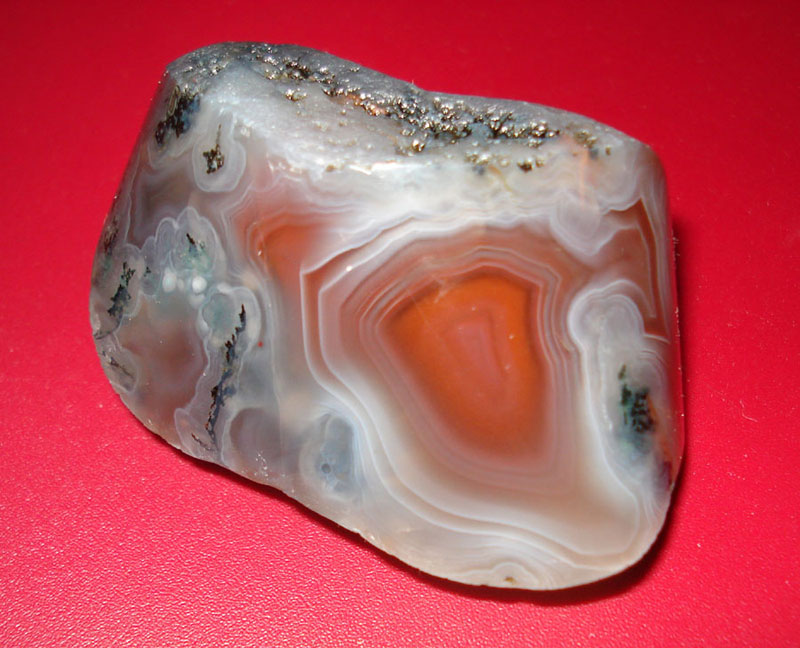
The first is one that I purchased while in New Mexico a couple of years ago. I received a call from a friend saying that an acquaintance had a garbage can full of rocks left over from her dad’s rock shop, which used to be located in northern Minnesota. It actually turned out to be nearly a dozen garbage cans – all of which had sat untouched for 20 years. Many of the cans had other non-agate rocks. Even those with agates, had other material. It took me all day to go through those specimens. The agate pictured below is one that I retrieved and purchased. I call it my Champaign Agate because the shadow has bubble-like structure to it. You cannot depict this shadow effect in a digital image, but you can see the ghosted like contrast of the shadow on the right side of the agate in the detailed picture below. The rock shop owner cut, but did not polish this specimen.

The next agate is one that I have for sale. It is an interesting tube agate. The detailed picture shows cross sections of some of the tubes. On the other end of the specimen (not pictured) there are several other tubes clearly visible through the translucent chalcedony. Due to the roundness of this section of the agate, the scan didn’t come out so I can’t include this view (sorry). Although the rest of the banding is not as well defined, the tubes make this an interesting specimen.


CUSTOMER AGATE FINDS: December 2008

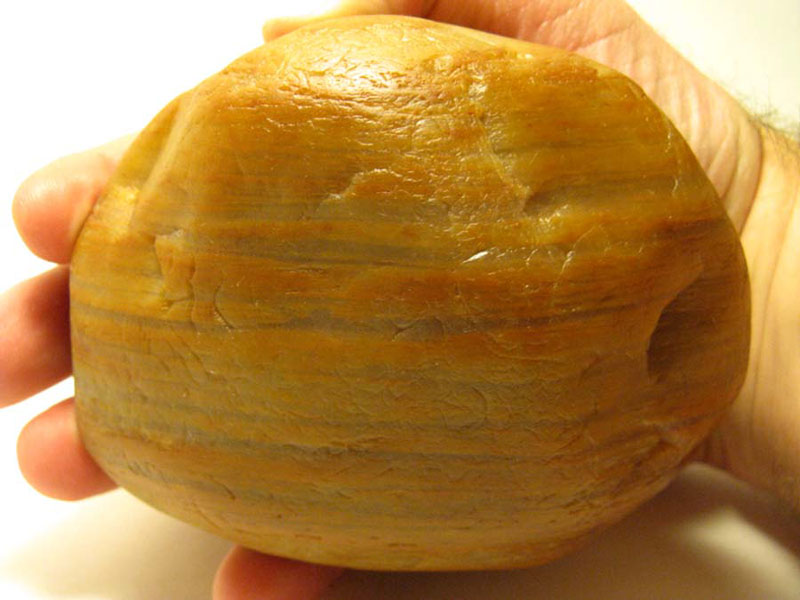
A couple of weeks ago I received a series of photos attached to an email from Todd Bird. When he purchased a house in Tawas, MI, this rock was left behind as a door stop. It is approximately 7.5” by 4” and weighs 5 pounds. Most of the specimen is translucent. There is banding throughout, with the most striking being the candy-stripped bands at the end of the specimen. I have examined it by zooming in with Photoshop. The bands definitely look self-organized, although the appearance is much different than that of other agates found in the upper Midwest. It most likely is some type of bizarre tube agate, probably formed within a sedimentary rock seam. The banding pattern reminds me of the sedimentary agate from Thunder Bay, Ontario, but the color and appearance is much different.

If any of you have seen something similar, or if you have any other ideas about the rock’s genesis, please send me an email to .

CUSTOMER AGATE FINDS: November 2008

Agate hunting is soon to be done for the year. I haven’t had time to go out, but a few of my friends have been diehards and have found a few small agates as of late.

The agate finds featured this month include some found by Adam Nothelfer, who is from the Lapeer area of the Lower Peninsula. They are all very unusual, each for its own reason. First of all, there is the agate he found in on his family’s private property in a small lake in far northern Lapeer County, north of the town of North Branch. This lake was once a gravel pit and has produced masses of fossils, Petoskey Stones, and other minerals. This 1 pound 5.5 ounce agate is apparently the first agate to be found in the lake. According to Adam, the pictures DO NOT do this specimen justice. He says that “It is absolutely dreamy to get it wet and look at it under the magnifying glass. It has eyes all over it and areas of banding mostly white but some with red and pink floating in clear chalcedony.” The dimensions are 4.25″ x 3.5″ x 2.5″ — quite large for any agate. It certainly appears different than Lake Superior agates. If I were to guess, I would say that it is an agate that formed within a sedimentary rock pocket.

Apparently Adam usually comes to Grand Marais to agate hunt. This year, he instead headed to the Keweenaw Peninsula and looked for copper replacement agate nodules at the Wolverine Mine. Pictured below are a couple that he pulled out of the basalt piles wherein the agate nodules fractured in half while still in matrix. Adam collected a large plastic coffee can full of nodules and hopes that more have banded agates inside, and maybe, some — with copper bands.

The last agate picture agate sent to me is one of a yellow and white water level banded agate. It looks similar to others I have seen that come from Vermillion Beach. However, he says that he found this 3.5 pounder near Muskellunge Lake, east of Grand Marais around 20 miles.

I have seen several of these, but have not had time to really study them. From what I can see in the emailed picture, it appears to have distinct water level bands that alternate between chert and chalcedony. It appears that this also was formed in a sedimentary rock pocket.

If any of you readers have anything to add about any or all of these unusual agates, please send me an email to .

CUSTOMER AGATE FINDS: October 2008


Although I think spring is the best time to agate hunt given that the recently melted icebergs dump their load of new rocks on the beach, there have been a lot of good finds this fall. I do agree that the fall storm waves mix the rocks and sometimes push new rocks up onto the beach. Other times, though, the waves will undertow the rocks out back into the lake and/or cover them up with sand.

None the less, there are several recent finds featured this month. My friend, Renee Beaver who appeared last month, is featured again with a 1/3 pound candy stripper.

The Weihing family contacted me early this fall about their successful agate hunting trip to Minnesota. Ashley, Kayla, and Courtney show off their finds in the pictures below.

Ron and America Dukowitz emailed me the picture below documenting their recent U.P. agate finds.

And finally, I recently took a few days off to agate hunt in Minnesota with my friend, Tom Tomasek. Pictured below is Tom and his dog Alex, as well as the agates he found on the trip.


CUSTOMER AGATE FINDS: September 2008

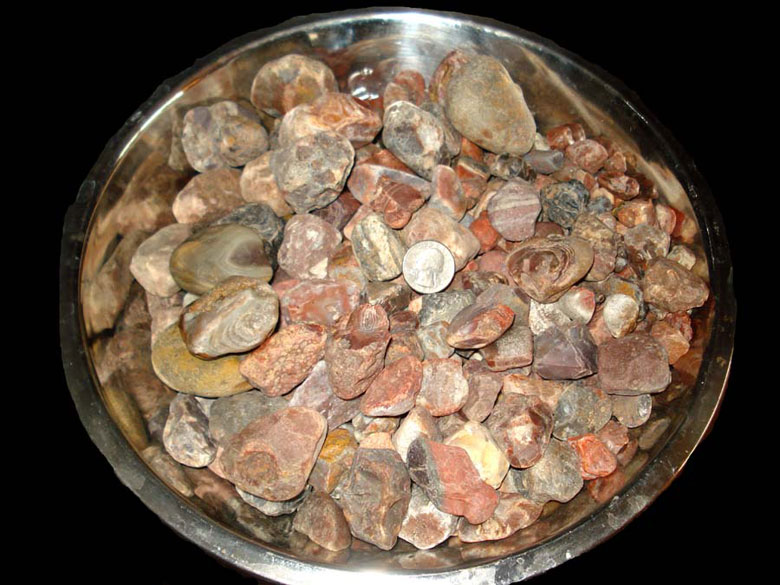
Many of you who know me are aware that I do not get much time to go out agate hunting. However, when I do go out — especially when I go to Minnesota, I am able to put my knowledge to use. My poor eye sight requires that I get close to the rocks in order to see them. Of course, I always have my 10 power “eyes” on while agate hunting. Usually, I dig to get down to layers that others may not have searched. At the request of many museum patrons, I have included a picture of the bowl of agates I’ve found so far this year. I wish I could say I have found a “fister”, but so far one has eluded me.

My friend, Renee Beaver, also makes a repeat visit to the web page. Earlier this month she headed to the beach after one of the storms. Some storms cover the rocks up and/or undertows them back into the lake. However, other storms mix up the rocks to perch new agates up on top. Apparently, the storm that preceded Renee’s agate finds was a GOOD storm. She found 16 good agates — which for Grand Marais is a great day!


CUSTOMER AGATE FINDS: Summer 2008

Since I was not in town for half of July, I have fewer customer agate find pictures. There are a couple, though. Actually, the first specimen is one that email pictures were sent to me by Dana Maudel, from McGregor, MN. She said in the email that her boyfriend found this specimen. I emailed back to ask more questions about the weight and location, but did not receive a response. It is unusual and remarkable enough, that I am going it include it in this month’s web page update. It is quite large, over 10 pounds. It appears to have unusual tubes running down the side of the specimen. Has anyone ever seen anything like this before?

The second agate is one found in the Grand Marais area by Michael Webb from Dearborn, MI. He brought it in during Festival Weekend, but I forgot to take a picture of Michael holding the agate. He asked me to face polish the agate and mail it back to him. It is extremely translucent with the carnelian fortification pattern along with various inclusions. Nice agate!

CUSTOMER AGATE FINDS: May 2008

With the melting of the icebergs on the beach has come the early-season agate hunters. Mike Miller makes a return to the web page with his friend, Terry House — both from the Muskegon/Fruitport area. Terry House found this nearly half-pound nodular agate with well defined banding around a quartz center fill. Mike Miller found two nice agates. The first is a small but beautiful agate with a carnelian center. The second is an absolutely amazing water level agate that is around a third of a pound. These agates and more were found east of Grand Marais. Congratulations Terry and Mike!


CUSTOMER AGATE FINDS: February 2008

Dan Kinney from Sault Sainte Marie, MI has made the web page again. If you remember, last summer he found the large brown agate, which he later donated to the museum. When he donated the agate, he said that he would just have to go out and find a bigger one. Well he did. Just before the snow started to pile up, he managed to find this pounder. It is a paintstone agate with zillions of bands that don’t show up too well in this photo. None the less, it is an amazing find. Dan asked me to face polish the specimen to accentuate the banding. I am glad I had the chance to “dress up” this agate.

When I went to the Soo to deliver the agate, as well as to run errands, I was able to finally see some of Dan’s agate jars. Wow!