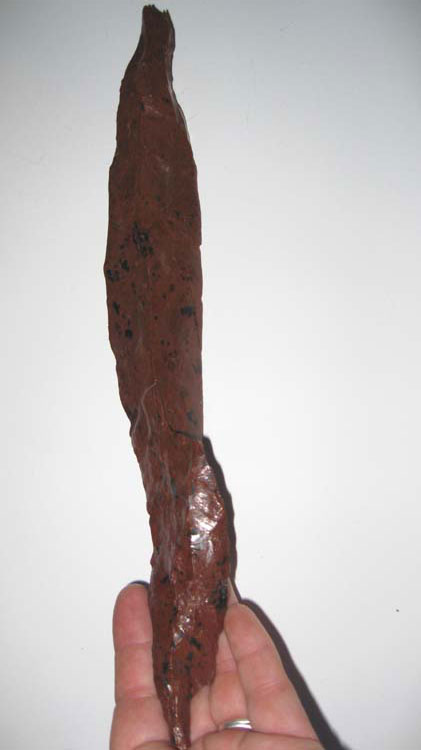
MINERAL OF THE MONTH: July 2010 – Mookaite Jasper

Mookaite jasper is a sedimentary rock formed when ancient sea bed sediment was jasperized into a mottled and beautiful quartz rock. This decorative rock, which is often used in jewelry, has truly beautiful patterns. It is only found in Australia and has the same earthy colors as those used by Aborigines in their art work. It is fossiliferous made up of the skeletal remains of radiolaria that had skeletal structures made of opaline silica. Billions of their remains were deposited as sediment in the shallow areas of ancient sea beds. When the sea levels declined, the sediments were cemented into solid rock by additional silica carried in groundwater. Colors were added by the remains of other marine organisms as well as minerals in the water. Mookaite includes various forms of silica including jasper, chert and chalcedony. Although most Mookaite contains just the chemical remains of the radiolaria, occasionally impressions of ammonites and other organisms have also been preserved.

Mookaite jasper (also known as mookite, mookalite, mookerite, moakite, moukalite and moukaite) is named after Mooka Creek which is located in the Kennedy Range near Gascoyne Junction, about 100 miles inland from the coastal town of Carnarvon in Western Australia.

This is a popular jasper because of its extreme range in color. It can include many bright colors including red, purple, tan, snow white, ivory white, pink, gold, black, and yellow.

Metaphysical Properties

Mookaite is an extremely soothing stone and can help to relieve stress, tension, and the negative effects of emotional trauma. It can help you to regroup when life gets complex and can also help to enhance strength and endurance to positively affect wellbeing. Some believe that it helps to stimulate youthful exuberance, which in turn can help to slow the aging process. It can also promote courage to help you to face new challenges. Mookaite’s healing powers can benefit glandular, digestive, circulatory, and immune systems.

MINERAL OF THE MONTH: June 2010 – Nantan Meteorite


A meteorite is a piece of a meteor that reaches the earth’s surface. Most of the meteorites found today were not witnessed when they fell. The Nantan meteorite fall is an exception. In May of 1516 during the reign of the Chinese Emperor Zhengde, the meteor hit the atmosphere above the Nantan province of China and broke into thousands of pieces that ranged in size from .35 ounces to 4,400 pounds. It is thought that the total weight of the meteor before it broke apart was around 20,900 pounds! The meteorite pieces were spread over an area that is approximately16 miles long and five miles wide.

A few years ago it was much easier to purchase Nantan meteorite specimens. Today they are very expensive costing around a dollar a gram. The one pictured below was acquired at the Denver Gem and Mineral Show around ten years ago. It weighs a little over one pound. Most of the Nantans that you see for sale are heavily oxidized. This is because large portions of the meteor was composed of iron oxide (rust) and not iron. By contrast this specimen came from the core of the meteor and is composed of approximately 98 percent metal. In addition to 92 percent iron and 6 percent nickel, more than ten minerals have been found in the Nantan meteorites including kamacite, taenite, plessite, scheribersite, triolite, graphite, spherlite, sideroferrite, dyslytite, cliftonite, and lawrencite. The Widmanstattern cross-banded woven pattern that is typical in iron meteorites is obvious in polished Nantan pieces.

What is interesting about these meteorites is that no one paid attention to them until 1958 when China needed a lot of steel to push the country a “Great Leap Forward”. During this period, everyone was told to look for iron ore. Farmers knew about the iron rocks and had found that they were so pure that they could not be melted in a regular fire. They reported the specimens to the government and scientists were able to prove that the “iron ore rocks” were in fact iron meteorites.

P.S.—I didn’t realize until today that I featured Kentucky agate twice in the last few months as the selected mineral. Chalk it up to having too many things to do and not enough time to do them. I apologize for the duplication.

MINERAL OF THE MONTH: April/May 2010 – Kentucky Agate

The mineral of the month is Kentucky agate. It became the state stone for Kentucky in 2000. This agate is quite unique in its coloration. It most typically has bands of yellow, black, and gray. Occasionally there are sections of blue, red, pink, or orange. This distinctive agate was formed in shale and siltstone in the Borden layer of the Mississippian geologic period between 225 and 375 million years ago. They can be found in Estill, Jackson, Lee, and Powell counties. Hunters find them most often in the Buck, White Oak, and Middle Fork Creeks. Due to the hilly terrain, rains cause the creeks to rise sometimes 10 or 15 feet, depending on the location. The rushing water washes the agate nodules out of the sedimentary layers. Since most Kentucky agates have thick husks, successful hunters use a rock hammer or other metal object to hit the rocks in the river. The silica rocks have a “ping” sound, as compared to other river rocks that have more of a “thud” sound. Not all silica rocks found in the creeks are agate, however. There are also silicified fossils, geodes, and quartz balls.

The photos included in this update were taken by Tom Shearer. These are three of the photos from the new agate book Please see the gift shop section of this web page for more information about the new agate book.


MINERAL OF THE MONTH: March 2010 – Fossilized Dinosaur Bone

This month’s featured mineral is fossilized dinosaur bone. For the new agate book, Tom Shearer borrowed samples of fossilized bone from Mark Anderson (www.differentseasonsjewelry.com). The specimens pictured below come from Utah. Although they certainly have agate pockets, technically the fossilization process is different than the agatization process. Therefore, these specimens are classified as fossilized dinosaur bones that have agate pockets.

You might wonder how these bones become fossilized in the first place. The process happened as follows:

  1. After their death, dinosaurs became buried in mud or sand.
  2. The softer tissues decayed and rotted. However, the harder parts like bones and teeth did not rot and became encased in the sediment.
  3. In time mineral-rich water seeped into the bone. The process of fossilization occurred in two different ways. Either the original organic material was replaced with other minerals (permineralization), or tiny spaces in the bone filled in with minerals (recrystallization). In the case of the fossil photographs included below, agate filled in some of the spaces.
  4. This process causes the bone to turn into a fossil. The fossil has the same shape as the original bone, but chemically has been converted to rock!


MINERAL OF THE MONTH: Fall 2009 – Fairburn Agate

The Fairburn Agate is the state stone in South Dakota. It is named after the town from which the first agates were found: Fairburn, SD. This is an unusual agate, in that they formed in sedimentary rock, rather than igneous rock in which most other agates formed. This sedimentary genesis probably contributed the minerals which cause the brilliant color of Fairburns. These agates are also known for the extreme color contrast in the banding. The agate bands typically have sharp peaks, often resembling a maple leaf pattern. Most Fairburns have concentric fortification banding.

These agates are found in the grassland and badland areas surrounding the Black Hills, located in the southern part of the state. It is believed that the sedimentary rock matrix in which the agates formed were uplifted when the Black Hills formed. As the limestone eroded, the hard agates eroded out. As they moved downstream with eroded material, many of the Fairburns were rounded and river polished.

The value of a Fairburn agate is determined by size (most are small—only a few ounces), color, quality of banding, number of bands, shape of the fortification pattern, and condition (fracture free). As far as I know, a Fairburn agate still has the record for the highest priced agate sold on EBay. Several years ago, a Fairburn agate sold for $13,000.

MINERAL OF THE MONTH: September 2009 – Banded Iron Formation

In the iron-rich areas around Lake Superior, there are deposits of banded iron formation. In addition to being called banded iron formation, many rockhounds label specimens as Jasperite, Jaspite, or Jaspelite. This is a distinctive type of rock found in Precambrian sedimentary rocks. The structures consist of repeated layers of iron oxides, either magnetite or hematite, alternating with bands of iron-poor chert or jasper. Some of the banded iron formations date back to 3 billion years ago. However, most formed around 1.8 billion years ago: others are much younger.

The total amount of oxygen locked up in the chemical bonds of the banded iron beds is believed to be perhaps twenty times the volume of oxygen present in the modern atmosphere. Banded iron beds are an important commercial source of iron ore. They exist in several areas of the world including Western Australia, Minnesota, and the Upper Peninsula of Michigan.

Scientists believe that the banded iron layers formed in sea water as the result of oxygen released by photosynthetic bacteria. The oxygen combined with dissolved iron in the oceans to form insoluble iron oxides, which precipitated out forming a thin layer at the bottom of the ocean. It seems that the amount of oxygen varied, perhaps by season, so that at other times chert or jasper formed intermediate layers when oxygen levels were lower.

The picture of the Jasperite boulder included above is in a boulder garden at my friends house (Kat and Ken), who live near Aitkin, MN. The other photo I took of a specimen for sale at the Ishpeming Gem and Mineral Show earlier this month.

MINERAL OF THE MONTH: August 2009 – Goethite

Goethite (pronounced: “Gertite”) forms by the oxidation of iron-rich deposits. It was named after the German multi-disciplinarian Johann Wolfgang von Goethe. It usually occurs as massive, botryoidal or stalactitic formations and tends to be found in soil and other low-temperature environments. It is in the hydroxide group with a hardness of 5 to 5 ½ and is blackish brown, or reddish to yellowish brown. It is opaque and has an orange to brownish streak. The luster is usually dull, but can be shiny on the crystal faces.

Goethite has been used since prehistoric times for its use as a pigment. Evidence has been found of its use in paint pigment samples taken from the caves of Lascaux in Southwestern France, dating back over 16,000 years. It was first described in the scientific literature in 1806 for occurrences in the Mesabi iron ore district of Minnesota.

Goethite is found all over the planet, but the most significant deposits are found in England, Australia, Cuba, Michigan, Minnesota, Missouri, Colorado, Alabama, Georgia, Virginia, and Tennessee. It was also found by NASA’s Spirit Rover, providing strong evidence for the presence of liquid water on the planet Mars at some point in its geologic past.

The metaphysical properties of goethite are believed to help you to enjoy the journey in life. It inspires pragmatism with imagination, bringing energy to pursuits of discovery. It also is thought to enhance communication and to provide for intensified concentration. It can facilitate body-building and also be used in the treatment of disorders associated with the ears, nose, throat, intestines, veins, and esophagus.

MINERAL OF THE MONTH: July 2009 – Obsidian Needles

Obsidian is a dark volcanic glass. It is rich in silica and breaks with a very sharp conchoidal fracture. It is formed by the very rapid cooling of viscous acid lava.

Although black is the most common color, it is also found in a variety of other colors from mahogany to red, green, pink, blue, silver, and rainbow. Obsidian Needles are a naturally occurring fracture. This one was dug out of the mountains near Davis Creek, California. Over thousands of years the razor sharp edges of the original fractured pieces have been smoothed by the minerals in seepage from rain and snow melt. Native Americans used these “needles” for leather work tools, hunting weapons, ornamental designs, and cutting utensils.

Obsidian is considered to be one of the main protection stones by many of the Native American tribes.

MINERAL OF THE MONTH: Spring 2009

Coyamito Agate from Chihuahua, Mexico

The mineral of the month is the Coyamito Agate from northern Mexico. It is mined on a ranch located around 40 miles from the world famous Laguna Agate location, which is around 75 miles south of El Paso, Texas. The ranch is in the middle of the Chihuahuan desert at an elevation of just under 5,000 feet. For the past 50 or 60 years, the Coyamito has been one of the most sought after Mexican agates. They display a wide array of colors with fine banding, and the most unusual pseudomorphs of any agate on earth. Both of the specimens featured in the photos below are agates that formed when silicon dioxide replaced aragonite crystals.

When a highway was built through this desert during the 1940s, rockhounds began venturing into the area. Mineral claims were made in the late 1940s and prospectors have been searching for these valued agates ever since. By the 1960s, most of the agates were already extracted. More searching resumed in the early 1990s, when two people died while using explosives. Rockhounding on the ranch was prohibited until the last few years, when special permission was given to a few well-known agate collectors. These prospectors had to quarry directly into 38 million year old andesite, and carefully, but with much difficulty, remove the nodules from the very hard matrix.

The specimen pictured on the two left photos is a sagenite-like pseudomorphs that has botryoidal formation on the top and back. The specimen on the two right photos is a pseudomorph Coyamito agate with a drusy quartz layer on top. The appendages most likely formed when agate replaced a needle-like mineral, such as goethite. You can see in the far right picture that in cross-section, the agate bands have an eye-like stalactite formation. I purchased this specimen already cut into the three sections. I am selling this unusual group as a set. If you are interested, please send me an email to karen @ agatelady.com.


MINERAL OF THE MONTH: March 2009 Selenite Desert Rose


Several different minerals form into rosette shapes including chalcedony, aragonite, hematite, barite, and selenite (a form of gypsum). This month’s mineral is the selenite “Desert Rose.” It is most similar to barite roses, but its edges are sharper and the crystalline structure is less hard. Thus, Desert Roses are brittle and can break quite easily.

These natural sculptures form in arid sandy environments through the evaporation of shallow saltwater basins. The “petals” of selenite desert roses are usually well defined and are crystals flattened along the cleavage planes. This mineral is also known as: sand rose, rose rock, gypsum rose, and gypsum rosette.

It is believed that selenite rose can enhance clarity and improve awareness. It is used by some in meditation to help them connect to the higher self. Others use selenite rose to improve their positive outlook on life.

Selenite rose is found in arid desert areas throughout the world including California, Libya, Egypt, and Saudi Arabia. Most of the commercially available selenite rose, including this specimen, comes from Mexico.