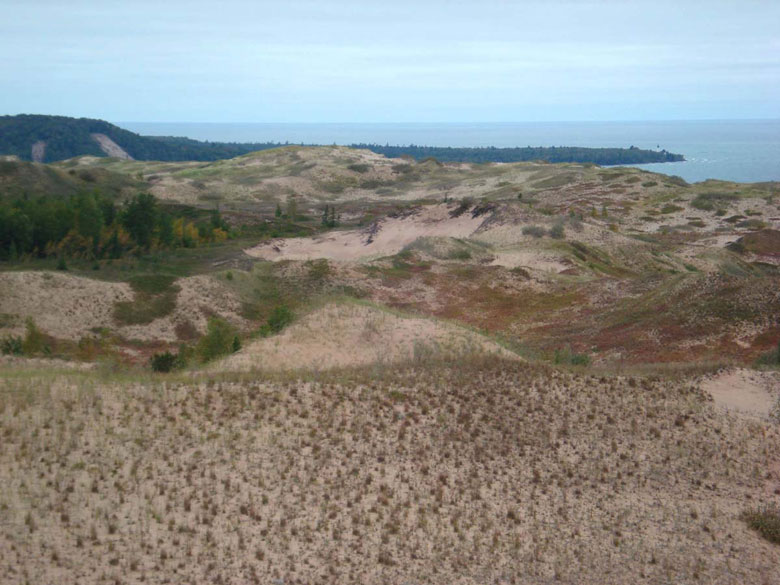
History’s Gem of the Month: The Shark: Post 3

March 2013

This is the second History’s Gem of the Month posting featuring a thesis written in 1995 by Jim Williams for a class at Western Michigan University. The curator of the Michigan Maritime Museum gave me a copy of the thesis when the museum also gifted me with the Shark. The thesis is several pages long, so I’ll include it over three postings.

Shark: A Lake Superior Fish Tug

By Jim Williams

Ingredients for a New Boat (continued)
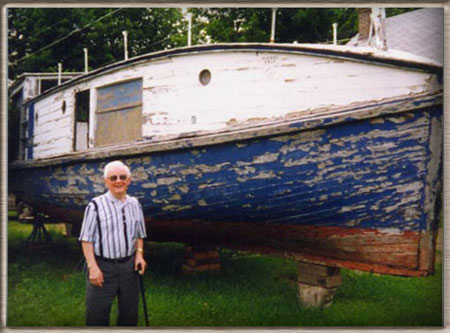
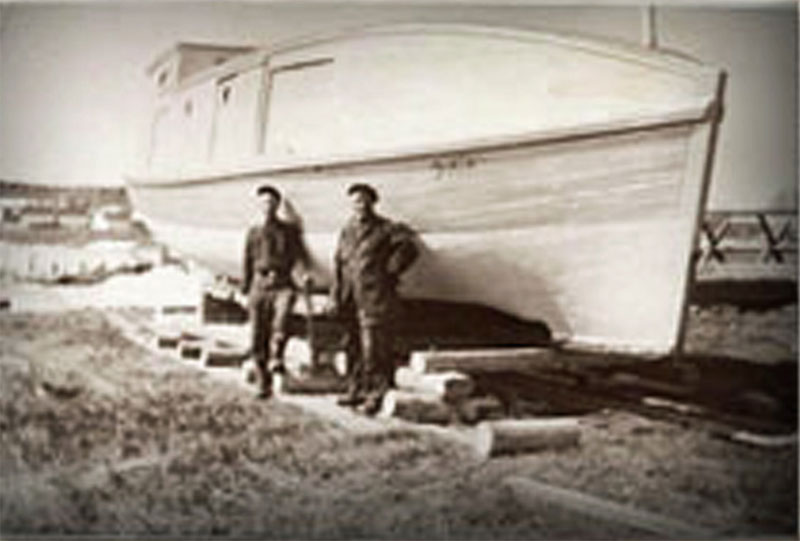
Niemies built Shark’s deckhouse out of ship lapped white pine boards. Alfred says that they probably built the deckhouse a foot higher than it should have been. He reasons that they laid the inside deck a foot too high in the hull, causing them to have to raise the deckhouse roof for head clearance. The change in deckhouse height gives an exaggerated angle to the house roof as it slopes down to the stem post; Shark shows a bit greater angle here than most fish tugs, giving her an unique profile. Alfred and Arvi sheathed the deckhouse roof with white pine boards, then covered it with canvas bedded in marine glue.

The Nimies used creosote on the hull as a preservative. They painted the black goo on every inch of the bilges. Then they painted it on the outside of the hull, from keel to a foot or so above the waterline. Both Alfred and Axel remember the unpleasantness of working with hot creosote. Fumes from the creosote caused the skin on Alfred’s face to peel off: twice. The brothers remember how, by the end of the day, they went home choking and gagging, with the skin sloughing off their hands. Otto repeated the creosote treatment twice a year as long as he fished the boat.

The Niemies overhauled the Fordson engine from the Elk and installed it in the Shark. They mounted an auxiliary shaft and Model T engine for emergency power. The Pentwater net lifter from the Elk also found a new home in Shark’s bow. Otto used his metalworking skills to build a galvanized metal box to protect the Fordson’s flywheel and magnetos from water damage.

The Fordson engine turned a Michigan wheel company propeller with reversible “buckets.” The helmsman controlled the boat’s speed by the infinitely variable pitch of the propeller. Axel remembers that it took only minute adjustments of prop pitch to change speed. The combination of the Fordson and the Michigan propeller drove the boat to a top speed of about eight miles an hour. At this speed, Otto’s favorite fishing grounds lay just an hour’s run to the northwest of Grand Marais.

Otto and his sons launched Shark in the spring of 1941. Axel chuckled when asked about how the boat got named. “Well,” he said, “dad kind of liked naming his boats after wildlife, and I guess he liked “Shark” because it was easy for him to spell.”

Fishing the Big Lake

All the Niemi boys worked on the boat from time to time, but Axel stayed full-time with his father. Together they fished the Shark until 1953. They put the boat in the water in May, most years, and hauled her out in September. Shark performed reliably, year in and year out. Alfred says that the Shark didn’t have the unpleasant characteristics of her predecessor; he remembers her as “really a good sea boat.”

Otto and Axel fished primarily for trout, “priding themselves on producing number one Lake Trout of the finest quality.” Axel also takes pride in saying that “dad didn’t hog the lake.” By that he means that, unlike many other fishermen who drove themselves to take increasingly large catches, the Nimies took only enough fish to make a comfortable living. They understood the fish as a finite resource and fished accordingly.

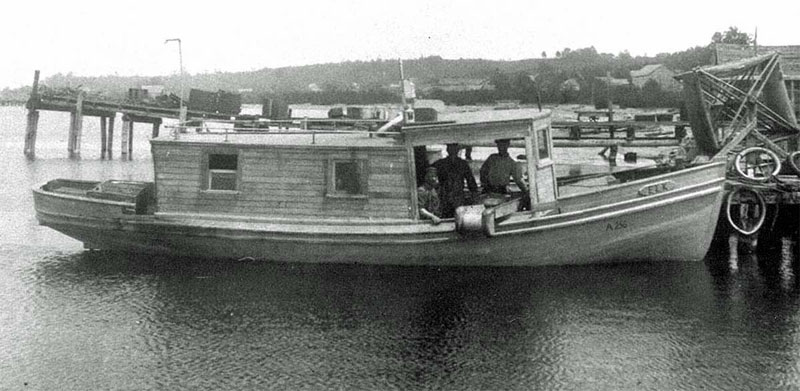
The Nimies began fishing in the spring using set hoods on long lines. They switched to using gill nets by summer. They usually set four to five boxes of nets per day. Each box contained two nets measuring six feet wide and six hundred feet long, making a 1,200 foot set. Fishermen set nets by streaming them out through the large hatch at the boat’s stern while the boat moved slowly forward. When they hauled them in, they took a wrap of net around the drum of the lifter, and while one person “tailed” the net at the lifter drum, the other took the fish off the net. Most two-men boats had an engine and steering control station up forward for use when pulling nets. They left the nets in the lake for three to four days at a time. Each net got hauled and taken onshore to dry every three to four days.
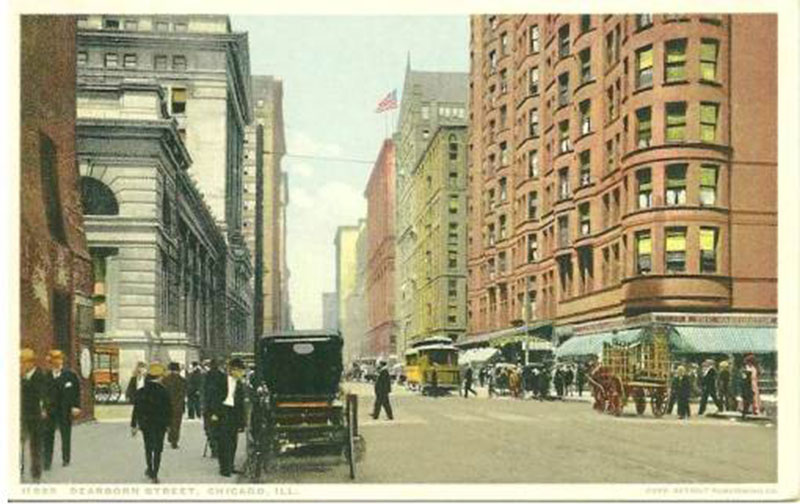
Lake Superior’s trout fishery declined by the early 1950s. The fishing business became so unprofitable that Otto Niemi hauled the Shark up on marine railway for the last time in the fall of 1953. Many people blame predation by the sea lamprey for depletion of trout stocks in the lakes. Axel Niemi acknowledges the lamprey’s effects, but places as much, or more, blame on overfishing.

 The decline of the Fishery

Native Americans harvested fish from Lake Superior’s waters for thousands of years. Fishing primarily the inshore waters supplied them with abundant food. The Indians took only what they needed for survival. When the French began to explore Michigan, the total Indian population of the state numbered 15,000 or less. Most of the Indians probably lived in the Lower Peninsula, since the Chippewa did not begin to move into the Upper Peninsula until the seventeenth century. Certainly, the Indian population put no pressure on Lake Superior fish stocks.

White explorers saw vast wealth in the north country’s resources. As early as 134, efforts began to establish a fishing industry on Lake Superior. The American Fur Company set up fishing stations on the lake in 1835, 1836, and 1837. The fishing industry caught hold, creating a need for more and bigger boats. Opening of the first lock system at Sault Ste. Marie made it possible to ship ever larger catches to down lake markets. Lake Superior fishermen soon shipped many tons of fish annual out of the north country. Pressure on native fish stocks increased exponentially as fishing became a primary industry on the big lake.

Seasonal catches for two sections of the lake serve as examples of the extent of the fishery. Fishermen on the section of Lake Superior between Ontonagon and L’Anse brought in “nearly 405,000 pounds of fresh fish and about 4,200 barrels of salt fish” in 1879. Thirty-three men fishing out of Marquette brought in a total catch of 450,000 pounds that same year. Trout, whitefish, siskowet, herring, and a few incidental species made up the catch.

Dramatic changes occurred in the Lake Superior fishery by the 1920s. For one thing, from a commercial point of view the whitefish had become virtually extinct along the American shore of Lake Superior. The trout catch plummeted from a peak of almost 5 million pounds in 1903, to 2.8 million in 1922. The trout catch for 1940 amounted to about 2.6 million pounds, a slight increase from immediately preceding years.

Lake Superior fish stocks continued to decline through the 1940s. A simplistic explanation blames the sea lamprey. A close look reveals that the sea lamprey did not enter Lake Superior until sometime in the 1940s. Scientists collected the first confirmed adult lamprey in Lake Superior in 1946, an immature adult. Scientists correlate scarring on lake trout with lamprey abundance. Commercial fisherman reported that less than one percent of the lake trout were scarred in 946 and five percent in 1951. The trend of increased scarring continued, peaking in 1959 and 1960 when more than 90 percent of trout taken bore lamprey scars. Lamprey took a terrible toll on the fishery, but so did other factors.

A U.S. Fish and wildlife Service study outlines a broader explanation for the fisheries’ decline; “undesirable changes have been attributed to the overharvest of desirable species, the invasion and introduction of undesirable exotic species, lowered water quality, and the destruction of portions of the physical habitat, including spawning grounds, vital to the maintenance of the recourse base.” Overfishing stands out as a major destroyer of fish stocks, from Axel Niemi’s point of view.

Not more than a dozen boats fished commercially out of Grand Marais at any one time until the 1940s, according to Axel Niemi. Popularity of trolling for trout brought an explosion of fishing boats to the lake by the end of World War II. According to Axel, “nine out of ten fish caught with trolling spoons are female.” He remembers seeing the trollers cleaning fish on the Grand Marais docks, throwing away barrels of fish innards containing millions of trout eggs. By 1950, fifteen to twenty trolling boats fished regularly out of Grand Marais.

Nylon nets also contributed to overfishing, says Axel. The ten to fifteen foot width of a nylon net takes more fish than the traditional six foot wide cotton cord net. Nylon nets will not rot, so fishermen leave them in the water all the time, never relieving the pressure on the fish stocks.

Whatever the causes, by 1953, Otto and Axel Niemi pulled the Shark out of the water for the last time. Otto retired and Axel pursued his passion for making agate jewelry, opening a rock shop and museum in Grand Marais.

Retirement

The story of the Shark’s later years remains incomplete. She sat on her marine railway outside Niemis net shack for three years. In 1956, two men from Cheboygan, Michigan, who had the idea of fishing for sturgeon in Lake Huron, approached Otto about buying the Shark. He told the “you can have it for a song.” Shark went off to Cheboygan on a flatbed semi-tractor after Axel helped load her. According to Axel, the men tried for two years, but never caught one sturgeon.

Shark reportedly saw some use as a pleasure boat after her time in Cheboygan. She then spent several years fishing out of St. Joseph, Michigan. Along the way, one of her owners took out the Fordson engine, re-powering her with a Perkins diesel with 60-70 horsepower, coupled to a Chris Craft transmission. Robert Trowbridge, of South Haven, acquired the boat, by now called Tug Her, in order to get the engine. He, of course, ultimately gave her to the Michigan Maritime Museum.

CITES:

Museum post cards

History’s Gem of the Month: The Shark: Post 2

 September 2012

This is the second History’s Gem of the Month posting featuring a thesis written in 1995 by Jim Williams for a class at Western Michigan University. The curator of the Michigan Maritime Museum gave me a copy of the thesis when the museum also gifted me with the Shark. The thesis is several pages long, so I’ll include it over three postings.

Shark: A Lake Superior Fish Tug

By Jim Williams

Ingredients for a New Boat

The Builder

Otto Niemi learned early how to work with his hands. As a boy, he did odd jobs around boat yards, learning from journeymen boat builders. He studied boat yards in the harbors where he sailed as a teenage crewman on the run from Finland to England. When it came time to build his fourth boat, Otto combined his memories of European boat yards with his experience building the Elk. He also drew upon his years of fishing experience to design a boat suited to conditions on Lake Superior.

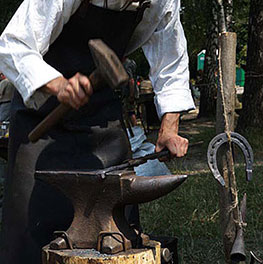
Otto’s skill with his hands extended to metal-working. He learned blacksmithing as a young man, at one time having the offer made of an apprenticeship in the trade. The skill served him well when it came time to fashion the iron and steel fittings for Elk and Shark.

Otto Niemi no doubt counted the talents of his sons among his boat-building resources. The Niemis stand out as a family of energetic, resourceful, sharp-witted people. Building the Shark clearly involved all the male family members, to one degree or another.

Building the Shark took nearly two years. The Niemi boys worked alongside their father whenever they could, during that time. Axel had the most ongoing involvement, since he stayed home while his brothers went off to college. The other sons, Alfred, Arvi, and Arvo, pitched in whenever they had a break from their studies. Shark reflects the spirit of co-cooperation that the immigrant Finns brought to many ventures in their adopted homeland.

The Boat Type

Boats used for work, travel, and transport on the Great Lakes took many shapes. A boat design evolves to meet two requirements: its intended use, and the conditions the boat will face. From the Indian canoe to today’s thousand-foot bulk carriers, each design fits the boat’s niche in the maritime economy of the lakes. The fish tug typifies that type of evolution.

The fish tug of Shark’s type reflects a development process that began with early bateaux, tracks its lineage through the Mackinaw boat, and reaches a mid-point with the sailing workboats of the nineteenth century. This paper cannot hope to trace the workboat heritage of the Great Lakes, or even that of Lake Superior; it represents far too massive an undertaking. The venerable Mackinaw boat, with the uncertainty about its derivation and regional variants, serves as a case in point.

Howard Chapella, in his American Small Sailing Craft, catalogs several variations of the Mackinaw boat type. He says that “the Mackinaw boat was also known as the “Collingwood skiff.” He goes on to say that the Collingwood skiff originated with a small skiff built on Lake Ontario, about 1854. Grace Lee Nute, in her book Lake Superior, says that “by 1825 the Mackinac boat had largely supplanted the canoe on the south shore of Lake Superior.” This apparent contradiction represents two different time lines for the same boat type.

Disagreement even exists over exactly what constitutes a Mackinaw boat. Nute says a Mackinaw “was a barge of red or white oak board with a flat bottom and rather blunt ends over a stiff heavy frame.” Chapelle, on the other hand, applies several different descriptions to boats of the Mackinaw type, suggesting that no such distinct type existed. Clearly, the evolution of Great Lakes boat types needs much more research in order to clarify even the most basic questions.

Like the Mackinaw boat, no thorough tracing of the evolution of the Great Lakes fish tug exists. Robert Grunst’s unpublished work stands out as probably the most research on the type done by anyone. Talking with Grunst leads one to some basic generalizations about the boats.

The ancestry of fish tugs like the Shark goes back to sailing workboats that plied the Great Lakes in the mid-nineteenth century. With the advent of steam power, many owners retrofitted their boats with engines. The made-over workboats found employment in the lakes developing barge-towing trade. Later, when barge towing began to slacken, fishermen bought idled tugs, adapting them to work in the fishery. A recent find of an 1870 newspaper article points to Erie, Pennsylvania, as the building place of the first steam tug built expressly for fishing on the Great Lakes.

The first fish tugs had open decks, with only the wheelhouse and engine covered over. The next stage of evolution saw fishermen roofing over the sterns of their boats, but leaving the bows open for lifting nets. When fishermen began to install mechanical net lifters in their boats’ bows they found it no longer necessary to have open foredecks; they could close in that part of the boat, getting the crew out of the weather. The called this a “turtled-over box.”

Two power-plant advances affected fish tug design in the mid-1930s: the Collemberg semi-diesel, and powerful, efficient gasoline engines. Better engines brought bigger boats. Most fish tugs of the time fell into the size range of thirty-eight to sixty feet long, with a beam ranging from thirteen and a half to fourteen feet.

Location of a fish tug’s wheelhouse reflects how the fisherman uses his boat. Placement of the wheelhouse at the boat’s stern enables two people to work the boat; the helmsman tends the net setting from the stern hatch while the other person works in the bow lifting nets or carrying boxes back and forth. A boat with her pilot house sitting amidship, as a rule requires a crew of more than two people, usually three or four; the helmsman cannot easily reach either bow or stern from his middle-of-the-boat position to help with fish and nets. “Mid-house” boats run to the upper size range, averaging from forty-eight to fifty-five feet long.

Otto Niemi’s design for the Shark reveals how he intended to use her. He planned his boat for thirty-three feet long, with her wheelhouse in the stern. He clearly expected to fish with only a small crew, perhaps even single-handed on occasion. Shark’s relatively small size shows that Otto did not intend to bring home overly large catches; her carrying capacity for both gear and fish show her owner’s modest expectations. For power, he planned to use the same 1919 Fordson tractor engine that drove the Elk.

Building the Shark

When Otto Niemi wanted a new fishing boat, he hoped to have it built by the Wiinika Brothers, a boatyard on the Lower Portage Ship Channel, near Chassel, Michigan. Wiinika’s had a reputation for building good boats; over the years their yard built more than thirty tugs for the Great Lakes fishery. Niemi found the Wiinika’s price more than he could afford, so he and his sons decided to build the new boat themselves.

Otto had in mind two changes from the design he used on the Elk. Elk’s fantail stern proved itself a weak point, showing the most deterioration as the boat aged. Otto meant to remedy Elk’s stern weakness by giving his new fish a transom stern. Alfred says that his father also wanted to build the new boat narrower.

“The Elk was too beamy,” says Alfred, in any kind of a sea, you had to keep from getting caught on the quarter, or she’d roll very badly.”

Otto designed Shark to have an overall length of thirty-four feet and a beam of ten-and-a-half feet. Alfred remembers that his father sat down with a 1-feet by 2-foot pine board and sketched out the new tug on it. Otto drew an elevation of the boat, then a top view; he worked over his sketches until he got just the hull shape he wanted. He then marked on those views just where he would place his station molds when he set up to build the hull.

Axel responded to a question about how his father arrived at Shark’s design with a chuckle.

“I probably shouldn’t tell you this,” he said, “I never told anybody else. When we were at Wiinika’s yard we walked around and looked at the boats they were building. We said, “We can build the boat ourselves.” So we took a good look at Wiinika’s boats and how they were putting them together, and we went home and got started.”

Niemi ordered White Oak for the hull from a mill near Corunna, Michigan. The oak arrived in Grand Marais fresh from the mill, “real green,” according to Axel. The Niemis didn’t realize until later what problems the unseasoned lumber caused.

The family laid down Shark’s keel timber first, a stick of oak measuring “about six inches by at least eight inches by thirty feet long.” They set up the oak stem and the station molds on the keel, then built a jig to bend the ribs around. Always inventive, the Niemis turned a cast-off hog scalder into a steamer for softening the rib stock.”

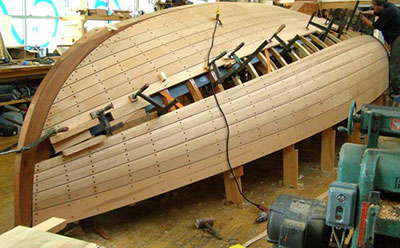
Otto wanted a boat capable of taking the punishment that Lake Superior dishes out, so he planned shark as a heavy-built vessel. Most boats of Shark’s size get framed with matching pairs of ribs spaced along the keel. That way the heal of each rib fits into a mortise in the keel. Niemis bent Shark’s ninety-six ribs in single pieces, so that they pass from side to side over the top of the keel. They then put a 2 ½ inch x 3 inch oak keelson on top, sandwiching the ribs between it and the keel. Niemis finished the keel framing by putting sixteen-inch bolts through keel and keelson, clamping the ribs in place.

The Niemis built the Shark in an unheated shed along the waterfront. As the first winter of boatbuilding pressed on, Otto came down with pneumonia from working in the cold. While he lay sick in bed for several days, the boys noticed a flaw in the boat’s design. Eyeballing the hull as it began taking shape, they decided that the Shark carried her beam too far aft, making her too wide in the stern. Taking it upon themselves to remedy the situation, the Niemi brothers took down the transom mold and cut six inches form each side. Replacing the transom, they continued planking the hull. Otto left the change alone when he came back to work, apparently agreeing with the boys’ design change.

Planking the hull presented its own set of problems. First of all, they bought the plank material rough cut, planning to hand plane it. By chance, a man with a portable electric planer came to town. When he saw that Otto and his sons had all that hand work to do, he offered to plane it for them. In the end, he charged them $15.00 to plane what Axel remembers as 1,500 to 2,000, board feet of green white oak down to 1 ¼ inch thickness. Axel laughs when he talks about how much work that man saved them.

Axel remembers that as they started planking, he realized that they could not just lay straight planks up to the boat’s stem. Instead, each plank needed a taper cut in it, so that as it bent around the curve of the bow it would lay fair to the stem, and to the planks above and below it. They had no power tools, so they tapered each plank using a hand saw and plane. They also planed the edge of each plank to accept caulking.

Planking became a time-consuming process, according to Alfred. The process started by steaming each plank until it softened enough to allow bending to the shape of the hull. When the plank became workable, the builders took it out of the steam box, clamped it to the ribs, and marked it for shaping. They then took it off the ribs and either sawed or planed to the marks. Then the plank went back into the steam box for re-softening. Once it got soft again it came back out of the steamer and re-hung. The clamp, mark, cut, and re-steam process continued until the plank fit properly.

They clamped the fitted plank to the ribs and drilled through both pieces. They then drove galvanized nails through the tight-fitting holes, leaving two inches of nail inside the hull for clenching over. The Niemis worked at each plank in that manner, the archetypal “cut-and-try” method. Both Alfred and Axel have vivid memories of the lengthy planking process.

As the oak dried during the planking process, the seams began to open up wider than expected. The Niemis realized the problem when caulking began. Instead of narrow seams requiring a single strand of cotton caulking, many seams opened wide enough to require two or three strands. Axel remembers that this problem dogged the boat as the planks swelled and shrank. The Niemis occasionally had to lay in extra strands of caulking in order to keep the boat dry. As a side note, Axel carefully points out that they did not use oakum to fill the Shark’s plank seams, but used only spun cotton caulking. When they finished caulking and painting the hull they gave Shark an “ice iron, ´a piece of galvanized iron mounted on the stem at the waterline to protect it from ice damage.

History’s Gem of the Month: The Shark: Post 1

June 2012

I was looking through the museum archive to look for something to post in this update’s History’s Gem of the Month when I came across a copy of a master’s thesis written in 1995 by Jim Williams for a class at Western Michigan University. The curator of the Michigan Maritime Museum gave me a copy of the thesis when the museum also gifted me with the Shark. The thesis is several pages long, so I’ll include the first part in this web page update, and continue it with the next.

Shark: A Lake Superior Fish Tug

By Jim Williams

Introduction


The Lake Superior fish tug, Shark, stands out as an artifact from a nearly extinct culture. Not many years ago, one saw fishing boats in nearly all communities that lay along the Great Lakes’ shores. Depletion of the fish stocks, economic pressures, and other factors combined to all but erase commercial fishing as a way of life on the lakes. Large companies dominate the little commercial fishing that remains on the lakes. That has not always been the case.

Otto Niemi planned and built the Shark so that he might earn a living fishing Lake Superior. He and his four sons labored winter and summer for nearly two years to create just the right boat for their needs. The Niemi family knew every nail, every splinter of wood in her. They, men and boat, became intimately connected. The boat’s story intertwines with the human story, giving the boat immeasurable value to the study of human history.

Shark’s Vital Statistics
Length Overall 33 feet
Beam 10.6 feet
Depth 3.8 feet
Number of Ribs 96
Hull Material White Oak
Horsepower 44
Main Engine 1919 Fordson 4 Cylinder
Back-Up Engine Model T
Net Lifter Pentwater
Capacity 11 gross tons – 7 net tons
Crew 2

Setting The Stage

The forces of nature began to shape the Great Lakes at the beginning of the Pleistocene Era, about a million years ago. General cooling of the planet resulting in increased snowfall and short, cool summers gave rise to great masses of ice that covered much of North America. Two-mile-thick glaciers pushed slowly southward from Hudson’s Bay, reshaping landforms as they went. Over time, the glaciers began to alternately advance and retreat. Geologists call the last great glacial period the Wisconsin Stage.

The Wisconsin glaciers reached as far south as Illinois, Indiana, and Ohio. One theory holds that as the glaciers inched their way over Michigan, they followed paths of least resistance presented by ancient river courses. The glaciers scoured out the relatively soft river bottom soils, widening and deepening the channels into basins. Warming of earth’s climate halted the glaciers’ southward movement short of the Ohio River, starting a grand retreat that gave rise to the most complex succession of fresh water lakes known to geologists.

Many pauses and occasional small advances marked the glacial retreats that took place over thousands of years. The receding glaciers left behind landforms composed of glacially tilled soil that sometimes acted as barriers to the runoff of melt water. With nowhere to run, melt water ponded in the glacier-created basins, resulting in the formation of the first lakes in the Great Lakes region, some 18,000 years ago.

An immense lake system lay in the retreating glacier’s wake. As the glacier began to retreat past the Lake Superior basin, about 8,500 years ago, its melt water formed what geologists call Lake Duluth. It took about 2,500 more years for the glacier to move northward past the Great Lakes region. The earth’s crust, relieved of the unimaginable weight of a continent-sized sheet of ice, began a process geologists call “crustal rebound.” Simply put, the earth’s crust started to bounce back to its pre-glacier elevations. Crustal rebound continues today in the Lake Superior region, where the landforms increase in elevation at the rate of about six inches per century.

In the post-glacial period, the Nipissing Great Lake formed in response to changing land elevations that shifted drainage patterns. Geologists note this era as the largest of all the Great Lakes stages. Lake Nipissing itself, occupying the Lake Superior basin and beyond, began to diminish about 3,000 years ago. The lake discharged its water through just one outlet: the St. Mary’s River. When the water surface dropped to the level of the sandstone sill in the St. Mary’s River, Lake Superior was born.

Lake Superior Country

No fresh water lake on earth exceeds Lake Superior in size. It measures 350 miles east to west and 160 miles north to south. The lake has a total surface area of 31,820 square miles. Superior’s cold blue waters reach a maximum depth of 1,290 feet. In all, Lake Superior drains an area of nearly 81,000 square miles.

The rugged Lake Superior shoreline shows its ancient Lake Nipissing origins. Bedrock that bore the grinding passage of glaciers stands exposed. Massive boulders left behind by the glacier’s retreat dot the landscape. Swamps and bogs fill vast low areas scoured out by glaciers. Remarkable geologic formations line the lake’s perimeter. The coast of Lake Superior contains the strongest and most spectacular shore features in the entire region, according to some geologists. The lake’s shoreline acts as a stage setting for the lake itself.

Looking out over Lake Superior makes one think of an ocean, except no salt tang hangs in the air. That a body of fresh water of such vastness exists seems incomprehensible. Superior’s mercurial temperament, however, may be its most prominent characteristic. The lake has a legendary ability to change moods almost instantly; from serene to unbelievably violent, without warning. Even people who don’t know the lake treat it with respect, if not awe.

Men and the Lake

France began sending expeditions to the New World in the late sixteenth century. French missionaries pushed into the Great Lakes region by the early seventeenth century, looking for a route to the Far East, while converting Indians to Christianity. Driven by a sense of adventure, the Frenchmen also wanted to exploit the riches of the new land for their mother country.

French eagerness to explore the New World placed young Etienne Brule in the position of becoming the first white man to set eyes on Lake Superior. Historians believe that Brule explored as far as Sault Ste. Marie in 1618 or 1619. In 1621 or 1622, Brule and a companion paddled a canoe up the St. Mary’s River and into Lake Superior, giving them the distinction of being the first European boaters on the big lake.

Brule’s discovery of Lac Superieur, as the French named it, helped open the way for French explorations to the west. Explorers and missionaries followed the Indians’ lead in using the lakes as primary transportation routes. The French learned to make birch-bark canoes from the Indians, adopting it as their vessel of choice for wilderness travel. Throughout the seventeenth century the French used canoes to crisscross the lakes, exploring, trading, trapping, and doing their missionary work. The canoe stands as forerunner to a vast array of watercraft to see service on the Great Lakes since settlement began. Likewise, those early French explores foreshadowed a multitude of immigrants of diverse racial, ethnic, and cultural background who came to the upper Great Lakes seeking their fortunes.

Emigration

When Finlander, Otto Niemi, decided to emigrate to the United States, he followed an established trail. Finish settlers helped establish a settlement called New Sweden at the mouth of the Delaware River. Between the settlement’s beginning in 1638 and the time the Dutch conquered it in 1655, about five hundred Finns landed there. New Sweden did not result in significant Finnish immigration to the New World, however. Instead, most Finns who settled in this country in the ensuing centuries came from the ranks of seaman who found the land to their liking. Finnish immigration to this country began in earnest during the middle 1860s.

Immigration statistics reveal the extent of Finnish immigration. U.S. immigration records show 1,942 Finnish arrivals in this country between 1871 and 1883. Between 1883 and 1920, the peak years of Finnish immigration, the total number exceeded a quarter million. The 1900 federal census contend 62,641 Finns living in this country, 47h percent of them in just two states: Minnesota and Michigan. The number of Finns in Michigan totaled 18,910 inn 1900. Ten years later, the census showed a total of 55,548 Finns living in Michigan, more than 31,000 who claimed Finland as their birth place. By 1920, some 149,824 U.S. residents made that claim.

Finnish immigrants landed in all parts of the United States. They followed the pattern of most ethnic groups, gravitating to settlements composed of their country men and women. As a people of the upper latitudes, the vast majority of Finns have continued to reside in the northern states, where thee stony soil, the long winters and abundant snowfall, the myriads of lakes dotting the landscape, and the blanket of evergreens so strongly resemble the homeland. Some Finnish immigrants tried to start settlements in the south after the turn of the century, but those efforts failed, soon falling before the unceasing onslaughts of mosquitoes and grasshoppers and the oppressive heat.

A tangled skein of factors lay behind the Finns’ desire to leave their homeland for a new life in the United States. They moved because of economic concerns, burgeoning population, food shortages, and political uncertainties. Without question, emigration from Finland was essentially the departure of the landless from rural areas.

The Czarist Russian regime that governed Finland during the late nineteenth and early twentieth centuries created a grim atmosphere which heightened the appeal of emigration. Compulsory service in the Russian Army, along with curtailment of freedoms propelled many Finns from their homeland in the years surrounding the turn of the century.

Some people left Finland simply to make their fortune or to seek adventure. Some left because relatives already in America wrote glowingly of life in their adopted home. Otto Niemi falls into the latter category.

Coming to the Country

According to Alfred Niemi, his father had distant cousins living in America who wrote home about the opportunities available here. The tales of life in America caused Otto to contract with an immigration agent known as Wooden Leg Mattson for passage to America. Mattson arranged for Otto’s passage to a place called Grand Marais, Michigan, in exchange for a fifty dollar fee that Niemi promised to pay back in installments. Alfred remembers that with Otto’s meager earnings, it took ten years to pay back Mattson’s fee.

Otto landed in Grand Marais, on Lake Superior’s south shore, in 1905. He took a job in a saw mill there. The saw mill’s owners shut it down five years later, when the White Pine stands played out, leaving Niemi without a regular job. Otto then spent several years earning a living by trapping and small scale farming. By this time he had a small family starting, so he decided to try fishing as possibly more lucrative.

Otto started his life as a fisherman using nets that he stretched out from the lake shore near Grand Marais. This method did not work well, according to Alfred Niemi. Otto’s short stature, just 5 foot 1 inch, combined with the often turbulent and always ice-cold lake water worked against his success. This method also limited Niemi to fishing shallow water, another factor working against him; trout and whitefish only frequent the shallows during certain seasons, and for limited times. Otto improved his prospects as a fisherman by acquiring his first boat: a short, heavy skiff powered by oars.

No good information survives about Otto’s first fishing boat, other than what Otto’s sons recall. Confusion exists over whether Niemi bought the skiff or built it. Previous accounts relate that he built it, but both Robert Grunst, who did extensive research on Otto Niemi, and Niemi’s sons say now that he possibly purchased the boat, after all.

In any event, Otto began earning a living by fishing from the skiff. The boat had several obvious drawbacks. It had a limited capacity for either fishing gear or fish. It had a limited ability to withstand heavy weather on the lake. It limited Otto’s fishing grounds to those he could reach by rowing. The skiff served an important purpose for Otto Niemi, in spite of its limitations: it proved to Otto that the fishing business would support his growing family.

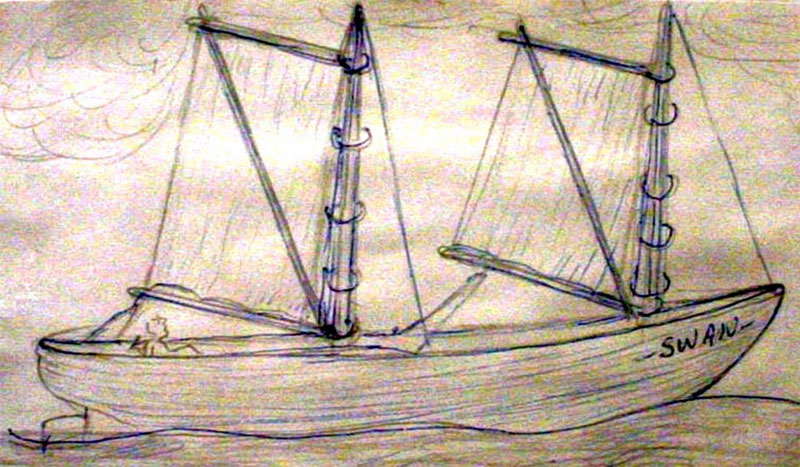
Otto felt ready for a bigger, more efficient boat by 1917. That year he bought the twenty-three foot sailboat Swan. The new boat increased Niemi’s range out of Grand Marais. He and a partner, Charlie Mattson, took the Swan as far as fifteen miles west of Grand Marais to fish the Grand Sable Banks. The patch of thirty-fathom water off Au Sable Point became, over the years, Otto Niemi’s favorite fishing grounds.

As Otto and his partner lifted their nets off Au Sable Point a hard south wind sprang up. In no time the lake turned violent and the fisherman pointed the Swan southeast for home. Driving the Swan close-hauled into the teeth of the gale, Otto rounded the breakwater and made the harbor in three tacks. Captain Truedell, who commanded the Coast Guard Station and had a nearly-legendary reputation for seamanship, met Otto on the pier to pay him a compliment. It seems that Truedell watched the whole episode play out with his lifeboat at the ready, expecting to have to rescue the Swan’s crew, or at best, tow them into harbor. Alfred recalls this episode with unabashed pride in his father.

Niemi eventually added a single cylinder Sears and Roebuck engine to the Swan. The engine increased the boat’s speed and made her less vulnerable to vagaries of wind. By 1922, Otto felt the need for a bigger boat, so he set out to build one himself.

The current opinion holds that Niemi’s third fishing boat represents his first attempt at boat building. With the Swan, Niemi had an open boat, forcing him to work while completely exposed to the elements. Otto intended to rectify this with his new boat, which he called the Elk. Niemi planned the Elk as a thirty-three foot tug which, but for eight feet at the bow and six feet at the stern, would be housed over.

Otto built the Elk with no plans other than in his mind. His plan called for the boat to have a fantail stern, a design that he thought would take a following sea better. He also planned her to have a flared bow that would deflect sea and spray.

Otto searched the woods and beaches for timbers with natural crooks that he could use to shape the Elk’s curved timbers. Alfred remembers that much of the material for the Elk came from drift logs hauled from the beach. Otto and his helper sawed the logs into 2 ½ inch square boards that became the Elk’s frames and planking.

Otto equipped the Elk with a 1919 Fordson Tractor engine and a Pentwater net lifter. These modern improvements promised to make his work easier and more efficient. Otto launched the Elk in the spring of 1923. He fished the boat for seventeen years, putting her in the water every spring and hauling her out every fall. Wooden boat era fishermen say that fifteen to eighteen good years was all you could hope to get out of the best wooden hull. In 1939, with the Elk beginning to show the effects of years of wear and tear, Otto began building a new boat. He called his new boat the Shark.

History’s Gem of the Month: John Keating

March 2012

I wish I had a picture of John Keating. I do not. He was quite a colorful character that owned the Keating Knitting Factory in Grand Marais, MI at the turn of last century. He was born in Ireland on November 10, 1869. When he was 23 years old, he immigrated to the United States in 1892 and initially settled in Sault Sainte Marie, MI. On December 14, 1895 he married Matilda (Tillie) Porter, who was born in 1871 in Canada. According to census records the couple lived in McMillian in 1900 with two children. By 1910 the family moved to Grand Marais with three children. After the shutdown of the mills in Grand Marais and the closing of the railroad, most left Grand Marais prior to 1914. But according to the 1920 census records, the family with three children was still living in Burt Township.

As far as I have been told, there are only a couple of Keating sweaters known to still exist today. Apparently the Keating family has one and the Gitche Gumee Museum has the other. I found the following article in the museum’s archives. Axel retyped it from “The Evening News,” published in Sault Ste. Marie, MI. (Date unknown)

Rugged Grand Marais Giant Knits Sweaters For a Living By John T. Nevill

Among “inconsistent vocations” we’d like to cite that of the late John Keating, of Grand Marais, Mich., a rough-and-tumble gentleman, who lived in an era when fists sometimes were more potent than law in maintaining one’s status in the workaday world.

Keating, who towered well over six feet tall, was a hardened iron-muscled giant who taught boxing to hardy young buckos around the Grand Marais sawmills, and once in a while, when provoked into it, gave a brief but painful lesson in the science of self-defense to a would-be “tough guy” of the lumber camps. But boxing was not Keating’s vocation; it was strictly a hobby. Believe it or not, Jack Keating made his living by knitting sweaters.

In those days Grand Marais was a noisy, bustling lumber town. At least a half dozen lumber mills were in full operation. Boats sailed out of the harbor daily with fresh cut lumber stacked high on their decks, and Alger-Smith trains were continually chugging into town from the south carrying more logs to feed the yawning mills. Other logs, by the thousands, were driven down the Sucker River, and brought into town from the East end of the bay. There were 16 saloons within the tiny confines of the town.

Those were the days a Keating-made sweater was something worth fighting for. They were double-knit beauties, obtainable in almost any color a man might fancy, and they are said to have been nearly one-half inch thick. They were particularly prized by the hard-working jacks in the surrounding lumber camps; men who battled bitter cold from the darkness before down to the darkness after sundown.

But few, if any, men ever had to fight for a Keating sweater. John Keating saw to that by turning them out in quantity, loading 50 or more on his dog-sled, and visiting the lumber camps at fairly regular intervals. Once in the camps, he disposed of them easily at $8, $9, or $10 each. Many’s the time Grand Marais old timers say that when Jack Keating drove his yapping dogs back into town after one of his swings around the territory, with his sled empty and his pockets bulging with money. Mr. Keating’s sled was similar to the one pictured below.

Keating sweaters were available in either buttoned or “pull-over” style, and with or without high colors, which, of course, could be turned up to protect the back of the man’s neck and hood from the frequent sub-zero temperatures. They apparently were as rugged as Keating himself because few of them ever wore out.

Why, man-alive, they tell you in Grand Marais some of the sweaters John Keating made were still seen occasionally on the streets of the town 40 or 50 years later. No lumberjack, therefore, ever was in the market for another Keating sweater, having bought one, unless he wanted one “for dress” in the spring when he came into town to blow his hard-earned money.

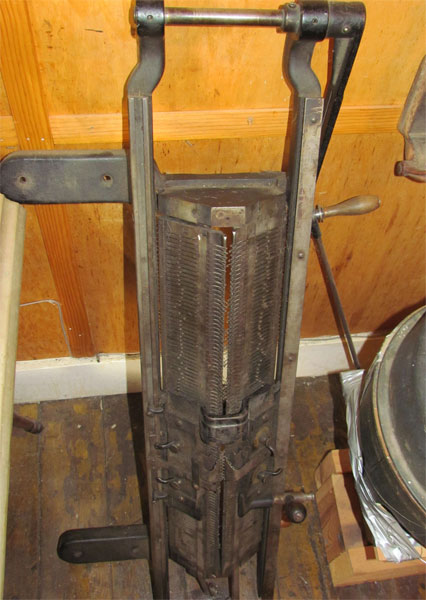
Jack Keating started his unusual business by knitting the first dozen or more sweaters by hand, but he soon obtained a machine which speeded up his production many times. No one presently in the area seems to know where Keating learned his trade. But learn it he did – and well.

They know, however, that Keating was no softie. No thermometer ever dipped too low, or no snow drift ever was too high for Keating to strap on his snowshoes and mush out of town with a load of sweaters for the boys deep in the tall timber. But he was never too busy making or delivering sweaters to perform a public or humanitarian service. Take for example, the tragic late fall storm which struck Lake Superior one bitter cold November. Two barges, loaded with lumber and human beings, broke loose from their tow and were swept by mountainous seas against the rocky shores. There, while angry and icy water battered the barges to pieces, many of their occupants perished by drowning. But that, comparatively, proved to be a merciful death. Others among them tried to make it ashore by swimming, then walking to safety over the ice – and froze to death attempting it. Jack Keating, manning his dog-sled, was among those who went out into the howling, sub-zero weather to journey up and down the Grand Marais area shoreline for miles looking for, finding, and picking up the frozen bodies. A total of 31 bodies, both men and women, were found and brought into Grand Marais.

Grand Marais, often a target for Lake Superior’s violence, will never forget that tragic storm, and that’s one reason Grand Marais can never forget Jack Keating. Keating, the father of two sons and one daughter, passed away decades later – although the exact date is not known. One of his sons was killed in World War II. His daughter, Marie, married Commander Stanly Herbst of the Navy. They had planned on retiring in Grand Marais, but Mr. Herbst died before they could make the move. So unfortunately there are no more Keatings left In Grand Marais today to contribute their hard work and tenacity.

History’s Gem of the Month: Old Postcards and Pictures

Winter 2011

When I was visiting my friends in Marquette, Jim and Helen Riley, Helen donated a couple of old Grand Marais pictures. These were given to her by her namesake aunt, Helen Olli, who is 91 years old. The first is a picture that she thought was the Wabash Hotel. I researched the photo and found out that it is in fact the Bay View Hospital, which was owned by Dr. James Anderson and Dr. D. H. Weir. It stood at the base of the hill entering Grand Marais, a few building south of what is now the Superior Hotel. It was built in the 1890s and served the medical needs of Grand Marais for a number of years. In the picture you can see the doctors’ buggy, used to make house calls.

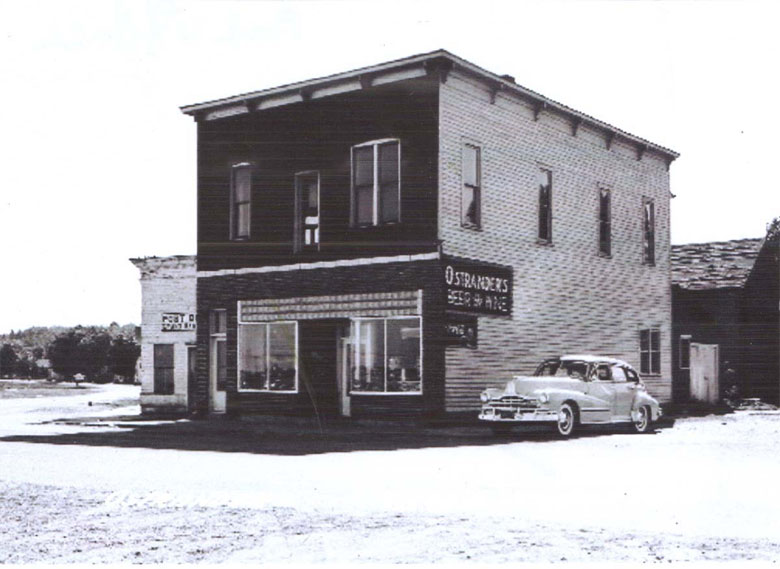
The second photo donated by Helen Olli is a picture of the Ostrander Drug Store. This building has stood in Grand Marais for over 100 years. After it was the Ostrander Store, it was the Beaver House, General Store, Grand Marais Gazette, and is now a private residence after it was renovated a few years ago.

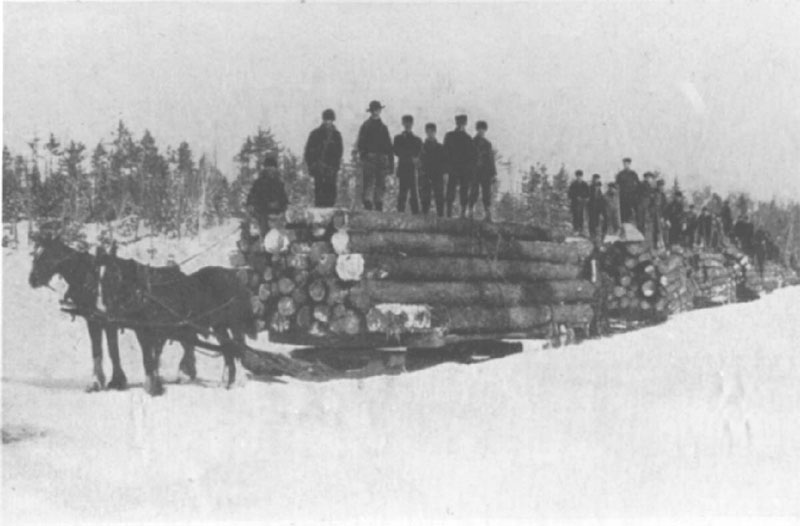
During my travels last year I purchased these old post cards that feature pictures from the logging days a century ago. Logging was certainly a tough way to make a living.

History’s Gem of the Month: Michigan Log Marks

 September 2011

The historical information included in this web page update has been taken from two sources. The subject involves the log marks used by lumber companies during the logging boom. The Michigan State College (now Michigan State University) published a pamphlet in January 1942 entitled Michigan Log Marks. (Memoir Bulletin No. 4, edited by Harold Titus, East Lansing). Additional information about lumbering was supplied by an article written by Maria Quninlan, originally published as a Great Lakes Informant (Series 3, Number 2). Additional information was also taken from the web page http://agilewriter.com/History/Mi_lumber.htm.

Michigan’s Logging History – A Summary

During the 19th century, Michigan’s forests yielded more money and created more millionaires than did all the gold mined during California’s Gold Rush. In turn, this wealth fueled the great financial and industrial rise of the state at the beginning of the 20th century. White pine, the most common tree, was preferred because it was easy to work and grew straight and tall. The largest specimens were 300 years old, 200 feet tall and up to 8 feet in diameter. Other abundant species were maple, elm, basswood and yellow pine.

Geographic factors played an important part in the development of Michigan’s lumber industry. White pine, the wood most in demand for construction in the nineteenth century, grew in abundance in northern Michigan forests. The state was also crisscrossed by a network of rivers which provided convenient transportation for logs to the sawmills and lake ports.

By 1840 it was apparent that the traditional sources of white pine in Maine and New York could not supply the growing demand for lumber. Michigan, the next state west in the northern pine belt, was the logical place to turn for more lumber.

The production of Michigan lumber increased dramatically during the middle decades of the nineteenth century. The Saginaw Valley was the leading lumbering area between 1840 and 1860, when the number of mills in operation throughout the state doubled, and the value of their products increased from $1 million to $6 million annually. Rapid growth continued, and by 1869 the Saginaw Valley alone was earning $7 million yearly.

As the potential of the lumber business became apparent, companies were organized to begin commercial logging in other areas of the state. Many rivers that could carry logs quickly were transformed into a valuable means of transportation. By 1869 Michigan was producing more lumber than any other state, a distinction it continued to hold for thirty years. In 1889, the year of greatest lumber production, Michigan produced approximately 5.5 billion board feet. (1 foot long, 1 foot wide and 1 inch thick).

The increased lumber production during the final decades of the nineteenth century was due in part to changes in machinery and techniques which brought greater efficiency to the industry. Throughout the first half of the nineteenth century lumbering had been a weather dependent and seasonally limited enterprise. Cutting was done during the winter when timber could be pulled on large sleds, if there were snow, from where the tree had been felled to banking grounds along a river.

The river drive was also dependent on a good winter snowfall for it was the spring run-off which enabled the rivers to carry the huge pine logs to the sawmills. Log drivers were usually men who had spent the winter in the woods cutting timber. It was their job to control the flow of the river by building and breaking dams and to break up log jams they could not prevent.

Sawmills were most often located at the mouths of the driving rivers. Associations were formed to cooperate in the sorting of logs into a pond or bay where floating “booms” of logs separated the property of one company from that of another. From the booms logs were floated to the mills to be sawed.

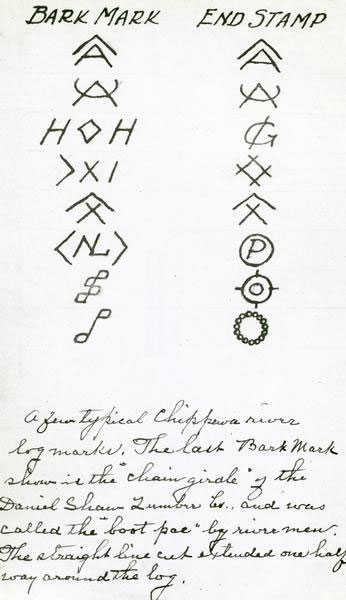
The logs were identified and sorted by the marks that were applied to the logs. Log marks were to Michigan what cattle brands are to the grazing states. The billions of board feet cut by thousands of operators would have been chaotic without log marks. These identifying symbols were recognized by law. Lumbermen identified ownership of logs by hacking or stamping symbols on them. Initially, the marks were cut into the bark by ax, so the designs were limited to straight lines, simple initials, triangles, squares, and combinations of these. At first, some business men tried to control the rights of using rivers to transport logs, but in 1853 a court decision was made declaring that all persons using rivers had equal rights. To the lumbermen, it meant that they could continue to float logs without interference from land owners. In 1855, the state legislature passed an act to provide for the formation of companies to run, drive, boom and raft logs.

As the logging business grew, those marking and sorting the logs ran into issues. Although there was an attempt to mark the light side of the logs so that the marks would float upward, or to mark two sides of the log – it was still difficult to efficiently see all of the marks. Besides being limited in design and varying somewhat according to individual wielders of axes who cut the marks, this process of cutting the log marks slowed down the operation. Thus, in 1859 a law was enacted to require owners of logs floated in the Muskegon river, or its tributaries, to mark the ends of their logs (rather than the sides) in a distinctive manner and to register the marks in the local county. The law was revised in 1864 that gave boom companies full power of contract to enforce log mark registration requirements. Provisions were also enacted to make it illegal to remove or change a log mark, which unscrupulous men were doing to steal logs from other companies. In fact it was because of log stealing that the main logging companies in Seney relocated to Grand Marais. They discovered that people were stealing their logs being floated down the Manistique River.

Most trees were felled by axes until the 1870s, when crosscut saws were improved so that they could be used to cut down standing timber. Two Michigan-initiated innovations of the 1870s were responsible for the largest increases in logging production. The Big Wheels invented by Silas Overpack of Manistee enabled cutting to continue in the snowless seasons by providing an alternative to sled transportation. As its name implies, this device consisted of a set of enormous wheels drawn by a team of horses. Logs were chained beneath the axle, and once the inertia of the load had been overcome, it was relatively easy to keep the wheels moving.

Like the logging wheels, the narrow gauge railroad helped to make lumbermen independent of the weather. Trains could be used in place of sleds year round for the relatively short run to the riverside banking grounds, or the river drive itself could be ended by carrying the logs to a mainline railroad depot. In addition, the logging railroad was sufficiently economical to allow cutting in areas that had been considered too far from the nearest driving stream to make sledding practical.

In their haste to move on to new cutting sites, loggers usually gave little thought to the lands they were leaving. By the 1870s stumps and branches already littered much of northern Michigan. There was no longer any barrier to erosion on cutover land, and the dried debris created an enormous fire hazard. At the end of the dry summer months fires frequently broke out, sometimes moving into still uncut timberlands or settled areas, as in 1871 and 1881, when fires broke out across the state. These dangerous conditions in the former logging districts inspired, in large part, the first attempts to conserve Michigan’s natural resources.

The primary effect of the lumber industry upon the State of Michigan was economic. The timber boom in the latter half of the nineteenth century brought millions of dollars into the state, both to lumbermen and those who supplied them. Thousands of men and some women found employment in some aspect of the business. The decline of lumbering also had its effects; both individuals and entire villages and cities, formerly thriving, lost their most important source of income. In Grand Marais, the logging era ended in 1910 when the lumber company took its railroad and tracks to Minnesota. The town’s population dropped from a couple of thousand permanent residents (plus a couple of thousand transient workers) to only a few hundred by 1914. Those who stayed in Grand Marais were a hardy bunch since the road was not put in until 1919. In the winter, it was difficult if not impossible for people or supplies to get into or leave Grand Marais.

The lumbering era also saw vast changes in the natural environment of northern Michigan. The conservation programs in effect today on state lands grew out of concern over the conditions the loggers had left behind them. Another legacy evident today is the body of songs and stories about lumbering, an important part of the folklore tradition of Michigan, and indeed, of the entire nation.

History’s Gem of the Month: Reprint from the Douglas Houghton Expedition

Fall 2010

The following text was found in the Gitche Gumee Museum’s archive. There is a note attached that says it was taken from The Superior Sun (1929), which in turn took it from Geographical Reports of Douglas Houghton, published by the Michigan Historical Commission in 1928, but written in 1874 by Bela Hubbard.

“Among the pleasantest of all my reminiscences of travel is that of the exploration, in connection with the geological survey of Michigan, of the coasts of our upper peninsula in 1840.

The party for this expedition was composed of the State geologist Dr. Douglas Houghton; his two assistants, C.C. Douglas and myself, Fred Hubbard, in charge of instrumental observations; for a part of the way, H. Thielson, a civil engineer; and Charles W Penny, a young merchant from Detroit.

We left Detroit on the steamer Illinois, arriving at Mackinac on May 23rd. Here two boat crews were made up, consisting of six Canadians. These men belonged to that class so famous in the early days of the fur trade, and the French regime, now extinct, and known to history as “coureurs de bois.” They were of mixed blood, in some the French while in others the Indian predominated. Bred to the business, they would row without fatigue from daybreak until dark – twelve or fourteen hours – unload the boats, pitch the tents for the bourgeois, pile up the baggage, prepare the evening meal, and then creep silently under their blankets in the open air and enjoy the sound sleep that labor bestows.”

…”The beaches [of the southeastern shore of Lake Superior] terminate at a deep harbor called the Grand Marais. Steep cliffs are first observed rising from the water with a very uniform face, of about 200 feet in height, beyond which are visible dunes, rising still higher in the distance. On our approach the whole appeared like lofty hills enveloped in fog. This proved to be nothing less than clouds of sand which the winds were constantly sweeping toward the lake, and which formed a mist so dense as to conceal completely the real character of the coast.

On ascending these steep and wasting [sand dune] cliffs, a scene opens to view, which has no parallel except in the great deserts. For an extent of many miles nothing is visible but a waste of sand; not under the form of monotonous plain, but rising into lofty cones, sweeping in graceful curves, hurled into hollows and spread into long-extended valleys. Thrusting through the sand are several tops of half-buried pines, barkless, and worn dry and craggy by the drifting sands, while below the surface their [trunk] bodies appear to be in perfect preservation. To our imagination they seemed the time-worn columns of an antique temple, whose main structure has long ago tumbled into dust, or been buried like the ruins of Egypt, beneath the drift of many centuries.

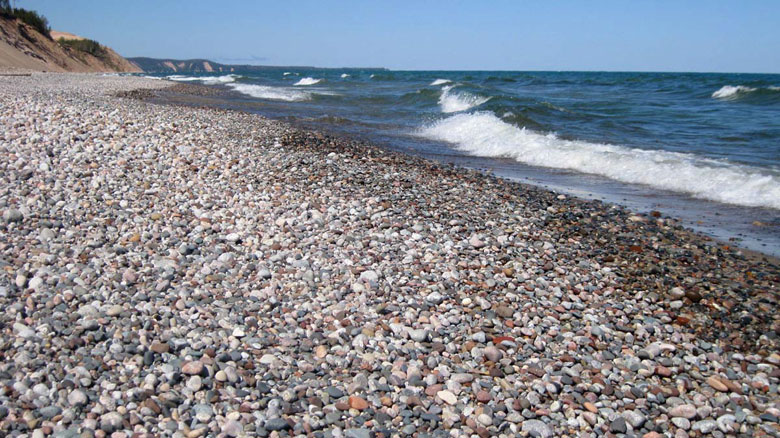
At Grand Marais the surface sand is mostly packed quite hard, and may be trod as a solid floor. This, in many places, is strewed thickly with pebbles; the deep hollows presented vast beds of them. Among these are a great variety of precious stones common to the rocks of the country – agates, chalcedony, jasper, quartz of every shade of color and transparency, with hornstone, trap, and other minerals. All are worn smooth, and often beautifully polished by the sharp, drifting sands; many rich specimens were obtained. We were reminded of the valley of diamonds in the Arabian tales, which it was the fortune of Sinbad to discover, in scarcely less singular depository.

In the rear of this desert, a small and beautiful lake lies embosomed. From the diamond lake, issues a small stream (Old Grand Sable), which after making its way through the sand, reaches the clay that constitutes the base of these dunes, and tumbles a perfect cascade into the greater lake. This rivulet separates the dense maple forest which lies on the east from the cliffs of driven sand, which rise abruptly to a height that far overlooks the woodland, and are the commencement of the Grand and leafless sables.

The view on ascending these is most entrancing. On the one side stretches beneath, and far away, the verdant forests; while by a transition as sudden as it is opposite in character, on the other side every feature of the landscape seems as if buried beneath hills of snow. The desert surface might be likened to that of an angry ocean, only that the undulations are far more vast, and the wave crests more lofty than the billows of the sea in its wildest commotion.

Looking upward from one of these immense basins, where only the sand-wave meets the sky, the beholder is impressed with a sublimity of a novel kind, unmixed with the terror which attends a storm upon the Alps, or on the ocean. The [Grand Marais area} scene, wild and unique, may well claim this brief praise– though hitherto unsung and lacking the charm of historical association—is the consecration and the poet’s dream.”

History’s Gem of the Month: 1958 Detroit News Article about Axel Niemi

 August/September 2010

1958 Detroit News Article about Axel Niemi

When I work on the web page update, the last segment I always do is the History’s Gem of the Month. I have a couple of closets in my house jammed with museum archive materials. It is always fun to pull out a box and look through it to find something interesting.

The first thing I pulled out this time is a 1958 Detroit News Pictorial Sunday Magazine, published on August 31, 1958. On Pages 10 and 11 there is the following article about Axel Niemi, the founder of the Gitche Gumee Museum. As is his usual fashion, he added his comments in the margins. Axel says that the second paragraph is a “big lie.” That is probably true on several fronts. One thing for sure is that Axel started to collect agates when he was a young boy, not after World War II as the article suggests. He started numbering and journaling agates during elementary school.

All That Glitters….
By Harry C. Sahs

If agates were gold nuggets, Axel A. Niemi would be the richest man in Michigan. Of all the “rock hounds” who have combed the storm-tossed beaches of Lake Superior for agates, probably none has found as many of the beautiful rocks as Niemi.

Known as the “agate king” of Grand Marais, Niemi has been an avid collector since he came home from two and a half years of Army service during World War Two. Although he had spent all his life where agates are relatively common, Niemi didn’t “get the fever” until he met an Australian in the South Pacific who carried a clear orange crysolite faceted agate.

Today, self-taught in the art of cutting, grinding, sanding, and polishing the semi-precious stones—and with a study course in gemology under his belt—Niemi’s “agate king” title goes undisputed.

The 40-year old collector believes he has found the second largest agate ever discovered in the United States. It is an almond-shaped translucent stone weighing five and a half pounds and valued at $200. Only the 10 ½ pound stone now in the Smithsonian Institution in Washington, D.C., surpasses Niemi’s find.

Best time for agate hunting, says Niemi, is immediately after a violent storm when deep waves churn the lake bottom and toss up new rocks on the beach. Even then, however, it’s no easy job to find the elusive agates. It takes time—and patience.

History’s Gem of the Month: Shipwrecks at Agate Beach

 July 2010

Shipwrecks at Agate Beach

In the museum’s archive I found the photo included below. It shows ships that went aground between Agate Beach and the breakwater that protects Grand Marais Bay.

On the back of the photograph, the following description was written:

On October 20, 1905 at nightfall the second mate of the Turret Crown steamer warned the captain that the storm was increasing in fury. All the day before leaving Sault Saint Marie, the Captain had been drinking. When in front of the Grand Marais, Michigan lighthouse the Captain asked the first mate what lighthouse it was. The captain turned to enter the harbor of refuge but entered on the port side of the pier. The second mate was right in mentioning that the ship would go aground. The captain’s excuse was that he believed the harbor to be Grand Marais, Minnesota. Later a wrecking tug assisted the Turret Crown to deeper water, after which she continued on to Duluth.

The Galatea, a lumber barge, also ran aground during the same storm just west of Grand Marais’ pier. The vessel was a wooden 3-masted schooner built by the F. Wheeler Company in Bay City, MI in 1882. She was 180 feet long, 33 feet wide and 12 feet high. She was driven so far ashore by the waves that the crew could step off onto solid ground by clambering over her stern. Even though salvagers dug a 900 foot channel to her, she was unsalvageable and broke up the following winter. Her sister ship, the, the Nirvana, was being towed by the propeller ship LL Barth. The Nirvana smashed into the pier and was sunk ¼ mile off shore. The crew was saved but the heavy seas pounded the Nirvana to bits. She later washed up east of the piers on the beach.

Research on the internet regarding the Turret Crown shows that the steamer was built in 1895 by the William Doxford and Sons Company in Sunderland, England. She was 258 feet long, 44 feet wide, and carried a gross tonnage of 1,827 pounds. She was used to carry goods by the Canadian Lake and Ocean Navigation Company. Apparently the problem in Grand Marais was not the only incident. On July 22, 1903 the Turret Crown collided with the wooden freighter Waverly near Harbor Beach, MI causing the freighter to sink. She also collided with the William C Mack on May 4, 1913 causing damage to both vessels. During World War I the Turret Crown was used in the Atlantic to transfer goods. After World Work I she was used along the Pacific coast. Below is a photo taken of the Turret Crown at a dock in Seward, Alaska.

The steamer returned to Great Lakes service in 1922. On October 7th of that year she ran aground again off Cove Island in Lake Huron. She was again salvaged and continued service. Her luck ran out on November 2, 1924 when she ran aground and was stranded at Meldrum Point on Manitoulin Island. The metal from her hull was later salvaged and used during World War II.

History’s Gem of the Month: Box of Rocks Gets Diploma

June 2010

Reprinted from recoilmag.com, July 2005 issue

Pinconning, Mich. — A historic collegiate achievement was realized Friday when a medium-sized cardboard box containing a half-dozen rocks received a Bachelors Degree of Science in Business and Marketing from University of Phoenix Online, a popular online college. “Congratulations! You’ve graduated!” the box of rocks was informed by e-mail following the completion of the course’s final exam. “Welcome to the exciting world of Business/Marketing! Click here to register for a Masters Degree from University of Phoenix Online, the nation’s leading University for working professionals.”

According to sources, the box of rocks had been able to obtain its degree online in only three years and without having to seek a leave of absence from its current job at a Pinconning residence, where for five years it has been solely responsible for stopping a porch’s screen door from opening all of the way.

The event marked a milestone for the inanimate object, which had previously received no formal education via public schooling or private vocational training. University of Phoenix public relations director Kyle Rise refused to disclose the cumulative grade point average earned by the box of rocks, but confirmed that it had indeed earned passing marks in all of the courses required to receive a diploma from the atypical school.

“That a box of rocks was able to earn its degree through the University of Phoenix’s online program is proof positive that anyone or anything – regardless of social class, cognitive ability or financial resources – can, through hard work and persistence, earn a college degree,” said Rise. Rise speculated that news of the box of rocks’ achievement could spark increased enrollment among demographics previously absent from the University’s student body, such as bags of hammers, telephone poles and other similar objects.